The debt-to-equity ratio stands as one of the most fundamental financial metrics for evaluating a company’s financial health and investment potential. This critical ratio reveals how much debt a company carries relative to its shareholder equity, providing investors with essential insights into financial leverage, risk levels, and overall stability.
What Is the Debt-to-Equity Ratio
The debt-to-equity ratio measures a company’s financial leverage b
y comparing total liabilities to shareholder equity. This calculation reveals the extent to which a company finances its operations through debt versus its own resources. The ratio serves as a key indicator of financial risk and helps investors assess whether a company maintains a healthy balance between debt financing and equity funding.
Financial analysts classify the debt-to-equity ratio as a type of gearing ratio, which focuses specifically on leverage concepts in financial analysis. The underlying principle assumes that moderate leverage can benefit companies, while excessive debt places organisations at significant risk.
How to Calculate the Debt-to-Equity Ratio
Basic Formula
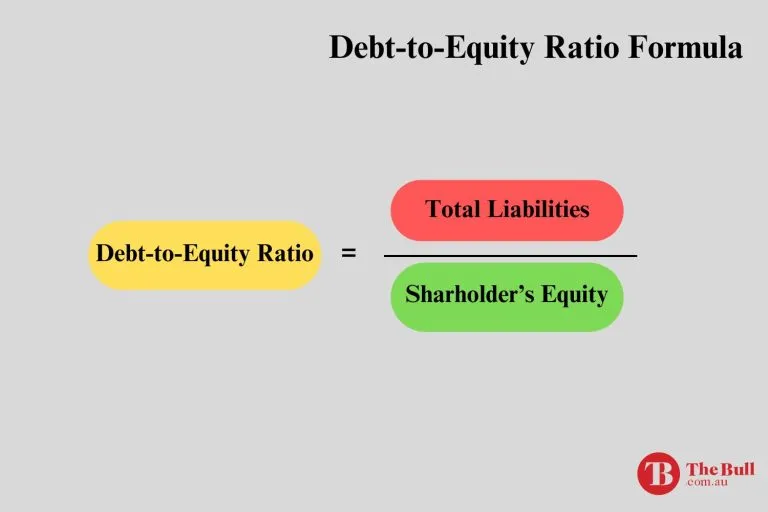
The standard debt-to-equity ratio calculation follows this formula:
Top Australian Brokers
Get Ahead of the Market
Smarter investing starts with better information. The Bull Premium gives you everything you need to grow your wealth and build your future. You will get:
- Early access to 18 Share Tips – delivered 3 days early
- A comprehensive weekly market outlook
- An exclusive complete investing course
Sign up today and get your first week free
Debt-to-Equity Ratio = Total Liabilities ÷ Shareholders’ Equity

Finding Required Information
All necessary data for calculating the debt-to-equity ratio appears on a company’s balance sheet, also known as the statement of financial position. The balance sheet provides:
- Total liabilities (short-term and long-term debt combined)
- Shareholders’ equity (share capital plus retained earnings)
- Total assets (used for verification purposes)
Manual Calculation Steps
Follow these steps to calculate the ratio manually:
- Locate the company’s most recent balance sheet
- Identify total liabilities from the balance sheet
- Find shareholders’ equity on the same statement
- Divide total liabilities by shareholders’ equity
- Express the result as a decimal or ratio
Using Excel for Calculations
Business owners and analysts often use spreadsheet software for ratio calculations:
- Enter total liabilities in cell B2
- Input shareholders’ equity in cell B3
- Create the formula “=B2/B3” in cell B4
- The result displays the debt-to-equity ratio automatically
Many Excel templates include pre-built formulas for financial ratio calculations, including the debt-to-equity ratio and related metrics.
Interpreting Debt-to-Equity Ratio Results
Understanding Ratio Values
Different ratio values indicate varying levels of financial leverage:
- Low ratios (below 1.0): Companies rely more heavily on equity financing
- Moderate ratios (1.0 to 2.0): Balanced approach between debt and equity
- High ratios (above 2.0): Significant reliance on debt financing

Risk Assessment Implications
Higher debt-to-equity ratios typically indicate increased financial risk because:
- Debt requires regular interest payments regardless of company performance
- High leverage amplifies both potential gains and losses
- Overleveraged companies face greater bankruptcy risk during economic downturns
- Interest rate changes significantly impact highly leveraged businesses
Positive Aspects of Debt Financing
Debt financing offers several advantages when managed properly:
- Lower cost of capital compared to equity financing
- Tax-deductible interest payments
- Retained ownership control for existing shareholders
- Potential for accelerated growth through leveraged investments
Industry-Specific Considerations
High Debt-to-Equity Industries
Certain industries typically maintain higher debt-to-equity ratios due to their business models:
Utilities: These companies often carry high debt levels because they operate in regulated environments with stable, predictable cash flows that support debt service obligations.
Banking and Financial Services: Banks naturally maintain higher debt ratios due to their business model of borrowing money to lend to customers.
Capital-Intensive Industries: Airlines, manufacturing, and industrial companies require substantial fixed asset investments, often financed through debt.
Low Debt-to-Equity Industries
Technology companies and service-based businesses typically maintain lower debt ratios because they require less capital investment and generate higher profit margins.
Modified Debt-to-Equity Calculations
Long-Term Debt-to-Equity Ratio
This variation focuses specifically on long-term debt obligations:
Long-Term D/E Ratio = Long-Term Debt ÷ Shareholders’ Equity
This calculation provides insights into a company’s long-term financial commitments and excludes short-term operational liabilities.
Total Debt-to-Total Capital Ratio
Some analysts prefer this alternative calculation:
Total Debt-to-Total Capital = Total Debt ÷ (Total Debt + Shareholders’ Equity)
This formula expresses debt as a percentage of total capitalisation.
Practical Application for Investors
Comparative Analysis
Investors should always compare debt-to-equity ratios within the same industry and among companies of similar size and growth stage. Cross-industry comparisons often prove misleading due to different capital requirements and business models.
Trend Analysis
Examining debt-to-equity ratio trends over multiple periods reveals important information about:
- Management’s financing strategy
- Company growth patterns
- Financial stability improvements or deterioration
- Market condition responses
Integration with Other Metrics
The debt-to-equity ratio works best when combined with other financial ratios:
- Current Ratio: Measures short-term liquidity
- Quick Ratio: Assesses immediate debt-paying ability
- Interest Coverage Ratio: Evaluates ability to service debt obligations
- Return on Equity: Measures profitability relative to shareholder investment
Debt-to-Equity Limitations and Considerations
Balance Sheet Timing
Debt-to-equity ratios reflect financial position at specific points in time and may not capture seasonal variations or recent significant transactions.
Accounting Classifications
Different accounting treatments can affect ratio calculations:
- Preferred stock classification varies between debt and equity
- Off-balance-sheet financing may not appear in calculations
- Intangible assets and goodwill can distort equity values
- Operating leases versus capital leases create different impacts
Market Conditions Impact
Economic factors influence debt-to-equity ratio interpretation:
- Interest rate environments affect debt service costs
- Credit availability impacts refinancing options
- Industry cycles influence optimal leverage levels
- Regulatory changes may alter acceptable ratio ranges
Best Practices for Ratio Analysis
Consistency in Calculations
When comparing multiple companies, ensure consistent calculation methods across all analyses. Use the same debt and equity definitions for accurate comparisons.
Multiple Period Analysis
Examine debt-to-equity ratios across several reporting periods to identify trends and assess management’s financial strategy effectiveness.
Peer Group Comparisons
Select appropriate peer companies based on:
- Similar industry classification
- Comparable company size
- Similar growth stage
- Geographic market overlap
The debt-to-equity ratio serves as an essential tool for evaluating company financial health and investment risk. While higher ratios indicate increased leverage and potential risk, they may also signal growth opportunities and efficient capital utilisation when properly managed. Investors should interpret debt-to-equity ratios within appropriate industry contexts, combine them with other financial metrics, and consider company-specific factors before making investment decisions. Understanding this fundamental ratio enables more informed investment choices and better risk assessment across diverse market conditions and industry sectors.