China’s real estate downturn has left vast housing developments abandoned, a stark reminder of the nation’s popped debt-fuelled property bubble.
Among these is “Life in Venice,” a sprawling residential complex on China’s east coast, now a desolate landscape despite its ambitious origins.
Located just an hour and a half’s drive from Shanghai’s bustling commercial hub, “Life in Venice” was conceived as a luxurious, resort-like escape. Inspired by its Italian namesake, it boasted European-style sculptures and buildings interconnected by canals and bridges, once marketed as Shanghai’s very own garden by the sea.
However, the dream soured as property prices plummeted several years ago. Its developer, Evergrande, ultimately declared bankruptcy in 2024. Today, this once-promising development stands as a ghost town with a sea view, its numerous units remaining unsold and uninhabited.

A man swings on an empty beach at the semi-abandoned “Life in Venice” housing complex in Qidong, on China’s east coast (AP Photo/Dake Kang)
Home prices here have more than halved. Many villas are abandoned, mere husks of concrete and alabaster, their private docks left unused. A three-bedroom apartment here can be rented for just 800 yuan ($116) a month.
Those bargain prices are luring some who are seeking a laid-back, low-cost way of living and an escape from the hypercompetitive rat race in China’s megacities.

Children’s clothes are hung out to dry in public (AP Photo/Dake Kang)
A few grocery stores, some restaurants and a package delivery station offer enough for the people who have chosen to move here.
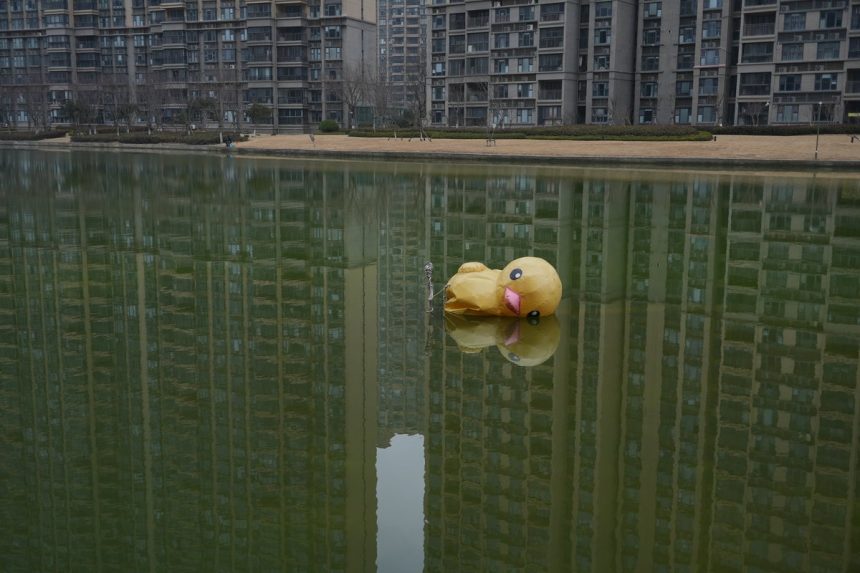
In the winter the complex is largely quiet, as residents enjoy a slower pace of life. Some men fish next to a deflated rubber ducky.
Children’s clothes are hung out to dry in public. A lone man, swaying on a swing on an empty beach, gaze out at an abandoned pier.

Residents fish in an artificial canal (AP Photo/Dake Kang)
China’s much-touted progress in developing a modern, high-tech economy, exemplified by its advanced robotics and autonomous vehicles, is now confronting significant headwinds as a prolonged downturn in its housing market, struggling small businesses, and widespread youth unemployment take their toll.
This stark divergence between Chinese leader Xi Jinping’s ambitious vision for an AI-driven future and the harsh realities of slowing growth forms the critical backdrop for the annual meeting of the country’s largely ceremonial national legislature, the National People’s Congress, which commences on Thursday.