When the RBA hiked cash rates 13 times beginning in 2022, a clear winner emerged from the ranks of borrowers.
Those who had fixed their interest rates on three or more year loan terms.
When the official cash rate bottomed out at 0.1 per cent as the Covid pandemic rocked the economy, borrowers were paying such little interest on their home loans, they may have become a little complacent.
But there were a number of savvy homeowners who locked in fixed rates for several years. Their rates were generally around the 2 per cent mark, with some even below that.
For the next three years, they watched, unaffected, as borrowers on variable rates saw tens of thousands of dollars added to their yearly interest payments.
This was an example of the perfect scenario for locking in fixed rates. At the bottom of the market, before a steep cycle of rate hikes.
MORE:Shock results of today’s RBA meeting
Fast forward to 2026, the RBA has left rates on hold for the second meeting in a row after three straight hikes.
Inflation has begun to track downwards, the conflict in Iran is getting closer to an end, which will normalise oil prices and unemployment has risen to 4.5 per cent. Meanwhile, the heat has come out of the property market the big banks have revised their rate hike forecasts down to reflect that they think this cycle is at an end.
Today’s current scenario is a long way from that perfect fixing scenario. Nearly the opposite in fact.
MORE:Banks rush to drop rates as RBA hands down decision
Unlike some economists and at least one big bank, I believe the next movement for rates will be down.
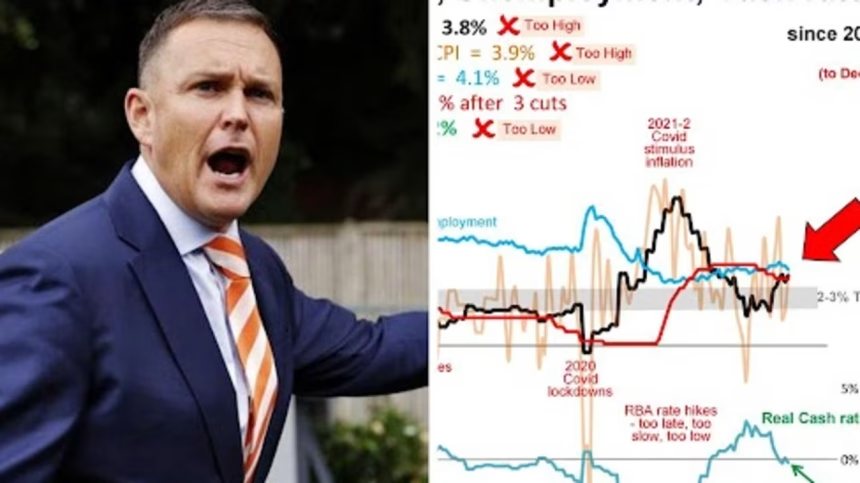
The RBA should have cut in June. It should certainly cut in August, and if not then, it must cut before the end of this year.
Could you think of anything worse than fixing your repayments at a level where you are already struggling to get by, only to watch multiple rate cuts bring variable rates down to where they might have saved you thousands of dollars a year if you hadn’t fixed?
I know people who this happened to after the GFC. They locked in rates at around 7.5 per cent, only for variable rates to fall below 5 per cent. Ouch.
I’m not qualified or legally able to give financial advice, but if I looked in the mirror and asked myself if I should lock in a fixed mortgage rate now, I’d look back sternly at myself and say ‘Don’t do it!’
MORE:Happy 44yo paid off home in five years after Aldi act
But why should I take my word for it? Let’s check in with some economists to see what they think.
Finder’s cash rate survey asked its expert commentators whether they’d recommend a variable, fixed, or split (one portion variable, one portion fixed) home loan for a new owner-occupier.
Seventeen out of the 28 economists said variable and 10 said split. Just one economist, Jakob Madsen from the University of Western Australia, recommended fixing, suggesting that “it gives more security”.
MORE: Warning as common items linked to house fire surge
Of those who suggested variable, Nicholas Gruen from Lateral Economics said he’d seen variable loans turn out to be cheaper in nearly 80 per cent of cases.
“There’s usually a hefty liquidity premium built into the fixed rate,” Mr Gruen said.
Matt Turner of GSC Finance said fixed rates were “now too elevated to make economic sense compared to where economists are predicting rates to land at the end of the cycle.
“Now some lenders are pushing (fixed rates) upwards of 6.75 per cent. It doesn’t make sense when the variable rates are still under 6.25 per cent.”
In other words, fixing now may mean you’d possibly need to see a couple of rate hikes just to break even.
Originally published as Why fixing your mortgage rate now could be a costly financial mistake