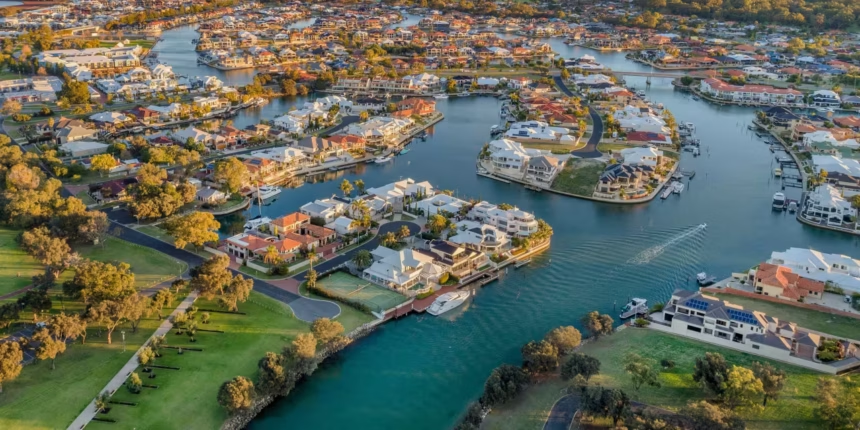
Mandurah in Western Australia has always had plenty going for it, with long pristine beaches and a grand estuary twice the size of Sydney’s famed harbor. Now the city, which sits less than one hour’s drive from Perth, is also home to one of the country’s hottest property markets.
Previously overlooked by interstate buyers because of its distance from the east coast, Mandurah has emerged as a compelling alternative to Australia’s increasingly expensive coastal cities with a growing luxury market. Home to about 100,000 people, it offers comparable waterfront living and a similar climate to Sydney, Brisbane and the Gold Coast at a fraction of the price.
MORE: The Best Celebrity-Built Hotels Deliver More Than a Famous Name
According to data from PropTrack, the west coast destination has lived through more than 12 months of extraordinary housing price growth fueled by the perfect storm. A robust resources market, a post-pandemic flight to lifestyle, an uptick in remote working, and an extremely palatable entry price have all combined to buoy Mandurah’s housing market. However, given a recent shift in Australia’s real estate landscape, is there still room to grow?
Prices and Housing Stock
PropTrack revealed that Mandurah recorded annual house price growth of 22.2% last calendar year, making it Australia’s top-performing regional market during the period. But REA Group economist Luc Redman said that after several years of growth, the market will likely enter a more subdued and sustainable phase defined by population growth, hybrid working and low supply.
“Typically, Western Australia is very much boom-bust cycle driven,” he said, referring to the state’s long history with mining iron ore, lithium, gold, liquefied natural gas and copper.
MORE: Scared of Cyclospora? Here Are Tips to Easily Grow Your Own Fruits and Vegetables.
“When there’s quite strong iron ore prices, as there has been for quite some time now, that tends to create strong incomes for mining companies and the people who work for them. Housing is often wrapped up in that cycle,” Redman said.
Five years ago, Mandurah’s median house price was about A$295,000. Today it sits at A$676,000 (US$478,821), according to PropTrack, yet remains affordable compared with many eastern coastal markets.
Selling agent John Phillips, of John Phillips Real Estate in greater Perth, said the local market remained undervalued for years.
“Our market has more than doubled in just the last couple of years, but that’s not sustainable. We’ve come from a lower base than other regional cities; we’ve basically just played catch-up to where we should have been,” he explained. “Mandurah is still probably as good value as you’re going to get for a coastal market within an hour of a capital city.”
He said the local prestige market had also matured as Perth’s waterfront suburbs increase in value, therefore pushing lifestyle buyers toward new territory. Phillips said A$1.5 million would secure a savvy buyer a luxury apartment overlooking the Mandurah marina, while beachfront and canal-front homes with private jetties sit between A$2 million and A$5 million.
MORE: A Venetian-Style Villa on an Island in the San Francisco Bay to Be Sold at Auction—Yacht Included
Matt Knight, a buyer’s agent with Precium, said although Mandurah prices appear quite low against the multimillion-dollar deals in the east, he warned that purchasers shouldn’t be tempted to overspend.
“The buyers who do best here treat the affordability as a reason to be more precise, not pay less,” he said, adding that local suburbs that stand out for value include Dudley Park, Coodanup and Greenfields for purchasers seeking opportunities close to transportation and water, while Halls Head, Madora Bay and Lakelands attract families seeking lifestyle.
Lifestyle and Amenities
While mining remains an important economic driver, Mandurah’s appeal extends beyond the resources sector.
“It’s a genuine town, not a suburb of a bigger one, which for families and retirees is the whole point. The trade-off is distance. You’re around 50 minutes on the train from the Perth CBD, so daily city work asks [for more of your time]. But that same distance is why your money goes further and the pace is calmer,” Knight said.
Mandurah has been built up around the Peel-Harvey Estuary and extensive canal system that’s home to a large population of wild bottlenose dolphins, more than 100 species of waterbirds, plus blue swimmer crabs and western king prawns. Visitors and residents can enjoy access to 10 beaches, as well as waterfront parks and fine-dining venues.
MORE: The AI Gold Rush Could Hit These Luxury Second-Home Markets
“Boating, fishing and crabbing are daily life here, not a special occasion,” he added.
Art has also shaped the local landscape with a large-scale outdoor art trail featuring six towering wooden sculptures by Danish artist Thomas Dambo, known as the Giants of Mandurah.
Future infrastructure is also expected to further cement the region’s appeal, with a shipyard expansion around Kwinana, local rail improvements, ongoing foreshore development and the new Peel Hospital.
Who Lives There
Population growth has also become a significant contributor to Mandurah’s rising prices. Western Australia has recorded some of Australia’s strongest increases in recent years through overseas migration, interstate migration and natural increase, creating sustained demand for housing beyond Perth.
“The rise of hybrid work makes the area a lot more desirable for a wider range of buyers. If you don’t have to be at work every day, then the choice between where you live and proximity to your workplace can be traded off a bit more,” Redman said.
While Mandurah has traditionally attracted retirees, Phillips explained that today’s buyer profile is diversifying. “FIFO [fly-in-fly-out] workers continue to play an important role in Mandurah’s housing demand because of the city’s easy access to Perth Airport. Investors have played a part, but the bulk of the market that I’ve spoken to in the last six to 12 months has been owner-occupiers,” he added.
Property Market Outlook
History has proven that Western Australia’s property market is more volatile than much of the country, however Knight said Mandurah’s economy has diversified beyond its mining roots.
“A pure mining town lives and dies with one commodity. Mandurah has several engines: lifestyle migration, health, construction, tourism and resources as one part of the mix,” he said.
“But the easy money is behind us now. Mandurah houses have run hard. Good homes have been selling in single-digit days. That tells you demand is still well ahead of supply,” Knight said.
He added that the mistake buyers should avoid is reading one headline about a booming coast and applying it to every pocket.
“Some suburbs have had their run. Others are still catching up. The opportunity sits in that gap.”
Phillips agreed that the wind had come out of Mandurah’s sails.
“We’ve definitely seen a slowdown in the market and a slowdown in buyer inquiry,” Phillips said. “However, there’s a difference between a slowing market and a market that’s going backwards. We’ve got a solid base where we’ll stabilize.”