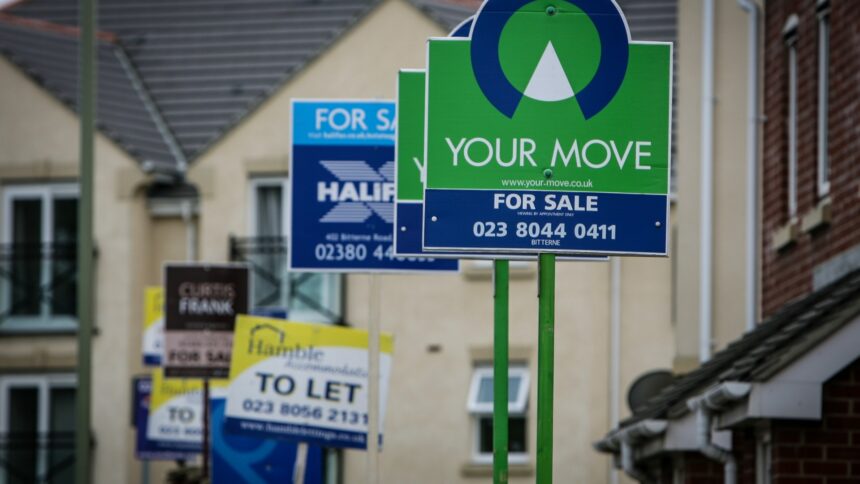
HOMEOWNERS are being warned to act now to secure a mortgage deal before rates shoot up, as turmoil on the financial markets sends borrowing costs surging.
Government borrowing rocketed to a 28-year high within hours of the Prime Minister’s Commons debut this week.
Mortgage experts warned that lenders could begin pulling their cheapest deals and raising fixed rates within days as their own funding costs increase.
No firm forecast has been given for how much mortgage rates could rise, as lenders price their deals differently.
But the aftermath of Liz Truss’s disastrous 2022 Mini-Budget shows how quickly costs can spiral.
The average two-year fixed mortgage rate rose from 4.74% at the beginning of September 2022 to a peak of 6.65% the following month, according to Moneyfacts — an increase of 1.91 percentage points.


Over the same period, the average five-year fix climbed from around 4.75% to more than 6.5%.
The latest alarm was triggered when the yield on 30-year government bonds, known as gilts, jumped to 5.91% on Wednesday.
That easily surpassed the market chaos triggered by Ms Truss’s Mini-Budget, when the yield peaked at just above 5.1%.
Ten-year borrowing costs also climbed as high as 5.29%, their steepest level since the 2008 financial crisis.
Is your mortgage deal about to end? Get FREE advice and save £1,000s on repayments

*If you click on this link we will earn affiliate revenue
Falling onto your lender’s Standard Variable Rate (SVR) could cost you hundreds of pounds extra each month.
Mortgage Advice Bureau compares your current deal against thousands of competitive remortgage offers to help lock in lower rates before your term ends.
Mortgage Advice Bureau Limited. Registered Office: Capital House, Pride Place, Derby. DE24 8QR. Registered in England Number: 3368205
A gilt is effectively an IOU issued by the Government.
Its yield shows the return demanded by investors to lend money to the UK, with higher yields meaning higher borrowing costs.
Fixed mortgage rates are not set directly by the Bank of England’s base rate, but they are heavily influenced by movements in financial markets.
They are largely priced using swap rates, which tend to follow gilt yields and reflect where markets expect interest rates to go next.
Swap rates also influence how much it costs lenders to secure the money they then lend to mortgage customers.
Nicholas Mendes, of broker John Charcol, said: “When a lender offers a five-year fix, it is borrowing at the five-year swap rate to fund it, so when that rate moves, the mortgage rate follows within days.”
The two-year swap rate has risen from about 3.7% to 4.3% over the past year, while the five-year rate has climbed from roughly 3.8% to 4.4%.
Rachel Springall, of financial information service Moneyfacts, warned that borrowers could soon feel the pain.
She said: “Mortgage rates could be set to soar as swap rates have jumped sharply. This does not bode well for borrowers.
“Those borrowers who were hoping for cheaper mortgage rates will be frustrated if lenders start hiking rates over the coming weeks, so it is essential borrowers seek advice and secure a new deal quickly.”
To put the potential impact into perspective, repayments on a £200,000 mortgage over 25 years would rise by around £117 a month if their mortgage rate increased from 4.5% to 5.5%.
That’s why anyone whose current deal is due to expire within the next six months should consider locking in a new rate now rather than waiting.
Mark Harris, chief executive of SPF Private Clients, said borrowers have more flexibility than many realise.
He said: “Mortgage offers are typically valid for six months, so if you are concerned that rates will rise further, it would be sensible to lock into a new deal ahead of time now.”
Crucially, if rates happen to fall before the mortgage completes, most borrowers can switch to a cheaper offer instead, although it is worth checking your lender’s specific rules first.
Mr Harris said the decision between a two-year and five-year fix comes down to personal circumstances.
He said: “If you would struggle to pay the mortgage were rates to rise, then a fixed rate is a sensible option.”
He added that a five-year fix could suit those wanting certainty, particularly as the gap between two and five-year rates is currently unusually narrow.
The average two-year fixed mortgage rate has jumped from 4.85% in February 2026 to 5.59% today, according to Moneyfactscompare.co.uk.
Over the same period, the average five-year fixed rate has risen from 4.94% to 5.63%.
David Hollingworth, of L&C Mortgages, said many borrowers had been holding out for better news that has not fully materialised.
He said: “Those borrowers coming to the end of a current deal that have been holding off in the hope of more improvements may want to act sooner.”
He added: “Locking into a new fixed deal six months ahead will protect against any increases to fixed rates.”
Anyone unsure of their options are being urged to speak to a mortgage broker as soon as possible, rather than risk missing out on today’s rates.
How to get the best deal on your mortgage
IF you’re looking for a traditional type of mortgage, getting the best rates depends entirely on what’s available at any given time.
There are several ways to land the best deal.
Usually the larger the deposit you have the lower the rate you can get.
If you’re remortgaging and your loan-to-value ratio (LTV) has changed, you’ll get access to better rates than before.
Your LTV will go down if your outstanding mortgage is lower and/or your home’s value is higher.
A change to your credit score or a better salary could also help you access better rates.
And if you’re nearing the end of a fixed deal soon it’s worth looking for new deals now.
You can lock in current deals sometimes up to six months before your current deal ends.
Leaving a fixed deal early will usually come with an early exit fee, so you want to avoid this extra cost.
But depending on the cost and how much you could save by switching versus sticking, it could be worth paying to leave the deal – but compare the costs first.
To find the best deal use a mortgage comparison tool to see what’s available.
You can also go to a mortgage broker who can compare a much larger range of deals for you.
Some will charge an extra fee but there are plenty who give advice for free and get paid only on commission from the lender.
You’ll also need to factor in fees for the mortgage, though some have no fees at all.
You can add the fee – sometimes more than £1,000 – to the cost of the mortgage, but be aware that means you’ll pay interest on it and so will cost more in the long term.
You can use a mortgage calculator to see how much you could borrow.
Remember you’ll have to pass the lender’s strict eligibility criteria too, which will include affordability checks and looking at your credit file.
You may also need to provide documents such as utility bills, proof of benefits, your last three month’s payslips, passports and bank statements.