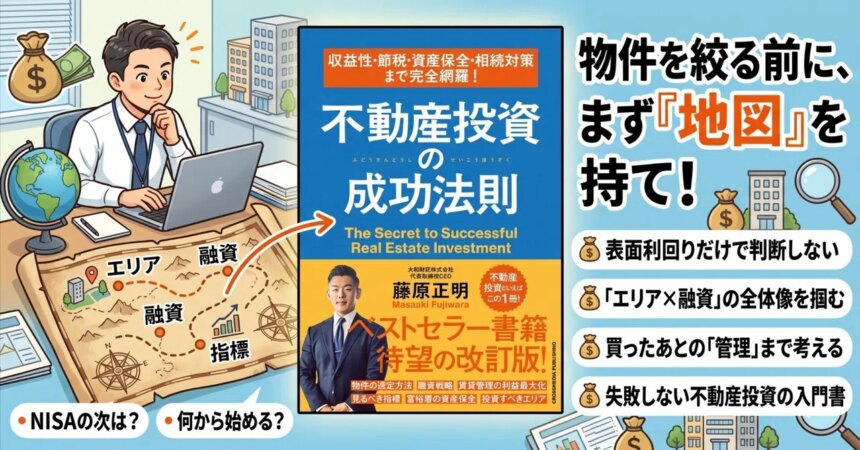
I’ve started NISA. My savings plan is also, in a way, getting on track.
Around that time, advertisements and videos for real estate investment started catching my eye. But I don’t know what I should look into first.
If you are a company employee who has started building assets, you might go through a period like this.
For real estate investment, it is safer to grasp ‘what to look at and how to judge’ before looking at properties.
There is a book that summarizes that perspective into one volume, divided into five parts: area, indicators, property, financing, and management. It is ‘Complete Coverage from Profitability, Tax Savings, Asset Preservation, to Inheritance Measures! Success Rules for Real Estate Investment’ by Masaaki Fujiwara.
I will tell you in advance that I have not read this book yet. While researching asset formation, I am interested in it as a book that helps grasp the whole picture before starting.
From the publisher’s introduction and the table of contents, I have summarized the contents of the book and points that seem useful.
Please note that this article does not recommend investment.
Table of Contents
-
What kind of book is it? The ‘5 Success Rules’ from someone who runs a revenue-generating real estate company
-
3 points I was interested in as an overall map
-
Things to know before reading
-
Who this seems suitable for
-
Hardcover or Kindle version, which one should I read?
-
Summary: Before buying, have one map
What kind of book is it? The ‘5 Success Rules’ from someone who runs a revenue-generating real estate company
The author, Masaaki Fujiwara, is the representative of the real estate company Yamato Zaitaku.
His previous job was at a major developer, where he was in charge of condominium development. After that, he was involved in the buying, selling, and management of revenue-generating real estate, and he founded his company in 2013.
This book is a revised edition of ‘Success Rules for Real Estate Investment to Maximize Profitability and Tax Savings’ published in 2021.
The old edition focused on cash flow from rental income. In the revised edition, asset preservation and inheritance measures have been added. The ‘complete coverage’ in the title refers to this expansion.
The structure consists of 7 chapters in total.
-
Chapter 1: Basic Knowledge of Real Estate Investment
-
Chapter 2: Success Rule 1 ‘Area’
-
Chapter 3: Success Rule 2 ‘Metrics’
-
Chapter 4: Success Rule 3 ‘Property’
-
Chapter 5: Success Rule 4 ‘Financing’
-
Chapter 6: Success Rule 5 ‘Management’
-
Chapter 7: Learning Success Rules for Real Estate Investment from Case Studies
The chapter structure itself serves as a checklist of items to review for real estate investment. That was my first impression upon looking at the table of contents.
It will be released in June 2025. It is 336 pages long and the list price is 1,518 yen (tax included).
Three points that caught my attention as an overall map
I will interpret the contents of the book, which can be understood from the table of contents and press release, from the perspective of a company employee who is just starting out.
1. Don’t judge solely by ‘gross yield’
The theme of Chapter 3 is evaluating investments using correct theory. It seems to cover metrics such as FCR, yield gap, and IRR.
The press release also touches on the ‘trap of gross yield.’ It’s the perspective of not judging based only on the most prominent numbers in advertisements.
When choosing investment trusts for NISA, I think many people check the fees and the underlying assets. This means there are ‘numbers to look at’ for real estate as well.
Just knowing the terminology makes it harder to blindly accept prominent numbers or sales pitches. This is the chapter I want to grasp most before starting.
2. Think of ‘where to buy’ and ‘how to borrow’ as a continuous process
Among the five rules, area and financing are each independent chapters.
The results change not only based on the property itself, but also on which area you buy in and what conditions you borrow money under. From the table of contents, that seems to be the structure.
When company employees consider real estate investment, they will in most cases use financing.
Investment that includes borrowing requires a different way of judging than stocks or investment trusts. I think it is significant to know this from the start.
3. Includes ‘management’ and ‘succession’ after purchase
Chapter 6 is about choosing a management company as a partner. The press release also touches on countermeasures for the ‘dead cross’.
A dead cross is a state where you are in the black on paper, but the cash on hand is decreasing. It is a matter you should be concerned about the longer you hold the property.
Furthermore, in the revised edition, asset preservation and inheritance measures have been added.
It is all in one book, not just the moment of purchase, but while you own it, when you let it go, and when you pass it on to your family. Real estate is an asset you have a long relationship with, not something that ends when you buy it, a structure that lets you know that from the beginning.
Things to know before reading
The author is the manager of a company that handles income-generating real estate.
In the book, the author takes the position that buying an entire apartment building or condominium is ‘optimal’. This claim also overlaps with the author’s company business.
Therefore, it is best to read it as a map drawn from one perspective. If you want to compare it with sectional condominiums or REITs, reading other books as well will help you avoid bias.
Also, the inheritance measures part seems to be strongly aimed at landowners and people with many assets. If you have just started building assets, I think you should focus on reading chapters 1 to 6 first.
Depending on the company, there may be rules in the employment regulations regarding side jobs and real estate investment. It is reassuring to check once before starting.
Seems suitable for people like this
-
People who are thinking about what comes after NISA and want material to judge whether or not to do real estate investment
-
People who want to grasp the basic terminology and points to look at before listening to explanations from real estate companies
-
People who might eventually be concerned about how to handle their parents’ land or family home
For those who already own property and want to deepen their knowledge of specific methods, it might be more of an introductory book.
Which should you read, the paperback or the Kindle version?
-
Paperback: Since it is 336 pages, for those who want to put sticky notes on each chapter. You can look back at the relevant pages before listening to what real estate companies have to say
-
Kindle Edition: For those who want to read a little bit during their commute. You can look up unfamiliar terms on the spot while reading.
Success Rules for Real Estate Investment (Hardcover)
Success Rules for Real Estate Investment (Kindle Edition)
Summary: Before you buy, have one map in hand
Real estate investment involves large sums of money and often includes borrowing. That is precisely why, before looking for properties, you want to have a clear idea of ‘what to look at to make a decision’.
If you have a map, you will be less likely to be swayed by the numbers in advertisements. You can decide whether or not to start after that.
Once I finish reading, I plan to summarize what I’ve learned in another article.
Success Rules for Real Estate Investment (Hardcover)
Success Rules for Real Estate Investment (Kindle Edition)
*This article contains affiliate links