Among real estate investment failures, the dead cross is the hardest to notice. The year it occurs can be back-calculated from two figures: depreciation expenses and principal repayment amounts. By multiplying these by your tax rate, you can even determine how much your cash flow will decrease each year. In my case, it was the 9th year. Even though the books showed a profit of 4.76 million yen, the money in my account decreased by 870,000 yen that year.
This article is written for physicians and professionals with an annual income of 12 million yen or more who have owned a pre-owned single building purchased with a loan for 3 years or longer. It is not intended for those who bought with cash or those who own only one single-unit condo.
I received a LINE message from a young doctor on a Saturday night.
“Doctor, it’s about the 22-year-old RC building in Kohoku Ward, Yokohama, that I bought in 2023. My tax accountant told me, ‘Starting from next year’s tax return, you will be paying taxes instead of receiving a refund. Congratulations on becoming profitable.’ But the balance in my account is slowly decreasing every month. Is this really something to be happy about? I don’t know how to explain this to my wife.”
Let me start with the diagnosis. It is not something to be happy about. The young doctor’s property is already in a dead cross as of 2026. If nothing is done, the after-tax cash flow will be almost zero around 2031, and it will enter the negative territory after that.
I was the same back then. There was a night when I felt relieved after being told, ‘You are in the black.’ 5 years later, that same phrase would come back to haunt me. The following information is as of October 2026.
If you reach the tax filing deadline in March 2027 without knowing the year your depreciation ends, you will be billed for several hundred thousand yen that you didn’t plan for in the resident tax notification that arrives in June. If you don’t know this, you will only realize it when you open the notice. First, if your repayment schedules and financial statements are scattered, gather them in one place using something affordable like an A4 file box for document organization (the price is roughly around 1,000 yen). It’s a waste to spend your nights trying to find figures while wondering, ‘Where did I put that paper?’ Now, let’s calculate the numbers.
【What you will learn in this article】
1. The mechanism of why your account balance decreases despite being in the black
2. 【Case Study】 A record of how cash flow went from 4.27 million yen to –870,000 yen in the 9th year
3. Why the seller’s simulation stops at pre-tax figures
4. 【Prescription】 Back-calculation formula and quick reference table for the year the dead cross occurs
5. 5 steps to restore cash flow
6. 【Prognosis】 The blind spot your tax accountant won’t tell you and what to do this week
📌 Recommended reading
・Recovering 870,000 yen in depreciation through building and equipment apportionment: The complete procedure for getting taxes back as quickly as possible via a request for correction (2026/9 Definitive Edition)
・Breaking through the 9 million yen taxable income barrier with a 100,000 yen LLC: Full calculations and establishment procedures for saving 800,000 yen in taxes annually (2026/9 Definitive Edition)
💸 The failure of real estate investment where your account balance drops despite being in the black
The young doctor’s question is, ‘Why does my money decrease even though I am in the black?’
The answer is that you are measuring tax calculations and the movement of money in your account with different rulers.
・Items that can be treated as expenses for tax calculation: Interest, depreciation expenses
・Money that actually leaves your account: Interest, principal repayment
There is only one difference. Depreciation expenses are treated as expenses even though no money leaves your account. Principal repayments are not treated as expenses even though money leaves your account.
For a while after purchasing, depreciation expenses are larger than principal repayments. The books show a loss, and since that loss can be offset against your salary, you get a tax refund.
However, as the years pass, these two lines cross.
━━ Principal Repayment > Depreciation Expenses ━━
This crossover is the dead cross. From this point on, the money leaving your account exceeds your expenses. The books show a profit, your taxes increase, and the money in your account decreases.
‘The “profitability” your tax accountant talks about and the “profit” in your account are two different things.’
There is a trap that serious people often fall into. It is filing your taxes properly every year to receive a refund, and then treating that refund as ‘profit from rent’ and using it for living expenses or as a down payment for the next property. A refund is not profit. You are simply borrowing money from the taxes you will have to pay in the future.
If you want to rethink your assets not by book profit, but by whether they “put cash in your pocket,” the fastest way is to read the assets and liabilities chapter of Rich Dad Poor Dad. This is because a dead cross is the moment a property you thought was an asset turns into a liability.
💡 What to do today: Take out your repayment schedule and add up the “principal” column for the 12 months of this year. That total is the money leaving your account without being counted as an expense.
📉 [Case Study] Cash flow drops from 4.27 million yen to -870,000 yen in the 9th year
I will show you the figures for my first building. It is a 12-unit wooden apartment building in Kawaguchi City, Saitama Prefecture, that I bought in 2012. It was my 17th year of being a working doctor. The price was 8 years later. The price was 110 million yen, the loan was 100 million yen, the interest rate was 2.3%, and the term was 25 years.
The brokerage agent said, “This is a tax-saving property.” The breakdown is 51 million yen for the building, 15 million yen for equipment, and 44 million yen for the land. For a 17-year-old wooden building, using the simplified method for used properties, the depreciation period for the building is 17 years, and for equipment, it is 8 years and 3 years.
The tax rate is calculated at 43%, combining income tax and resident tax.
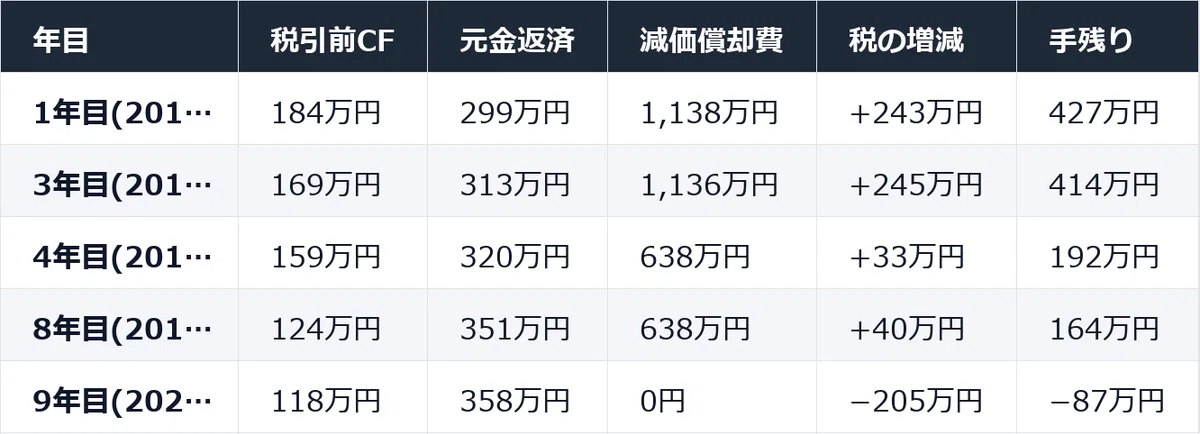
* A plus in “tax increase/decrease” is a refund, and a minus is additional tax payment. Interest on loans for purchasing land cannot be offset against salary income, so that portion is excluded from the calculation.
1st year, the cash flow was 4.27 million yen, but by the 9th year, it was – 870,000 yen. The difference is 5.14 million yen. The rent has hardly changed. The only thing that changed was that the depreciation expense became 0 yen.
Calculations like “multiply by 43% and divide by the number of years” are prone to input errors on a smartphone calculator. If you use a model with a check function like a Casio Professional Calculator, the price is roughly 2,000 yen to several thousand yen. If you keep one on your desk, tonight’s calculations will be much easier.
June 2021, I still remember the night I opened my resident tax notification at my desk in the medical office. I had just paid additional income tax in March, and the resident tax bill was added on top of that. The only money left in my account was what I had intended to set aside for repairs.
What made me cry with frustration wasn’t the loss itself. It was my own naivety in spending the annual tax refunds as “rental profit” for 8 years. I had even used it for the down payment on my second building.
“The cliff came twice. My cash flow halved in the fourth year, and turned negative in the ninth year.”
The first alarm had already sounded in the 4th year, after the 3-year equipment depreciation period ended. I dismissed it by thinking, ‘I guess there were a lot of vacancies this year.’
💡 What to do today: Please open the ‘Calculation of Depreciation’ section on page 3 of your Blue Return Financial Statement.
※ This article is a record of the author’s personal investments and corporate operations, and is not investment advice recommending the acquisition of specific properties or financial products. Please make investment decisions at your own risk.
💎 What you will get in the rest of this article (paid section)
✅ Why seller simulations stop at pre-tax figures
✅ Prescription: Back-calculation formula and quick reference table for the year the dead cross occurs
✅ 5 steps to restore your cash flow
From here on out, I’m going to show you exactly how to do it.