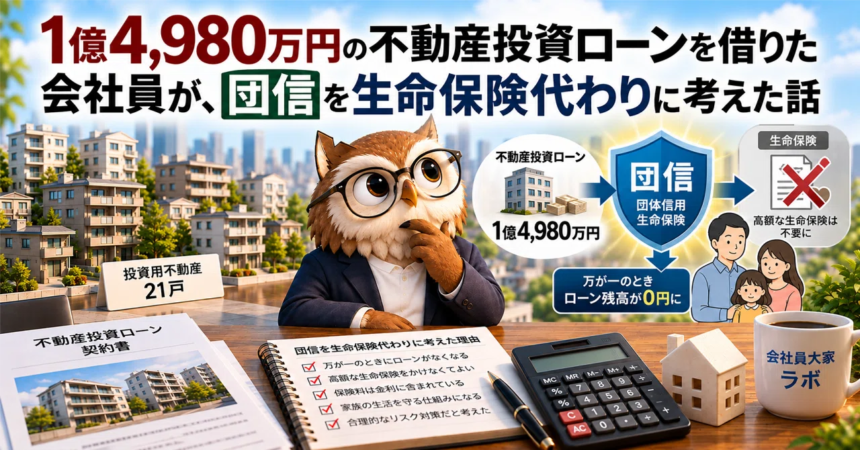
There is a common saying that real estate investment can serve as a substitute for life insurance.
If a real estate investment loan includes group credit life insurance, or so-called “danshin,” the loan is paid off in the event of an emergency, leaving the real estate behind.
I think this is a story often heard in real estate investment sales pitches as well.
I also joined this group credit life insurance when I started real estate investment in 2016.
The first apartment building I purchased in Kita-Senju was 86.8 million yen, and the apartment building I purchased five months later in Yotsugi was 63 million yen.
For both buildings combined, the loan amount is 149.8 million yen.
Both loans included group credit life insurance.
And, 10 years have passed since then.
I am also enrolled in general life insurance, but I have not actively increased my high-value death benefit coverage.
One of the reasons for this is the existence of group credit life insurance.
In this article, I would like to write about how I have thought about group credit life insurance since I started real estate investment, which properties I actually enrolled in it for, and its relationship with general life insurance.
My first group credit life insurance was for an 86.8 million yen loan
In June 2016, I purchased an apartment building in Kita-Senju.
The property price was 88.8 million yen. The loan amount was 86.8 million yen.
Enrollment in group credit life insurance was mandatory for this loan.
Group credit life insurance is a system where, if the loan contract holder dies or falls into a specified state of severe disability, the insurance proceeds are used to pay off the remaining balance of the target loan.
Unlike general life insurance, the insurance proceeds are not paid directly to the family.
Because it is used to repay the loan, the result is that the real estate remains with the debt cleared.
I had never purchased a home before, so this was my first time enrolling in group credit life insurance.
I had known about the mechanism for a long time, but I remember that my understanding of the system deepened considerably by actually receiving the explanation and signing the contract.
To begin with, the loan amount was 86.8 million yen.
If something were to happen to me, having such a large debt remain would be a major problem.
Joining group credit life insurance was mandatory, but I also considered it necessary myself.
On the other hand, since joining group credit life insurance was mandatory for this loan, I do not know how much the interest rate increased by joining it, or what the conditions would have been if there had been an option without it.
Then, in November of the same year, I purchased a second apartment building in Yotsugi.
The loan amount for this was 63 million yen.
It was a loan from the same financial institution, and joining group credit life insurance was again mandatory.
In this way, I ended up joining group credit life insurance for a total loan of 149.8 million yen.
Properties with and without group credit life insurance
After that, I purchased two condominium units in Meguro in 2017, and one condominium unit in Asakusa through my corporation in 2018.
Here, my thinking regarding group credit life insurance changed slightly.
For the two units in Meguro, I took out a total loan of 17.5 million yen.
I also attached group credit life insurance to this.
I recall that joining was optional, but for standard group credit life insurance, the insurance premiums were covered by the bank, and there was no interest rate surcharge.
On the other hand, I believe there was also an option to add a special rider for three major diseases by increasing the interest rate by about 0.1%.
I chose only the standard group credit life insurance.
Honestly speaking, the loan amounts for the two Meguro units were not as large as those for Kitasenju or Yotsugi.
If attaching group credit life insurance meant an increase in the interest rate, I would not have joined.
And in 2018, the condominium unit in Asakusa purchased through my corporation.
The loan amount for this was 7.5 million yen.
For Asakusa, I did not attach group credit life insurance.
This is because the condition for attaching group credit life insurance was an interest rate increase of 0.2%.
Since it is 0.2% on 7.5 million yen, a simple calculation based on the initial loan balance is equivalent to 15,000 yen per year.
Of course, in reality, the loan balance decreases, so it does not cost 15,000 yen every year.
Even so, I judged that there was no need to add group credit life insurance by increasing the interest rate for a relatively small loan amount.
In fact, for the Asakusa loan, I have since been making early repayments in 1 million yen increments.
As I wrote before in the story of making a 4 million yen early repayment on 3 condominium units, I made an early repayment of 2 million yen for Asakusa alone.
In other words, my thinking regarding group credit life insurance is not that it must be attached to all loans.
If the loan amount is large, I feel a strong need for it, and if there is no interest rate increase, I will join.
On the other hand, if the loan amount is relatively small and there is an additional interest rate burden, not joining is also an option.
That is the judgment I have made.
Can group credit life insurance serve as a substitute for life insurance?
When you invest in real estate, it can serve as a substitute for life insurance.
This is an explanation often used when introducing real estate investment.
I myself have a certain sense of conviction in this explanation.
For example, as of the end of September 2026, the loan balances for Kitasenju and Yotsugi are as follows.

For the two buildings, there is still about 112 million yen in loans remaining.
If something were to happen to me now and the conditions for the group credit life insurance payout were met, the loans for these two buildings would be repaid by the insurance money.
And even if the loan is gone, the real estate itself remains.
If the family who inherits the real estate continues to manage the rental business, they can also earn rental income.
Of course, property taxes, repair costs, and management fees will still be required, and there is also the burden of taking over the rental business itself.
Even so, the fact that the monthly loan repayment disappears is a big deal.
Thinking about it this way, I believe that group credit life insurance certainly has a role similar to life insurance.
However, it is not exactly the same as general life insurance.
With life insurance, the family can receive insurance money in cash according to the contract details.
On the other hand, what remains with group credit life insurance is the real estate, which is now free of the burden of loan repayment.
I think this difference is quite significant.
What about general life insurance?
So, how much general life insurance am I enrolled in?
First, in 2015, when I got married, I joined a group insurance plan provided as a benefit by my employer.
The death benefit is 2 million yen.
The monthly premium is about 600 yen for a term policy, and the beneficiary of the insurance money is my wife.
At the time, my wife was also working, and I didn’t think a high death benefit was particularly necessary.
After that, when my child was born in 2018, I joined another life insurance policy.
It is a US dollar-denominated whole life insurance policy with a death benefit of 30,000 dollars.
The premium was 188 dollars per month, and I paid it for five years.
The payments are now finished, but the death benefit continues for life.
Also, there is a cash surrender value, which is designed to increase according to the number of years that have passed since the contract began.
At the time, with a child being born, I became more aware of the need for life insurance than I had been before.
On the other hand, the fact that I had started real estate investment also influenced my thinking about insurance.
The properties in Kita-Senju and Yotsugi come with group credit life insurance (danshin).
In the event of an emergency, the loan is paid off, and the real estate remains.
Thinking about it that way, I felt that the need to secure even larger death benefits through general life insurance was not that high.
Of course, I do not think this is the right decision for everyone.
The necessary coverage should change depending on family structure, income, assets, and borrowing status.
In my case, this is how I have thought about it.
Furthermore, apart from these, I am also enrolled in small-amount savings-type life insurance and individual pension insurance.
These are intended more for life insurance premium deductions and individual pension insurance premium deductions rather than increasing death benefits.
By starting real estate investment and filing my own tax returns, my understanding of the tax system deepened, and I became more aware of systems like these deductions.
Even with the 2025 refinancing, group credit life insurance was continued
In December 2025, I refinanced the loan for the apartment building in Yotsugi.
This is a story I also introduced in the article about refinancing from a 4.175% interest rate to 2.0%.
At the financial institution before refinancing, the conditions were such that the interest rate would rise to 4.175%.
So, I refinanced with a different financial institution and was able to lower the initial interest rate to 2.0%.
At this new lender as well, enrollment in group credit life insurance was mandatory.
I personally felt that group credit life insurance was necessary for a loan amount like the one for Yotsugi, so there was no particular problem.
Although the interest rate and repayment conditions changed due to the refinancing, the coverage provided by the group credit life insurance was continued.
However, it is not that the same group credit life insurance was simply carried over; I enrolled again with the new loan.
I felt once again that loan conditions include not only the interest rate but also coverage in the event of an emergency.
Even with group credit life insurance, inheritance issues remain
Writing this far, it might sound like having group credit life insurance means you can rest easy in the event of an emergency.
However, I don’t think it’s actually that simple.
What I have been concerned about recently is the issue of inheritance.
If the loan is repaid through group credit life insurance, the real estate remains debt-free.
However, when inheriting real estate, there is a possibility that inheritance tax will be incurred.
Moreover, as a general rule, a loan that is guaranteed to be repaid by group credit life insurance cannot be deducted as a liability in the calculation of inheritance tax.
While it is grateful that the debt disappears, it also means that the liability cannot be deducted in the inheritance tax calculation.
Of course, the actual amount of inheritance tax incurred depends on the valuation of the real estate, other assets, and the situation of the heirs.
However, if inheritance tax is incurred, how will the funds for tax payment be secured?
This is a separate issue.
Even if the loan is eliminated by group credit life insurance, it does not mean that the same amount of cash will be in the family’s hands.
There is the idea of selling the real estate to cover the tax payment funds, but real estate is not something that can be sold and converted into cash immediately like listed stocks.
Selling takes time, and there is no guarantee that it will sell at the desired price.
Furthermore, the surviving family will also need to decide whether to continue managing the real estate or sell it.
In reality, I have not yet thought about this area sufficiently.
It has been 10 years since I started real estate investment.
I have thought about and dealt with loan repayments, interest rate hikes, and refinancing as they have arisen.
On the other hand, what should my family do if something happens to me?
If you ask me if I have organized that specifically, I still have a long way to go.
Thinking of group credit life insurance as a substitute for life insurance for 10 years
Looking back, since I started real estate investment, I have considered group credit life insurance (GCLI) as a form of life insurance. (Of course, since GCLI stands for Group Credit Life Insurance, it is life insurance by definition.)
I attached GCLI to the loans for the Kitasenju and Yotsugi properties, which had large loan amounts, joined without an interest rate markup for the Meguro property, and chose not to join for the Asakusa property due to the interest rate burden.
Regarding general life insurance, I have also enrolled while considering the necessary coverage at milestones such as marriage and the birth of my children.
And even now, my fundamental view that GCLI can serve as a substitute for life insurance has not changed.
However, having GCLI does not mean everything is taken care of.
The fact that the loan is paid off and the real estate remains is not necessarily the same as the surviving family being able to live without financial hardship.
When I started real estate investment, having GCLI gave me a sense of security regarding large borrowings.
Now, 10 years later, I have come to think that perhaps that alone is not enough.
Not just how to pay off the debt, but what to do with the remaining real estate if something were to happen to me.
This is also one of the issues I must think about from now on.