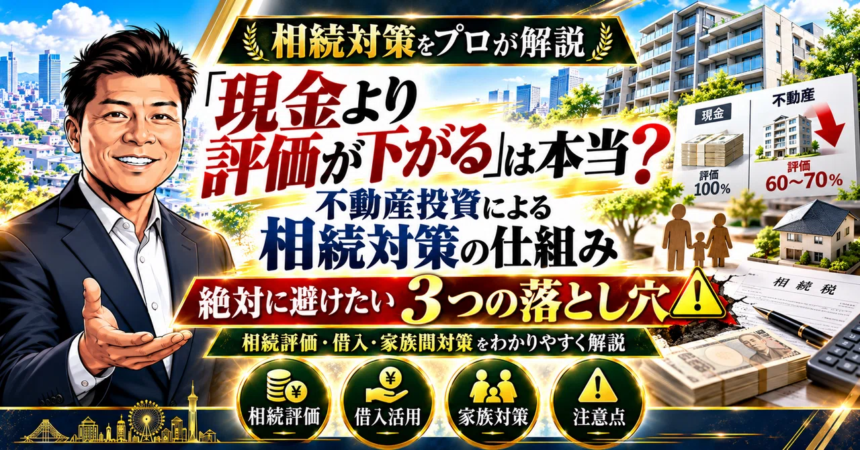
Real estate investment as inheritance planning. The mechanism of “valuation being lower than cash” and pitfalls often overlooked
“I heard that if I’m worried about inheritance tax, buying an apartment or a rental condominium will be a good countermeasure”—even in the Hanshin area, I have more and more opportunities to hear this in consultations every year.
It is true that real estate can sometimes have a lower valuation for inheritance tax calculations than holding it as cash. However, in recent years, the system has been under review, and it is not a situation where you can say “it’s safe if you buy it.”
To conclude, while rental properties can be expected to have the effect of lowering inheritance tax valuations, “lowering the valuation” and “being a viable investment” are two different things. If you buy solely for the purpose of tax savings, you may end up leaving a burden on your family due to vacancies or losses on sale.
In this article, I will organize the mechanism of how the valuation is lowered using figures and share points to be careful about that are easy to overlook, based on 23 years of on-site experience.
Why does real estate lower the inheritance tax valuation?
When calculating inheritance tax, assets are not evaluated at “market value,” but according to rules set by the government. If you have 100 million yen in cash, it remains 100 million yen. On the other hand, real estate has the following rules.
Land is evaluated by “road rating” (rosenka), and buildings are evaluated by “fixed asset tax valuation”
-
Land: Evaluated based on the road rating determined for each road. It is generally considered to be lower than the actual selling price (market value).
-
Building: Evaluated at the same amount as the “fixed asset tax valuation” found in the fixed asset tax assessment statement that arrives around April every year. This valuation is considered to be about 60% of the construction cost.
In other words, if you build or buy a building with 100 million yen in cash, the image is that the 100 million yen construction cost drops to about 60 million yen for inheritance tax calculation purposes.
Furthermore, if it is “rented to others,” it drops even further
Real estate rented to others cannot be used freely by the owner, so the valuation drops even further.
-
Valuation of rental house (building): Fixed asset tax valuation × (1 − 30% rental right ratio × rental ratio)
-
Valuation of land for rental housing: Valuation of land for own use × (1 − land lease right ratio × 30% rental right ratio × rental ratio)
“Rental ratio” is the occupancy rate. The rental right ratio is 30% nationwide. The land lease right ratio varies by region and is indicated by symbols “A to G” on the road rating map.
Let’s look at it with numbers
For example, under the following conditions (the figures are examples for explanation).
-
Fixed asset tax valuation of the building is 60 million yen, fully occupied (rental ratio 100%) → 60 million yen × (1 − 0.3) = 42 million yen
-
Self-use valuation of the land is 100 million yen, land lease right ratio 50%, fully occupied → 100 million yen × (1 − 0.5 × 0.3) = 85 million yen
If you build an income property with construction costs of 100 million yen in cash, the building’s valuation will drop to 42 million yen. Compared to keeping 100 million yen in cash, this calculates to a reduction of approximately 58 million yen in terms of valuation.
There is also a system called the Special Provisions for Small-Scale Residential Land, etc.
For land, there is a system called the “Special Provisions for Small-Scale Residential Land, etc.” This is a system that allows you to reduce the valuation of land used for business or residential purposes up to a certain area.
-
Land for specific residential use(such as land for your own home): 80% reduction for up to 330㎡
-
Land for specific business use: 80% reduction for up to 400㎡
-
Land for rental business use(land for apartments or rental houses): 50% reduction for up to 200㎡
For rental business use, the reduction rate is 50%, which is smaller than for your own home, etc. Even so, in areas with high land prices like the Hanshin region, the effect can be significant.
However, this special provision has detailed requirements, such as the heir taking over the business and continuing it until the tax filing deadline. There is also a rule that land that has been rented for less than 3 years is generally excluded. Please be sure to check with a tax accountant to see if it can be applied to your specific case.
The rules have become stricter in the last few years
The practice of “buying real estate to lower inheritance tax” is being continuously reviewed.
If the purchase is recent, it may be valued at market price
There have actually been court cases regarding the method of buying real estate just before inheritance to lower the valuation. If the purchase is recent, there is a risk that it will be valued closer to the actual market price rather than the road rating value.
Revisions from January 2027 onwards
In the discussions for the 2026 tax reform, a direction has been indicated to value rental real estate acquired within 5 years at a level close to the acquisition cost (approximately 80% as a guideline). This content may change due to future laws and operations. If you are considering this, please check the latest information from a tax accountant or materials published by the National Tax Agency.
In short, the practice of “buying in a short period and immediately lowering the valuation” is becoming increasingly difficult.
3 pitfalls that lead to failure when you intended to plan for inheritance
1. If there is a vacancy, both valuation and income will drop
The rental ratio is determined by the “occupancy rate.” If there are vacancies, the extent of the valuation reduction will be smaller accordingly. At the same time, rental income will also decrease. Even in the Hanshin region, there are differences in vacancy rates depending on the area and the age of the building. If you bought it aiming for tax savings and it does not become fully occupied, the effect will be diminished.
2. If there is a lot of borrowing, repayment will become a burden on the children
When you buy by taking out a loan, the borrowed money can be deducted from the assets at the time of inheritance (debt deduction). However, that loan will be taken over by the family who inherits it. If rental income drops and only the repayment remains, it will become a burden on the family.
3. It becomes an asset that is difficult to divide
Apartments and income-generating condominiums cannot be divided as easily as cash. If there are multiple heirs, it often becomes a cause of conflict regarding who will take it over, whether to sell it, or whether to hold it as a shared interest. If held as a shared interest, the consent of everyone will be required later to decide on selling or rebuilding.
The order of checks before buying for inheritance planning purposes
-
First, confirm whether inheritance tax will actually be incurred The basic deduction is ’30 million yen + 6 million yen × the number of statutory heirs’. For example, if there are 3 heirs, it is 48 million yen. If your assets are below that, you may not be subject to inheritance tax.
-
Think first about whether it works as an investment Check the yield, vacancy risk, repair costs, and even the exit strategy at the time of sale. A property that does not generate profit will not serve as an inheritance measure either.
-
Talk to your family Confirm your family’s intentions regarding who will take it over or whether to sell it.
-
Have a tax accountant perform a trial calculation with specific numbers Land valuation involves many adjustments, and it is said to be difficult for individuals to judge on their own.
Summary
Income-generating properties may have a lower inheritance tax valuation compared to cash. For buildings, it is the fixed asset tax valuation, and if rented out to others, it is further reduced by the 30% rental right ratio; there are also special provisions for land such as land for rented houses and small-scale residential land. However, there is a trend where valuations become stricter if the purchase was recent, and there are pitfalls such as vacancies, borrowing, and difficulty in dividing. It is safer to think in the order of ‘investing in a property that works as an investment, and using it as an inheritance measure as a result,’ rather than ‘buying for the sake of tax savings.’
I always feel something when I receive inheritance consultations. It is that ‘how the family will struggle afterward’ is a much bigger problem than tax figures. I have heard several times about cases where, despite the valuation being lowered, only an apartment full of vacancies and debt repayments remained. Tax savings are just a bonus. First, let me help you think about whether it is a property that your family can feel secure holding.
Consultations regarding income-generating properties and investment real estate in the Hanshin area (Amagasaki City, Nishinomiya City, Itami City, Kawanishi City, Takarazuka City, Ashiya City, Kobe City Nada Ward, Higashinada Ward) are accepted casually via real estate agent Kohei Ishida’s official LINE. Please add the official LINE below as a friend and send a message saying, ‘I would like to consult about income-generating properties considering inheritance measures.’ I will get back to you.
▼Click here for the official LINE
※Inheritance tax calculations and the application of special provisions vary in results depending on individual circumstances. Please check with a professional such as a tax accountant for specific judgments.
Reference Information