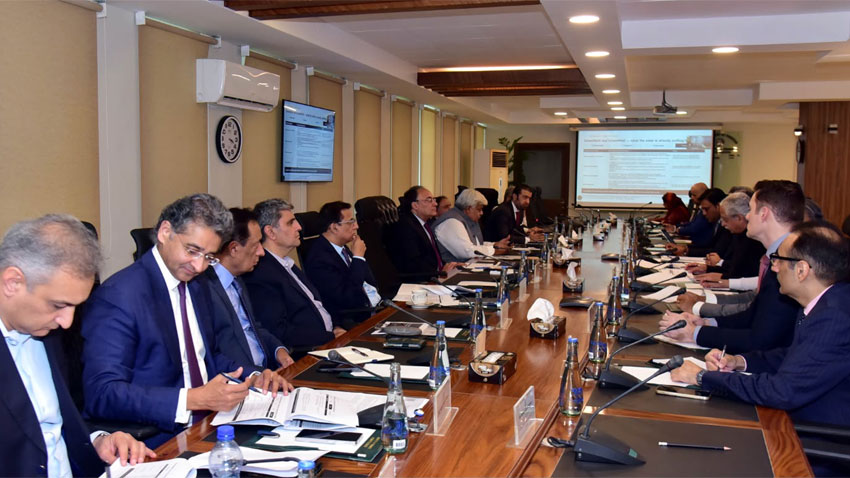
Minister for Finance Muhammad Aurangzeb has emphasized the need for a transparent, commercially viable and investor-friendly framework to help mobilize domestic savings, attract institutional investment and support private-sector-led economic growth.
He was chairing a meeting of the Committee tasked with developing the National Private Equity Framework in Islamabad today.
The meeting reviewed progress on regulatory and taxation reforms, domestic capital mobilization and the development of investment opportunities to support a robust private equity ecosystem in Pakistan.
The Finance Minister appreciated the substantive progress achieved across key workstreams and underscored the importance of translating regulatory and policy reforms into practical investment opportunities.
The Committee reviewed the potential of Pakistan’s private equity market, including opportunities arising from acquisitions, business consolidation, new projects and exits by existing investors.
Discussions highlighted the prospects of developing a substantial pipeline of investable opportunities over the next five to ten years, supported by significant domestic liquidity that could be channelled towards productive economic activity through an effective private equity ecosystem.
The Finance Minister emphasized that mobilizing domestic capital should be the immediate priority, providing the foundation for a credible and functioning private equity market capable of subsequently attracting foreign institutional investors and facilitating international co-investment.
The State Bank of Pakistan briefed participants of the meeting on recent regulatory changes, including the enhancement of the permissible investment limit for banks in a single private equity fund from ten percent to twenty percent.
On taxation, the Committee reviewed recommendations for establishing a clear, competitive and predictable tax framework for private equity funds.
The Finance Minister stressed the importance of comprehensively evaluating relevant international taxation models and adapting them to Pakistan’s economic and regulatory environment.
He emphasized that any proposed tax arrangements must support legitimate investment activity while preventing opportunities for tax arbitrage, unintended distortions or regulatory inconsistencies.
The Committee also underscored the need for a coordinated approach across regulatory and taxation authorities to ensure consistency in the treatment of different investment vehicles and facilitate the development of a well-functioning private equity market.
The Finance Minister directed relevant stakeholders to build on the progress achieved, address outstanding regulatory and taxation issues, and advance work on domestic capital mobilization and the identification of viable investment opportunities to move the National Private Equity Framework towards implementation.
Reiterating the government’s broader reform priorities, Muhammad Aurangzeb emphasized that the development of a robust private equity ecosystem should contribute to deeper domestic capital markets, improved access to long-term risk capital, greater private-sector investment and sustainable economic growth.