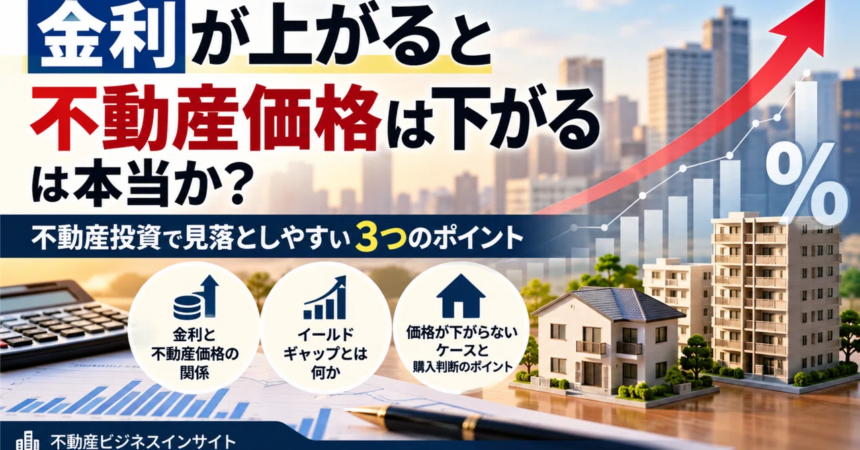
Is it true that “when interest rates rise, real estate prices fall”? 3 points often overlooked in real estate investment
When interest rates rise, real estate prices fall.
If you are interested in real estate investment, you have probably heard this before, haven’t you?
Certainly, rising interest rates are a significant change for the real estate market.
If the repayment burden for mortgages or real estate investment loans increases, the number of people who can afford to buy decreases, which may put downward pressure on real estate prices.
However, there is a question here.
If interest rates rise, will all real estate prices fall in the same way?
In reality, it is not that simple.
Real estate prices are determined by various factors, not just interest rates, such as rental income, property location, investor expected yields, and future resale potential.
In this article, we will organize the relationship between interest rate hikes and real estate prices, and explain three points that are often overlooked in real estate investment.
1. Why real estate prices tend to fall when interest rates rise
First, let’s confirm the basic relationship between interest rates and real estate prices.
In real estate investment, it is common to purchase properties by receiving loans from financial institutions.
Therefore, when borrowing interest rates rise, the monthly repayment amount increases.
For example, let’s consider the following conditions.
[Borrowing conditions]
-
Loan amount: 30 million yen
-
Repayment period: 30 years
-
Repayment method: Principal and interest equal repayment
-
Bonus repayment: None
How will the monthly repayment amount change if the interest rate changes under these conditions?
Borrowing Interest Rate Monthly Repayment (Estimate) 1.0% per year approx. 96,000 yen 1.5% per year approx. 104,000 yen 2.0% per year approx. 111,000 yen
*These are estimates assuming the same interest rate is applied throughout the entire period. Various expenses are not included.
If the interest rate rises from 1.0% to 2.0%, the monthly repayment amount increases by approximately 15,000 yen.
This is an annual increase in burden of approximately 180,000 yen.
If rental income remains unchanged, the funds remaining on hand will decrease by that amount.
Of course, the actual impact on repayment amounts depends on whether the interest rate is fixed or variable, the remaining repayment period, and other factors.
The important point is that due to rising interest rates, the profitability for investors changes even for properties at the same price.
If profitability declines, investors become cautious about purchasing at the same price as before.
This is one of the reasons why rising interest rates put downward pressure on real estate prices.
However, just because interest rates rise does not necessarily mean that prices will fall.
To understand the reason for this, the following perspective becomes important.
2. “Expected Yield,” which is important when considering real estate prices
When considering the price of income-generating properties, the “expected yield” becomes important.
When purchasing real estate, investors consider how much profit they can earn.
Here, to make the mechanism easy to understand, we will use the following simplified calculation formula.
Real Estate Price = Annual Net Income ÷ Capitalization Rate
Annual net income is the amount remaining after deducting operating expenses from rental income and other sources.
For example, let’s consider a property with an annual net income of 3 million yen.
If the capitalization rate is 5%,
3 million yen ÷ 5% = 60 million yen
This is the result.
So, what happens if the capitalization rate required by investors rises to 6%?
3 million yen ÷ 6% = 50 million yen
This is the result.
Condition Case A Case B Annual Net Income 3 million yen 3 million yen Capitalization Rate 5% 6% Calculated Property Price 60 million yen 50 million yen
Even if the annual net income remains the same, if the capitalization rate rises by 1 point, the calculated property price drops by approximately 16.7%.
What we should note here is that if borrowing interest rates rise by 1 point, the capitalization rate does not necessarily rise by 1 point as well.
The capitalization rate is influenced not only by interest rates but also by property risks, future rent outlooks, and investment demand.
Therefore, this calculation does not predict price declines due to interest rate hikes.
It shows the relationship that ‘if the yield required by investors changes, the valuation of real estate prices can also change significantly.’
3. What is the yield gap?
Here, let’s clarify the term ‘yield gap,’ which is also used in news regarding real estate investment.
The yield gap generally refers to the difference between the investment yield of real estate and the interest rate used for comparison.
For example, let’s consider the following conditions.
In this case,
5.0% – 1.0% = 4.0 points
This is the result.
So, what happens if the comparative interest rate rises to 2.0%?
5.0% − 2.0% = 3.0 percentage points
is the result.
As interest rates rise, the yield gap narrows.
However, the yields and interest rates used to calculate the yield gap vary depending on the purpose of the analysis.
Sometimes real estate yields are compared to long-term government bond yields, and other times the relationship with borrowing interest rates is checked.
Furthermore, the simple difference in yields cannot fully evaluate vacancy risk, repair costs, taxes, or principal repayment.
The yield gap is an indicator for considering the investment environment, and it is not something that can determine the quality of a property on its own.
4. Cases where real estate prices do not fall even when interest rates rise
Reading this far, you might feel that real estate prices are likely to fall if interest rates rise.
However, in the actual real estate market, factors other than interest rates also affect prices.
For example, in areas where rents are rising.
Suppose a property with an annual net income of 3 million yen sees its annual net income increase to 3.6 million yen due to rent increases or similar factors.
Even if the capitalization rate rises from 5% to 6%,
3.6 million yen ÷ 6% = 60 million yen
is the result.
In other words, if the increase in annual net income offsets the rise in the capitalization rate, the calculated property price may be maintained.
Of course, this is a simple example for illustrative purposes.
In reality, it is necessary to consider room for rent increases, vacancy rates, operating expenses, future repair costs, and more.
Also, the following factors affect real estate prices.
Trends in population and number of households
Even if the population is declining, there are areas where the number of households and housing demand are increasing.
Location conditions
Properties with excellent transportation convenience and living environments may maintain their demand.
Status of new supply
If the supply of new properties is suppressed due to rising construction costs, the competitive environment for existing properties may change.
As such, one cannot determine the direction of real estate prices based solely on the single factor of rising interest rates.
5. Three points often overlooked in real estate investment
So, what should real estate investors and rental property managers check during a phase of rising interest rates?
I believe the following three points are particularly important.
Point 1: Look at cash flow after interest rate hikes, not just current yield
It is dangerous to check only the gross yield when purchasing a property.
Even if the gross yield is high, if borrowing interest rates rise, the funds remaining in hand may decrease.
For example, it is necessary to check the following items.
-
If interest rates rise by 0.5 percentage points
-
If interest rates rise by 1.0 percentage points
-
If vacancies occur for a certain period
-
If large-scale repairs become necessary
What is important is not just whether you can operate as planned.
Whether you can continue operations even if unexpected expenses occur is what you need to confirm.
Point 2: Check whether the property allows for rent increases
Even if interest rates rise, if rental income increases, it may be possible to partially offset the deterioration in profitability.
However, rent cannot be increased at will.
It is necessary to consider surrounding market rents, the facilities of competing properties, and the tenants’ ability to pay.
Also, when changing the rent for existing tenants, the contract terms and rules under the Land and Building Lease Law are involved.
Therefore, when purchasing a property, it is important to look not only at the current rent but also at a comparison with the surrounding market.
If the current rent is lower than the surrounding market, there may be room for future rent improvements.
On the other hand, for properties already operating at rents higher than the surrounding market, there is a possibility that the rent may decrease after a tenant moves out.
It is necessary to have a perspective that looks not only at current earnings but also at whether those earnings can be maintained in the future.
Point 3: Consider not only the purchase price but also the selling price
In real estate investment, people tend to focus on the yield at the time of purchase.
However, the price at the time of future sale is also important.
For example, even if a property was valued at a 5% capitalization rate at the time of purchase, if the market demands a 6% yield at the time of sale, the calculated price will decrease if the annual net income remains the same.
Furthermore, buildings age over time.
At the time of sale, the condition of the building, repair history, occupancy status, and financing environment will also have an impact.
It is not guaranteed that you will be able to sell at the price you assumed at the time of purchase.
That is why, before purchasing, it is important to ask yourself:
‘Who will buy this property in 10 years, and under what conditions?’
This question is important to keep in mind.
6. What is important in a rising interest rate environment is ‘sustainability of earnings’ rather than ‘price’
So far, I have explained the relationship between interest rates and real estate prices.
Rising interest rates affect real estate prices through increased borrowing burdens and changes in investor expectations for yields.
However, interest rates are not the only factor that determines prices.
There are properties where rental income increases, and others where profitability worsens due to vacancies or repair costs.
Even in the same area, results differ depending on the condition and location of the property.
I believe the following three points are important.
1. Can you maintain cash flow even if interest rates rise?
2. Can you secure stable rental income in the future?
3. Is it a property that will find a buyer when you sell it?
Real estate investment is not something where the result is determined the moment you purchase.
You need to consider both the income during the holding period and the future sale price.
‘I won’t buy because interest rates are rising’
‘I will buy now because prices are rising’
Both are ways of thinking that judge based on only one factor.
Use changes in interest rates as an opportunity to re-evaluate the earning power of the property itself.
Isn’t that an important perspective in real estate investment?
Summary
In this article, I explained the relationship between rising interest rates and real estate prices.
The following three points are what you should keep in mind.
-
Rising interest rates can put downward pressure on real estate prices
-
However, prices may be maintained depending on rental income and real estate demand
-
When making investment decisions, it is necessary to check not only the current yield but also cash flow and future resale prices
When looking at real estate market news, try to pay attention not only to the result of whether prices have risen or fallen, but also to the profitability and financial environment behind them.
About Real Estate Business Insights
‘Real Estate Business Insights’ explains real estate market news and statistics from a perspective useful for practical business and investment decisions.
We publish articles that consider the meaning behind the numbers, such as land prices, interest rates, construction costs, population trends, and rental management.
We will continue to provide information that is useful for thinking about real estate.
*This article is intended for general information purposes only. The figures provided are hypothetical for explanatory purposes and do not guarantee individual property prices or investment results.