
“Can I really build assets while staying in my current job?”
“I want to increase my market value and advance my career…”
Have you ever thought like that?
I am Ozaki, President of Money-Tre University. Today, based on the case of someone who went from a part-time job paying 1,000 yen per hour to a job at a well-known financial institution and became a successful professional real estate investor, I will explain how to build a career and assets using expertise as a weapon.
What you will learn in this article
・Professional investment processes learned from 40 billion yen projects
・Realistic risks of real estate investment and information gathering techniques
・How expertise changes your career and annual income
Conclusion first: Expertise is the strongest weapon for building a career and assets
・Career Pivot: From a NEET graduate of the University of Tokyo to a major financial institution after obtaining qualifications. Career advancement from an annual income of 3 million yen.
By acquiring expertise, you can significantly change your career path. Increasing your own market value is the first step toward asset formation.
・Professional Investment Techniques: Formed a fund with investor capital, created hundreds of patterns of detailed income and expenditure calculations (cash flow models), and purchased 40 billion yen worth of real estate.
Professional investment is based on thorough analysis, not intuition. It is important for individuals to also have a perspective that analyzes the profitability of properties from multiple angles.
・Risk Management: Even in the professional world, you are side-by-side with the risk of “land sharks” (fraudsters). There is a gritty field where you must carefully verify the source of information.
Real estate investment has high information asymmetry. You should assume that “good deals” have a catch and get into the habit of verifying information.
・Work Style and Values: After experiencing hard work and high pay, felt a career ceiling and decided to become independent.
Values such as “what to use your time and labor for” are important, not just high salary. Thinking in terms of hourly wages also helps in career selection.
Even if you are currently a nobody, you can reverse your career if you acquire expertise that everyone wants.
① From 1,000 yen per hour to over 10 million yen in annual income. A unique career strategy
・Experienced being a NEET and a part-time job paying 1,000 yen per hour after graduating from the University of Tokyo
・Determined to succeed upon marriage and obtained the highly difficult “Real Estate Appraiser” qualification
・Entered the real estate industry using expertise as a weapon. After EY, moved to a major financial institution
The “Real Estate Appraiser” weapon that became a turning point in life
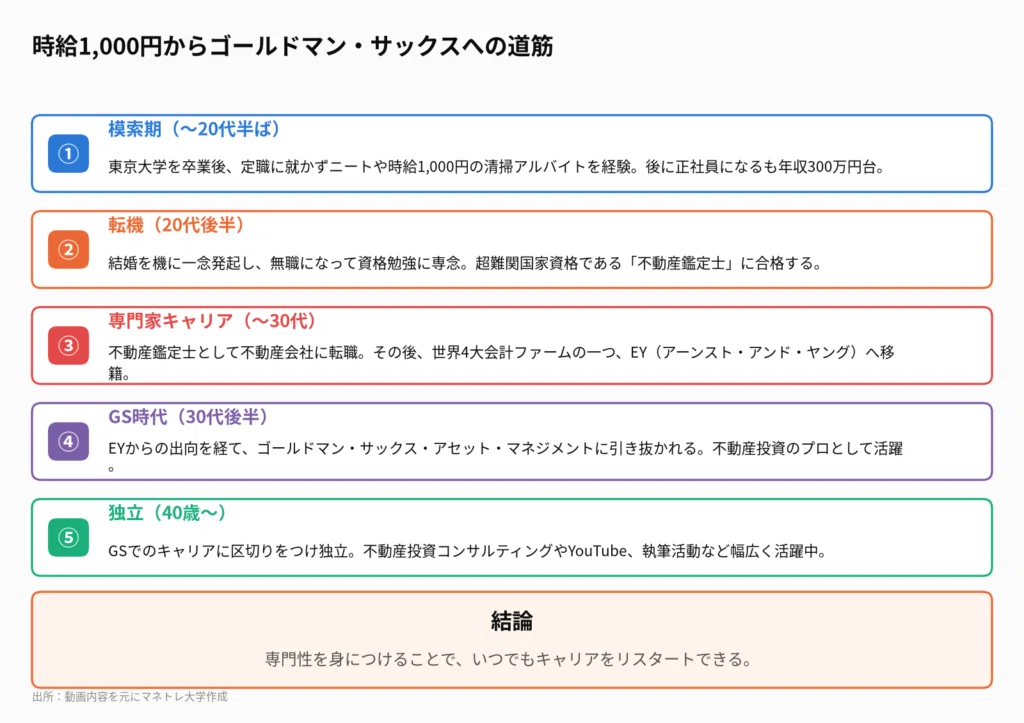
Guest Mr. Obara’s career began after graduating from the University of Tokyo, without a steady job, starting as a NEET and a cleaning part-timer earning 1,000 yen per hour.
After that, he became a full-time employee, but his annual income was in the 3 million yen range. It was a start completely different from the elite path many people imagine.
The big turning point came with his marriage and the birth of his child. Determined to support his family, Mr. Obara quit his job, became unemployed, and focused on studying for the qualification.
And the one he passed was the super-difficult national qualification counted as one of the three major qualifications for liberal arts students,“Real Estate Appraiser”.
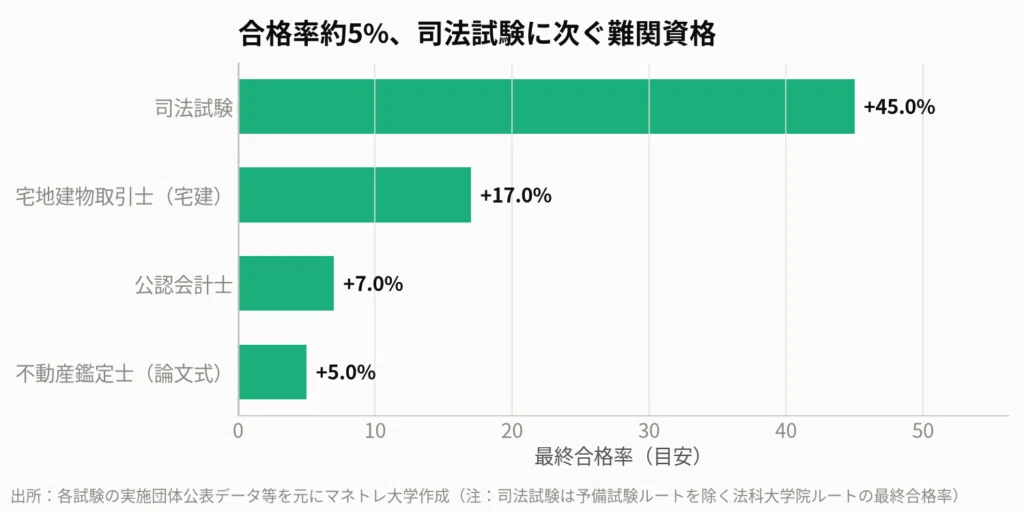
The Real Estate Appraiser is a qualification mentioned alongside lawyers and certified public accountants, but there are only about100 successful candidates per year.
While the pass rate for the Real Estate Notary (Takken) is about 17%, the final pass rate for the Real Estate Appraiser isabout 5%, which shows its high level of difficulty.
Using this expertise as a weapon, Mr. Obara changed jobs to the real estate industry. He dramatically improved his career and annual income.
The unexpected path to GS: Being headhunted by a business partner
Mr. Obara, who built his career as a Real Estate Appraiser, transferred to EY (Ernst & Young), one of the world’s four major accounting firms.
And the path to a major financial institution opened up from here in an unexpected way.
At the time, the EY team Mr. Obara belonged to was contracted to perform work in a secondment-like capacity, acting as “helpers” when clients lacked the manpower for real estate investment projects.
Mr. Obara was also stationed at the client’s office in Roppongi Hills, working just like one of their own employees.
This work ethic was recognized, and he was approached by a department manager at the client company who said, “I want you to come work for us,” leading to him being headhunted in an amicable manner.
In foreign-affiliated finance, it is very common for mid-career hiring decisions to be made through introductions from clients or former colleagues who know your true capabilities.
📝 Takeaway Memo ①
Even if you are nobody, you can turn your career around by honing your expertise. Think about what weapons (qualifications/skills) you have to increase your market value.
② Managing 40 Billion Yen Between Two People: The Behind-the-Scenes of Professional Real Estate Investment
・Real estate investment involves forming funds with capital raised from investors, rather than using one’s own funds
・The largest project handled was a portion of the “GranTokyo South Tower” in front of Tokyo Station (approx. 40 billion yen)
・Thorough analysis is conducted, such as creating 300 patterns of cash flow models for investors
What is the job of asset management?
Mr. Obara belonged to the Real Estate Investment Department, which is responsible for asset management.
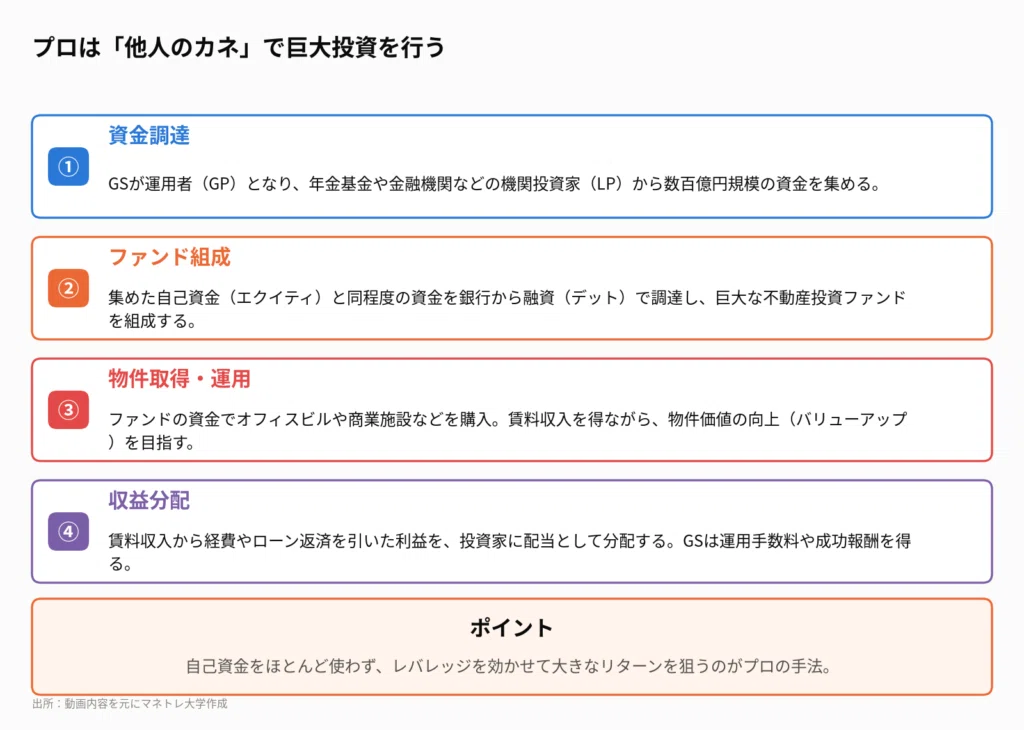
Their job is not to invest their own capital, but to collect money from external investors to purchase and manage real estate.
・Investors: Pension funds, life insurance companies, regional banks, etc.
・Mechanism: Combining capital from investors (equity) and loans from banks (debt) to create a massive fund
・Role: Acting as a fund manager to select, purchase, manage, and sell properties, earning management fees and performance-based compensation
This is a typical method where professionals use “other people’s money” and leverage it to aim for large returns.
The scale and mechanism are vastly different from individual investors buying properties with their own funds and loans.
Excel work that supports professional investment decisions
The largest project Mr. Obara was in charge of was the strata-titled floors (3 floors) of the “GranTokyo South Tower” at the Yaesu exit of Tokyo Station, with a transaction value amounting to approximately 40 billion yen.
What is surprising is the fact that the work related to the property acquisition for this massive project was carried out by effectively only two people.
To persuade investors, Mr. Obara creates a “cash flow model” in Excel to simulate the income and expenditure after purchasing the property.
It is necessary to assume various scenarios according to loan conditions and investor requests, and it is said that the number of models created eventually reached 300 patterns. The professional world makes investment decisions based on vast data analysis and simulations, not on intuition.
Demand from overseas institutional investors for such prime office buildings in the city center remains solid.
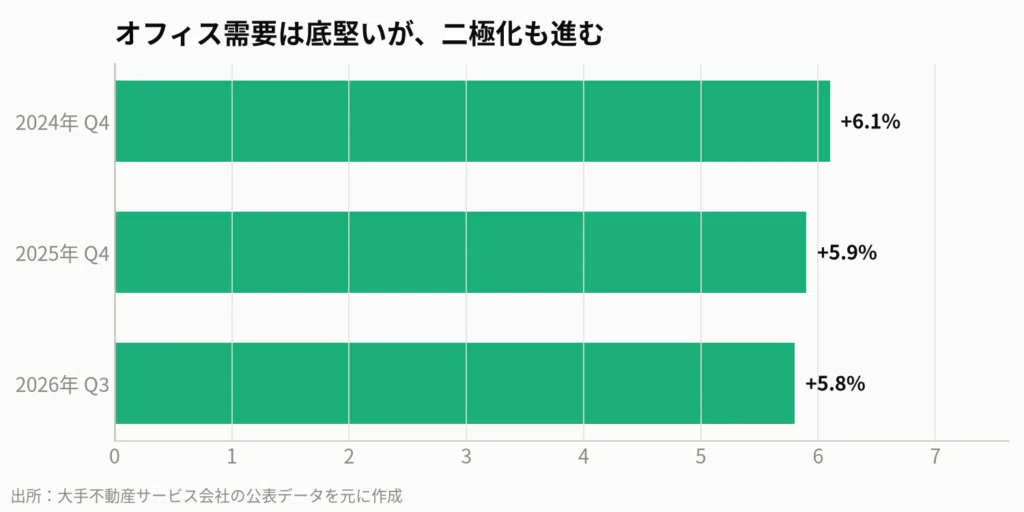
According to the Q3 2026 report by major real estate services firm JLL, the office vacancy rate in Tokyo’s five major wards is 5.8%, a gradual decline from the peak of the COVID-19 pandemic, with a noticeable concentration of demand (polarization) particularly for new buildings and those with high environmental performance.
📝 Takeaway Memo ②
Professional investment is built on thorough analysis. Even as an individual, try to develop the habit of assuming multiple scenarios for a single property, such as “What if the rent goes down?” or “What if interest rates rise?”
③ Land swindlers appear too? The “not-so-pretty” world of real estate investment
・Good property information is born from gritty communication with people
・There is always a risk of fraud from brokers with unknown origins or “land swindlers”
・Your creditworthiness is tested, such as being asked for proof of assets before meeting the seller
The Sourcing Manager who gains information through ‘breakfast, lunch, dinner, late dinner, and late-late dinner’ meetings
When you hear about real estate investment at top firms, you might imagine they smartly obtain information from sophisticated markets.
However, the reality is surprisingly gritty.
Information on good properties for sale rarely flows into the internet or public markets.
Sales professionals called ‘sourcing managers,’ who procure information on properties for sale, spend an enormous amount of time building human connections. The term ‘breakfast, lunch, dinner, late dinner, and late-late dinner’ mentioned in the video symbolizes their way of working, where they continue to meet people so much that they have five meals with others in a single day.
From the seller’s perspective, they want to sell their few high-quality properties to someone who will buy them ‘high, fast, and reliably.’
To win that trust, sourcing managers continue to communicate day and night.
How individual investors should evaluate information sources
While meeting people in search of information, you will naturally encounter suspicious individuals.
Even company representatives must deal with information from brokers of unknown origin and determine its authenticity.
In the real estate industry, there are also scammers like ‘ground masters’ (jimenshi) who impersonate owners to sell land and steal the proceeds.
It is a world with extremely high information asymmetry, where there are many intermediaries behind the information, making it unclear who the real seller is, or where you are asked for proof of assets before even meeting the seller.
This is the greatest lesson for individual investors as well.
You must assume that ‘good deals’ in real estate investment will never just fall into your lap for free, and it is essential to always doubt who the source of the information is, why the offer came to you, and to make it a habit to verify it with registry information and other means.
📝 Takeaway Memo 3
There is no such thing as a ‘good deal’ in real estate investment. Always ask who the source of the information is, why it came to you, and make it a habit to verify it with registry information.
4. The realistic working style and salary of foreign-affiliated finance. Career thinking in terms of hourly wages
・Long working hours are the norm, such as document preparation starting at 11:00 PM
・Systems that provide dinner and taxi fare end up encouraging long working hours
・Salaries are high (base salary from 24 million yen for VP class), but there are times when it doesn’t feel worth it when converted to an hourly wage
The welfare system that makes you miss the last train
Foreign-affiliated finance, especially top-tier firms, is known for being extremely demanding.
Mr. Obara’s personal experience also tells the story of that reality.
For example, it is a daily occurrence for a boss to give instructions around 11:00 PM saying, ‘Make this document by tomorrow morning.’
It is a way of working that assumes you will miss the last train.
The company provides generous welfare benefits to protect the health and safety of its employees.
However, there is an aspect where that system ironically encourages long working hours.
・Late-night meal: If you work overtime after 9:00 PM, you can order a luxurious meal at the company’s expense.
・Taxi: If you miss the last train, the full taxi fare to your home is covered.
Because the company removes the ‘reason to go home,’ you end up staying in the office and continuing to work.
The ‘quitting’ new graduates and the thinking of hourly wage conversion
Of course, the salary as compensation for that is at a very high level.
When you reach the VP (Vice President: section manager class) level where Mr. Obara was, the base salary alone exceeds 24 million yen, and a bonus is added to that.
According to the ‘Salary Survey 2026’ by the recruitment agency Robert Walters, the annual salary for the VP class in the asset management department of financial services is in the range of 20 million to 35 million yen, so Mr. Obara’s story can be said to be at a realistic level.
However, Mr. Obara says, “There were times when I felt it wasn’t worth it when converted to an hourly wage.”
Even with an annual income of 30 million yen, if you work 300 hours a month (e.g., 13 hours on weekdays + 8 hours on Saturdays), the hourly wage is about 8,300 yen. How one perceives this amount depends on individual values.
Due to the extreme workload, it is not uncommon for new graduates to suddenly stop showing up to work, a phenomenon known as “flying away.”
On the other hand, in mid-career hiring, it is also a characteristic of this industry that personnel mobility is extremely high, with talented individuals taking their subordinates and moving to rival companies as an entire team.
📝 Takeaway Memo ④
Think about the value of your work style not just in terms of gross salary, but in terms of “hourly rate.” What perspective can you take to increase your hourly rate? This connects career strategy with asset building.
⑤ Why did you leave a major financial institution? Toward asset building “for yourself”
・Career within the company stopped at VP, and there was no path to further promotion
・Decided to go independent, thinking, “If I’m going to do the same work, I can earn more by doing it for myself”
・The importance of thinking about realistic steps to build 100 million yen from zero
The difference between professional work and building your own assets
Why did Mr. Obara, who was earning a high salary as a VP, choose to abandon a stable career and go independent?
Behind that was the severe reality unique to foreign-affiliated financial institutions.
Within the company, there are positions above VP, such as MD (Managing Director) and Partner, but only a handful of people can reach them.
Mr. Obara felt that his career would hit a ceiling at VP.
And a greater motivation was the desire to “work for myself.”
Even if you close a deal worth tens of billions of yen for the company, it is the company’s profit, and your own assets do not increase directly. He thought, “If I do the same work for myself, couldn’t I earn more?”
5 steps to make your first 100 million yen
Building assets while working as a company employee and building assets through your own business after becoming independent require different approaches.
In Mr. Obara’s book introduced at the end of the video, realistic steps for building 100 million yen from zero assets are discussed.
This can be said to be a reproducible roadmap for many individual investors as well.
1. Polish your expertise and thicken your income pillars: First, increase your earning power through your main job or side job to create the “seed money” that will become the source of investment.
2. Thorough expenditure management: Do not waste the money you earn and maximize the funds to put into investment.
3. Invest in yourself by studying investment: Learn knowledge about finance and real estate, and acquire the literacy not to be taken for a fool.
4. Start investing within your risk tolerance: Start with a small amount at first, and gradually increase the investment amount while learning from failures.
5. Utilize the power of compound interest with long-term, diversified, and installment investments: Take your time without rushing, and maximize the “effect of compound interest” where assets generate assets.
Becoming a professional investor and protecting and growing your own assets are different.
Mr. Obara’s career change gives us a chance to think about a path to asset building that is unique to us, where promotion at a company is not the only goal.
📝 Takeaway Memo ⑤
The goal of a career is not just promotion at a company. Keep in mind paths to build your own assets, such as independence or side FIRE, and think about what you should do now by working backward from there.
What we individual investors should do right now
From Mr. Obara’s story this time, we have summarized 4 actions that we individual investors should learn and practice.
1. Polish your expertise and increase your market value.
Like Mr. Obara, expertise (qualifications or skills) that everyone wants is a weapon that will significantly raise your career and annual income.
2. Thoroughly verify information in real estate investment.
Even in the professional world, suspicious information flies around. Always doubt who the source of the information is and why it came to you, and make it a habit to verify it with registration information, etc.
3. Be conscious of your “hourly rate.”
Let’s calculate how much you are selling your time for in your current job or side job. Thinking about how to increase your hourly rate leads to efficient asset building.
4. Think about your career goals from multiple perspectives.
Beyond just climbing the corporate ladder, define your ideal way of working and living—whether that includes independence or side FIRE—and work backward from there to determine what you should be doing now.
Investments in prime city-center offices, like those handled by Mr. Obara, are supported by strong demand from overseas institutional investors. They have been attracted to Japan’s stable political and economic environment and lower interest rates compared to the West, using the weak yen as a tailwind to deploy capital. However, if the Bank of Japan shifts toward monetary normalization and long-term interest rates enter an upward trend, borrowing costs for real estate investment will increase. This could weigh on the previously booming REIT market and potentially trigger price adjustments. For individual investors, this can be considered a critical juncture to closely monitor the impact of interest rate trends on the real estate market and seek out the next investment opportunity.
Learn more in the video
Click here for the video explaining this with actual charts and materials👇
https://www.youtube.com/watch?v=Yvx_7EnekGs
Click here for the original blog post (with diagrams and reference materials)👇
https://www.gapartners.co.jp/gs-career-real-estate-2026/
🎁 Receive daily market commentary via our free LINE
At Money Training University, we provide specialized financial education and training that consolidates the financial knowledge and routine work learned by university students who started with zero financial background and went on to join major U.S. securities firms.
Daily market commentary and the latest information are delivered via free LINE. You can also find information here about the free study session, “Dual-Wielding Investment: Finance x Real Estate,” hosted by Kuniaki Ozaki, President of Money Training University.
▶︎ Click here for the free study session “Dual-Wielding Investment: Finance x Real Estate” and our free LINE
https://liff.line.me/1657649445-EzXz4aAM/landing?follow=%40040tprgr&lp=17eesW&liff_id=1657649445-EzXz4aAM
If you found this helpful, please give it a like and follow to encourage daily updates.
※The concepts and examples introduced in this article do not constitute a recommendation for any specific investment action. Please make final investment decisions based on your own judgment and responsibility.
Reference Information:
#RealEstateInvestment #CareerStrategy #AssetBuilding #StockInvestment #AssetManagement #NewNISA #InvestmentBeginner #MoneyStudy #MoneyTrainingUniversity