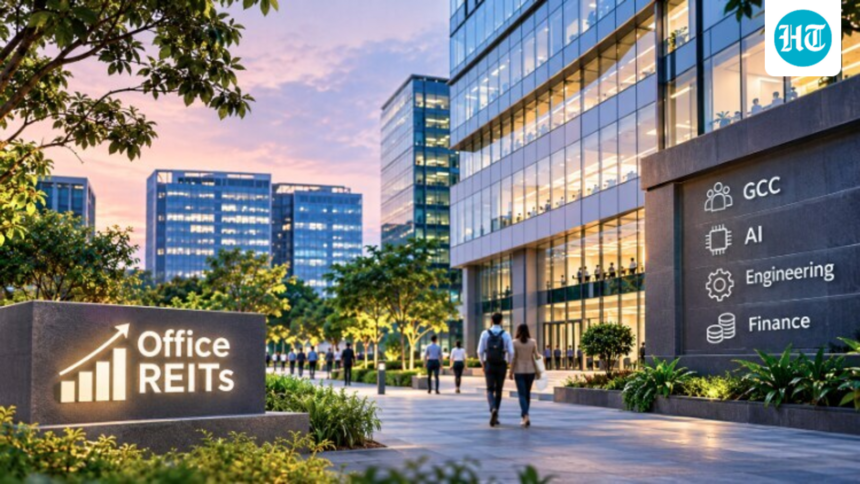
There is a curious contradiction in India’s office market. Companies are signing leases at a record pace, yet vacant office space remains plentiful in parts of the country’s biggest commercial hubs. Bengaluru continues to attract multinational businesses, Hyderabad is recording strong growth, and developers are adding millions of square feet of new space.
The numbers are substantial. JLL’s October 2026 research puts gross office leasing at 61.06 million sq. ft for the first nine months of the year. Global Capability Centres (GCCs), which handle business functions for multinational companies, accounted for 26.2 million sq. ft of that demand.
Much of the excitement surrounding GCCs comes from the work now being carried out in India. Artificial intelligence, engineering, product development and financial analytics are becoming increasingly important to these operations.
But does a larger GCC industry necessarily mean more occupied offices and higher rental income? For investors following office-focused Real Estate Investment Trusts (REITs), that is the more useful question.
The back office has acquired a bigger role
The description ‘back office’ no longer captures the full range of work undertaken by Indian GCCs. A multinational’s Indian operation might develop software, support financial decision-making, undertake engineering research or work on products used across its international business. These activities sit alongside more established support functions.
As the responsibilities have expanded, so have property requirements. ANAROCK’s India Office Market Annual Update 2025 recorded 32.6 million sq. ft of GCC leasing across seven major cities, compared with 28.2 million sq. ft in 2024. Their share of gross office leasing increased from 36% to 41%.
JLL’s October 2026 findings suggest that the expansion has continued. GCC leasing rose 30.6% year-on-year during January–September, with the 26.2 million sq. ft leased over those months already equivalent to 84% of the previous year’s full-year total, based on JLL’s figures.
It would be easy to assume that technology companies account for nearly all this activity. The tenant mix tells a more varied story. Colliers’ July 2026 research found that technology businesses represented 39% of cumulative GCC leasing since 2021. Banking, financial services and insurance accounted for 22%, while engineering and manufacturing contributed 16%.
A bank expanding its analytics operations and a manufacturer establishing an engineering centre have different reasons for leasing offices. Their decisions nevertheless contribute to the same commercial property market.
AI could change how much office space companies need
AI is becoming an important part of the work handled by GCCs. Colliers’ research identifies advanced analytics, digital engineering, research and AI-related operations among the activities supporting their development.
Consider the difference between two possible corporate decisions. One multinational establishes a new AI engineering team in India. It recruits employees, sets up operations and requires premises. Another company introduces AI tools into an existing business function, allowing its current workforce to handle additional work. Both companies are investing in AI. Only one necessarily needs more office space. This distinction has become increasingly relevant to India’s technology industry.
JLL’s October 2026 report observed that domestic technology companies were adopting AI to improve service delivery while approaching office expansion more cautiously. Leasing activity among these businesses slowed compared with the corresponding period in 2025 as operational efficiency received greater attention.
AI-related business growth, therefore, cannot be treated as a straightforward measure of additional office demand. The available research does not separately quantify the amount of space leased because of AI adoption. GCC expansion is measurable through property transactions, but its AI-specific component remains difficult to isolate. That uncertainty may be important to note when assessing how much further the office market might grow.
The Bengaluru–Hyderabad story has another layer
Bengaluru remains India’s largest office leasing market, but Hyderabad’s growth has been drawing attention. JLL recorded 17.11 million sq. ft of gross leasing in Bengaluru during January–September 2026, representing 28% of the national total. Delhi NCR followed with 10.78 million sq. ft, while Hyderabad recorded 9.93 million sq. ft. Hyderabad’s leasing increased 32% year-on-year, compared with 15.4% in Bengaluru. Pune also recorded growth of 31.6%. The figures reveal differences in growth rates, although Bengaluru continues to lead by total leasing volume.
There is another detail worth examining: companies are not spreading themselves evenly across these cities. Colliers found that the ten leading office micro-markets accounted for more than 70% of GCC space uptake between 2021 and the first half of 2026. Bengaluru’s Outer Ring Road and Hyderabad’s Secondary Business District together represented 37% of that demand.
For multinational businesses, an office address involves practical decisions about access to employees, transport connections and the surrounding commercial environment. A building in an established business district may consequently face very different leasing conditions from one elsewhere in the same city.
This geographical concentration becomes particularly relevant when examining REIT portfolios. Owning offices in a city with strong leasing demand does not automatically mean every property in that city will perform similarly.
Companies want better offices. Landlords have to deliver them.
The demand for premium commercial space is visible in the latest Grade A leasing figures. Colliers recorded 54.4 million sq. ft of Grade A office leasing across seven major Indian markets during January–September 2026, up 7% year-on-year. The September quarter alone accounted for 18.7 million sq. ft.
Grade A offices generally offer modern infrastructure, professional building management and facilities suited to corporate occupiers. The precise classification can differ between property consultants. Companies are also showing interest in green-certified buildings and higher-quality commercial developments, according to Colliers’ research. The preference has coincided with rental growth. Average office rentals across the seven markets increased 7% year-on-year during the third quarter of 2026.
Higher market rents can create opportunities for landlords negotiating new agreements. Existing tenants, however, may continue paying rents governed by contracts signed earlier. There is also the cost of keeping a building competitive. Older properties may require refurbishment, upgraded facilities or additional maintenance expenditure. A landlord receiving higher rent may therefore face additional expenses at the same time. Rental growth alone does not reveal the eventual effect on property income.
Why record leasing hasn’t filled every building
India’s developers have been busy too. JLL reported 43.7 million sq. ft of new office completions during January–September 2026. Over the same period, net absorption reached 41.96 million sq. ft, up 5.3% year-on-year.
The difference between leasing and absorption is important. A company may sign an agreement for space that it will occupy later. Gross leasing captures the rental transaction, while net absorption measures the change in physically occupied space after accounting for premises vacated by other tenants.
With new buildings entering the market, JLL’s overall vacancy estimate increased marginally to 14.8% at the end of September. It was nevertheless 90 basis points below the year-earlier level. Colliers estimated vacancy at approximately 16% at the end of the third quarter, based on its own market coverage and methodology. JLL also reported that prime office districts maintained single-digit vacancy rates, indicating tighter conditions in established locations.
The figures explain why landlords can experience different outcomes during the same period of strong national demand. Some buildings may be substantially occupied while others are still looking for tenants. For an office REIT, those differences can be more consequential than the country’s overall leasing record.
A signed lease is only the beginning for a REIT
Office-focused REITs own portfolios of income-generating commercial properties. Investors hold listed units in these trusts, whose financial performance is influenced by rental collections, property expenses and financing arrangements. GCC expansion can benefit a REIT’s operations when companies lease vacant space or renew agreements in its buildings.
But consider a property that is already almost fully occupied. Strong demand in the surrounding market may support future rental negotiations, yet there may be little additional space available to lease immediately. Another building could have substantial vacant space and benefit from new corporate tenants. Its financial performance would still depend on the agreed rent, the timing of occupancy and the expenses involved.
Existing leases can contain predetermined rental increases, so market rental growth does not necessarily translate into an immediate equivalent increase in income. REIT distributions also depend on factors beyond rental collections. Borrowing costs, operating expenses and capital expenditure can affect the cash available to unitholders. Meanwhile, listed unit prices can change independently of near-term property performance.
The connection between a busy office market and REIT investment returns is therefore indirect. Portfolio-level occupancy, lease expiries, tenant concentration and financial disclosures provide a more specific picture.
The next wave will have to find room among new buildings
Commercial construction is continuing alongside GCC expansion. Colliers recorded 41.7 million sq. ft of new Grade A office supply during January–September 2026. Additional developments give expanding companies more choice, but they also create competition for existing landlords.
Flexible workspace operators are contributing to demand as well. According to Colliers, these operators leased 12.6 million sq. ft during the first nine months of 2026, an increase of 37% year-on-year. Flexible offices can allow businesses to adjust their space requirements, although the financial implications for landlords depend on the agreements signed with operators.
Colliers projected in July 2026 that GCC leasing could reach approximately 35–40 million sq. ft annually over the following two years. That estimate remains a forecast, rather than confirmed future demand.
India’s GCC industry has already become a substantial participant in the commercial office market. AI is changing the work performed within these operations, while companies continue weighing expansion against efficiency.
The leasing records tell us how much space businesses are committing to. For office REITs, the unanswered part lies in what happens afterwards: when tenants move in, how long they remain, what rent they pay and how much it costs to maintain the buildings they occupy.
Note to the reader: This article has been produced on behalf of the brand by HT Brand Studio and does not have journalistic/editorial involvement of Hindustan Times.