Scores of small hydro businesses across Scotland have been landed with huge backdated demands for business rates totalling millions of pounds.
The hikes are a financial bombshell for producers of hydroelectric power – and were ordered during an ongoing battle over previous bills.
Alba Energy, which represents small hydro-operators in Scotland, condemned the retrospective invoices as ‘perverse, punitive and predatory’.
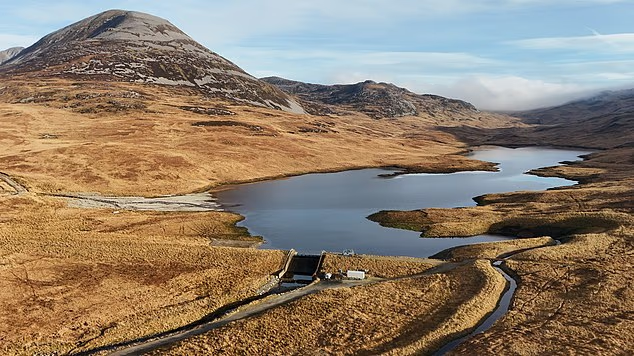
In one case, Inver Hydro on the Isle of Jura was issued with a new demand last Thursday for over £330,000 – with £157,000 of that to be paid by November 7.
The bills are a blow for the SNP Government’s net zero drive as hydro generation is a renewable, low-carbon power source with no greenhouse gas emissions during operation.
The shock bill for Inver Hydro is £269,000 more than the small island business had budgeted for rates between now and the end of the financial year in April next year.
Inver was told the additional charge would not be pursued if it withdrew its appeal against a 2023 valuation.
Owner John Lithgow said: ‘We’ve played by the rules, paid our bills, and pursued a lawful appeal.

Inver hydro-electric scheme on the isle of Jura in the Inner Hebrides
‘To be sent a retrospective top-up bill of over a quarter of a million pounds and told to pay up in a matter of months – and then told it goes away if we drop the appeal – is intolerable.
‘It is nothing short of extortion and is bullying of the worst kind.
‘Our small business is a success story within a fragile rural economy. Inver’s generation ensures energy security and has proved vital to keeping the island’s lights on when the local network failed.
‘This kind of goalpost-shifting puts locally owned renewable energy and small Scottish businesses at risk and it is totally unacceptable behaviour by a public office.’
Inver is currently building a solar project to better utilise the existing hydro scheme’s available Grid capacity and ensure renewable generation continues in the drier months.
The project will be the UK’s first hybrid solar and storage hydro scheme and is due to come online early next month.
Mr Lithgow said: ‘We are doing our bit for the island economy and for Net Zero, we continue to invest for the future, but it feels like some would rather see us punished for our efforts.’
Alba Energy claimed the change had been applied selectively to firms challenging valuations, meaning those exercising their right to challenge those made in 2023 valuations are being hit with even higher bills.
Alexander Linklater, executive director of Alba Energy, said: ‘In the middle of litigation, the Assessor has declared a brand-new way to value hydro, then re-issued historic rateable values and extra bills for 2023–2025.
‘Applying this only to schemes with appeals is punitive in effect.
‘For years, hydro schemes have been over-valued by the Assessors compared to onshore wind and other energy generators and this latest manoeuvre makes an already unjust position much, much worse.’
Alba Energy said the retrospective bills should not have been issued while legal proceedings are under way and has written to Ivan McKee, Minister for Public Finance, to request a pause on the timing of payment until a resolution has been reached.
In its letter, Alba Energy states: ‘No warning or justification was provided by the Assessors.’
Kate Gilmartin, chief executive of the British Hydropower Association, the trade body for the sector across the UK, said: ‘This isn’t just about rates — it’s about fairness.
‘Hydropower operators are facing opaque decisions and retrospective bills with no accountability.
‘We need transparency, proportionality, and ethical oversight before this becomes another case study in systemic governance failure.’
A sector-wide dispute over the 2017 revaluation reaches the Upper Tribunal in Edinburgh next month, before Lord Young.
More than 85 per cent of the UK’s hydropower is located in Scotland.
Most small hydro is designed in Scotland, developed in Scotland, engineered in Scotland and built in Scotland.
Mr Linklater said: ‘Unlike wind power small hydro it is mostly owned and operated by Scots.
‘We are not leased out to foreign companies.
‘Yet the message from Scottish Assessors is, “If you want to build green businesses in Scotland, we will punish you for the impertinence”.’
The Scottish Government sets non-domestic rates while councils administer and collect them.
The Scottish Assessors’ Association (SAA) represents land valuation assessors, based at councils, and their senior staff in Scotland.
An SAA spokesman said: ‘There is a statutory appeal process to challenge a Valuation Roll entry and it would not be appropriate for the SAA to comment on an ongoing legal case.’