Australians are visiting Japan in record numbers with some falling so hard for the Asian nation that they’re putting down roots and buying property.
Brisbane-based buyer’s agent Tatsuya Hioki told news.com.au he has been “extremely busy”.
“Rather than property investors, most of them are families looking to use the property as a holiday home,” he told news.com.au.
Mr Hioki, who runs buyinghouseinjapan.com.au, said his clients range from those wanting to buy one of Japan’s many old abandoned and vacant houses, known as akiya, to those seeking urban apartments.
“In the case of older akiya, many buyers purchase them at extremely low prices with the understanding that they’ll need to handle leftover belongings and carry out renovations,” he said.
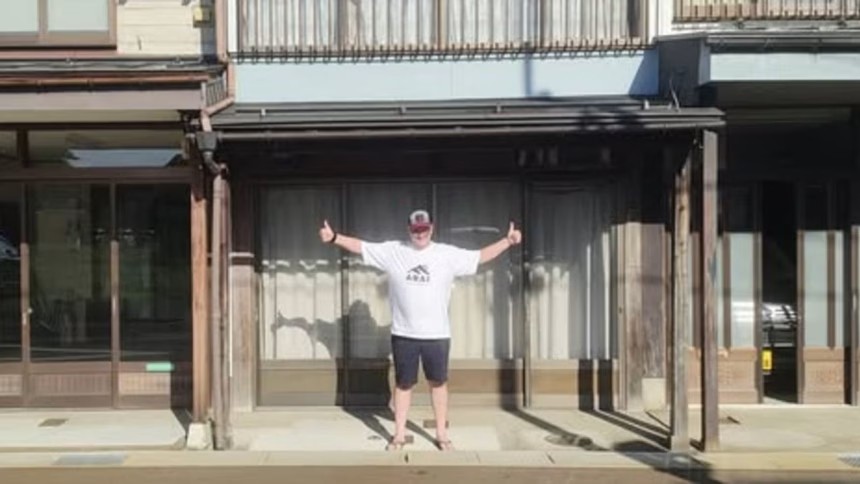
Anthony Randall, a 52-year-old urban planner from Wollongong, snapped up a two storey, three-bedroom vacant house in Japan’s Niigata Prefecture for just $5000 earlier this month.
“I don’t own a property in Australia and it’s just unreachable to buy something unless I want to keep working until I’m 80, which I don’t really want to do, and so when I turned 50 I thought I’m going to buy a house in Japan and started saving and researching,” Mr Randall told news.com.au from his new place in Joetsu.
MORE: Countries that will pay Aussies $140k to move there
While foreigners can fairly easily buy property in Japan, even as a tourist, it’s not a pathway to permanent residency. They need to obtain a visa to live there long-term.
“Even being able to live here part of the year is an attraction – coming and skiing and snowboarding,” Mr Randall said, who first visited the country in 2001 for a three-month homestay. “It’s really good for the spirit and your wellbeing. If that’s the most I can get out of the property, that’s a win for me.”
Ideally, he’d love to eventually move there one day.
MORE: Australia’s most undervalued and overvalued suburbs
Mr Randall’s “new” house is almost 100 years old but “completely functional,” and he guesses was renovated around the 1970s.
“From the outside and the inside it doesn’t present as a 96 year old house,” he said.
While the actual house was priced at only $5000 and stamp duty was an unbelievable $2, paid in cash, there are “hidden costs” that come with buying one of the millions of vacant homes in Japan.
Mr Randall said the house ended up costing more like $20,000 when including all the fees, the cost of a buyer’s agent and waste removal – which was almost as much as the house itself.
Having sat empty for 10 years, the abandoned property came with “bags of clothes, photographs, shoes, handbags”.
“You wouldn’t believe the things I found in hatches and hidden places,” Mr Randall said, adding that he held on to what he thought might be useful but most of the belongings had to go.
He was able to fit out his kitchen with sake sets and Japanese plates and bowls, which were wrapped in tissue paper and appeared to never have been used.
On top of the costs associated with buying the property and clearing it out, Mr Randall needs to install heating and is bracing for the possibility the house, which uses a septic system, may be required to be connected to the public sewer system.
“I’m quite pleased that it was $5000 because all these costs have all crept up and a lot you can’t predict. Had I bought a $40,000 house, I’d be in trouble,” he said.
There were more than 9 million akiya as of October 2023 (almost 1 in 7 of all houses), according to government figures announced last year. Other research estimates the number could actually be a lot higher.
A declining population has resulted in an oversupply of housing. Meanwhile, migration from rural to urban areas and younger generations not wanting the old homes they have inherited has meant many properties across the country are abandoned.
Mr Randall said there were empty houses everywhere in Joetsu, including one right next door, which he believes is why the community has welcomed him with open arms and is happy to see some life breathed back into the area.
He has shared meals with the locals and they’ve helped connect him with local contractors.
“In the first seven days I made friends at the bar and they’re still all my friends and helping me,” he said.
“The neighbours were the other worry and I met both neighbours on the first visit and introduced myself in Japanese and spoke to them, and the feedback I got from them was that they were more than happy I am here and that I’ve bought the property.
“The neighbours across the road who run a barber shop have taken me in like a son.”
Even though Joetsu is not a major city, with a population around 200,000, Mr Randall said he can be at his Japanese house within about two and half hours of stepping off the plane thanks to the bullet train.
But Mr Hioki said it’s not just abandoned homes Australians can buy for a fraction of the cost of real estate in their own country.
“In urban areas, another client purchased a three-bedroom apartment in Nishinomiya, Hyogo Prefecture, for about ¥25 million (about $250,000),” the buyer’s agent said.
“In regional Japan, you can even build a brand-new house from scratch for around ¥40 million (about $400,000).
“I also own a home in Australia, and the price difference between the two countries is truly staggering.”
Some of Mr Hioki’s clients will rent their properties out to other tourists on Airbnb when they’re not in Japan themselves.
Mr Hioki said there was a trend in the 2000s of affluent buyers investing in Niseko — the most famous ski resort area in Japan — but since then, the prices there have risen to “almost Australian levels”.
“More recently, I’ve noticed growing interest among ordinary consumers — not just ski and snowboard enthusiasts — who want to own affordable properties across Japan as a base for travel,” he said.
The most popular regions are Niigata, Hiroshima, and Wakayama Prefectures, Mr Hioki said.