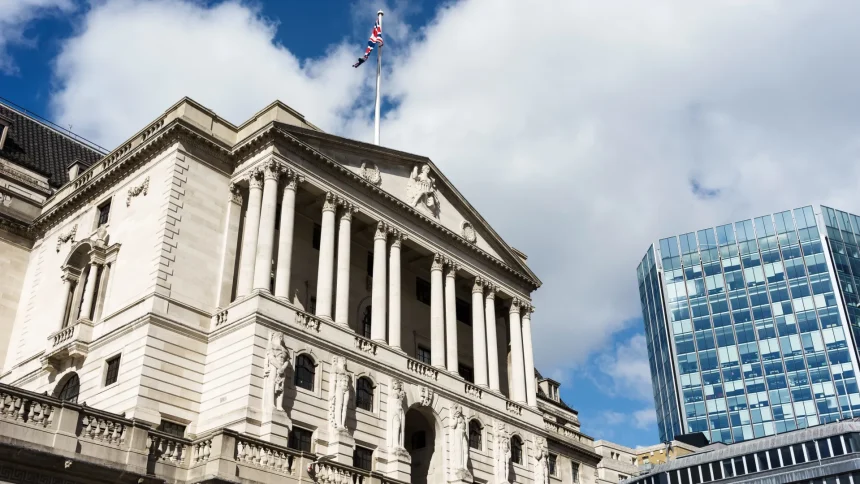
INTEREST rates are expected to fall below 4% next week – the first time since January 2023 – according to a major investment bank.
The Bank of England’s (BoE) Monetary Policy Committee (MPC) voted to keep the base rate steady at 4% last month, but analysts at Goldman Sachs expect a cut to 3.75% on Thursday.

This would be the sixth cut in a little over a year, though they expect a tight 5–4 vote in favour.
The investment bank said in a memo to clients that inflation has fallen more than anticipated, pointing to an unexpected drop in food prices last month even as the headline CPI rate remained at 3.8%.
However, Goldman also warned that the upcoming November 26 Budget is likely to slow the economy, as higher taxes are expected to leave people with less money to spend.
This leaves the Bank of England with a difficult challenge, as it must balance its 2% inflation target with the need to support economic growth.


Keeping the base rate high helps to curb inflation.
When rates are high, borrowing is expensive for both households and businesses – think mortgages and company loans – which encourages saving rather than spending.
This reduced spending power cools down the economy, slows demand, and helps stop prices from rising so rapidly.
However, the reason for considering a cut is to support the economy, which Goldman warns is set to slow down.
Cutting the base rate makes borrowing cheaper.
This can encourage people to spend and businesses to invest, pushing more money into the economy and helping to boost growth.
Goldman said that likely tax measures in the November Budget 26 would act as a “contractionary” force on the economy, strengthening the case for an earlier rate cut.
It expects freezes to tax thresholds, new gambling taxes, tighter anti-avoidance rules and changes to pensions and property taxation, which it says could trim demand by a further 0.3% over the coming years.
The Japanese investment bank Nomura also predicts a rate cut next Thursday, and investors broadly expect the same.
This move would bring welcome relief to many homeowners, as a cut in the base rate typically leads to lower mortgage rates.
Those on tracker or standard variable rate mortgages would likely see their monthly payments fall almost immediately.
Anyone on a fixed-rate mortgage will not see any change in their payments until their current deal expires.
However, lenders have already been slashing the price of new fixed deals this week.
Brokers say this is in anticipation of the upcoming Budget as banks try to gain market share before the Chancellor makes her announcements.
While new fixed-rate deals may become cheaper, the news of a base rate cut is less positive for savers, as interest paid on easy-access accounts is likely to slip.
Some fixed-rate savings deals might remain competitive, but this will depend on whether banks continue to fight for customer deposits.
Mortgage price war this week
Santander, NatWest, Barclays and HSBC have all cut their rates in the past week, sparking a mortgage price war.
On Monday, Santander cut its fixed rates for homebuyers and people remortgaging by up to 0.36%.
NatWest cut its deals by 0.21% this week, while HSBC and Barclays have also cut rates.
Most of the deals that have been cut are two-year fixes, with Barclays cutting its lowest two-year fixed rate from 3.92% to 3.86%.
HSBC also cut its lowest two-year fix for someone remortgaging from 3.99% to 3.92%.
NatWest is currently offering the cheapest two-year fix at 3.77% – down from 3.94%.
It’s available at up to 60 per cent loan-to-value (LTV), with a £1,495 fee.
Mortgage brokers have hailed the news “welcome relief” for borrowers, but urged them to lock down deals ahead of Rachel Reeves’ Budget next month.
Jack Tutton, Director at Fareham-based SJ Mortgages, said borrowers should act now ahead of the Budget on November 26.
“Lenders are ramping up the rate war ahead of the budget to gain market share before the Chancellor makes her announcements,” he told The Sun.
“All of which is great news for homeowners whose mortgage deal is coming to an end in the next six months.
“As it’s been for a while, it’s still best to secure a new deal at your earliest opportunity providing the lender will consider changing your product should the market improve.
“This gives you a worst case scenario for your mortgage moving forward, plus it protects you should the budget have a negative impact to our financial markets.”
Ben Perks, Orchard Financial Advisers managing director, added: “Lenders are starting to fight for business ahead of the Budget announcement.


“It’s widely thought that the Chancellor could bring in changes that stifle the property market, so lenders are reducing to try and increase lending ahead of this.
“Hopefully more lenders join this scrap for business and borrowers will see a selection of slightly improved rates.”
How to get the best deal on your mortgage
IF you’re looking for a traditional type of mortgage, getting the best rates depends entirely on what’s available at any given time.
There are several ways to land the best deal.
Usually the larger the deposit you have the lower the rate you can get.
If you’re remortgaging and your loan-to-value ratio (LTV) has changed, you’ll get access to better rates than before.
Your LTV will go down if your outstanding mortgage is lower and/or your home’s value is higher.
A change to your credit score or a better salary could also help you access better rates.
And if you’re nearing the end of a fixed deal soon it’s worth looking for new deals now.
You can lock in current deals sometimes up to six months before your current deal ends.
Leaving a fixed deal early will usually come with an early exit fee, so you want to avoid this extra cost.
But depending on the cost and how much you could save by switching versus sticking, it could be worth paying to leave the deal – but compare the costs first.
To find the best deal use a mortgage comparison tool to see what’s available.
You can also go to a mortgage broker who can compare a much larger range of deals for you.
Some will charge an extra fee but there are plenty who give advice for free and get paid only on commission from the lender.
You’ll also need to factor in fees for the mortgage, though some have no fees at all.
You can add the fee – sometimes more than £1,000 – to the cost of the mortgage, but be aware that means you’ll pay interest on it and so will cost more in the long term.
You can use a mortgage calculator to see how much you could borrow.
Remember you’ll have to pass the lender’s strict eligibility criteria too, which will include affordability checks and looking at your credit file.
You may also need to provide documents such as utility bills, proof of benefits, your last three month’s payslips, passports and bank statements.