“A land of contrasts” is probably the most tired cliché in travel writing. It also happens to be true of most countries. When it comes to economic matters, there are few places in the world today where contrasts are as noticeable as those in China.
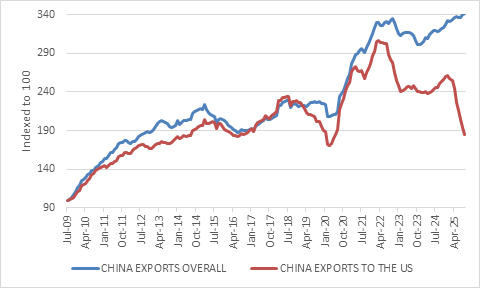
To name but a few: exports to the US have plunged in the face of steep import tariffs, yet overall Chinese export performance is stellar. China has some of the lowest interest rates among major economies, but borrowing growth is stalling. Though officially a communist country, competition in some industries is fiercer than anywhere else.
Read:
Even as it astounds the rest of us with its technological capabilities, sentiment among ordinary Chinese seems depressed. In contrast to that despondent mood, Chinese equities have put in one of the strongest performances in the world this year.
Despite maintaining economic growth rates South Africa can only dream of, there is consensus that a new growth model is needed.
Let’s tackle these apparent contradictions and the underlying themes that unite them.
Starting with trade, tensions recently resurfaced with Beijing announcing export restrictions on rare earth elements and US President Donald Trump threatening massive new tariffs on China, before things calmed down. Negotiations are underway again, and Trump and Chinese leader Xi Jinping are still scheduled for a face-to-face meeting in Korea this week.
Read: Here are the key US-China issues to watch in Trump-Xi summit
Stepping back from this, two points stand out: both countries are trying to reduce dependence on one another and increase self-reliance. And it won’t happen overnight, if ever.
Each country has pain points that the other can exploit.
Such as the fact that China is by far the biggest source of rare earths, which are low-cost but essential ingredients for electronics, planes and defence systems. Meanwhile it needs US high-end semiconductors.
Ultimately, an uneasy truce is likely where the two giants continue to trade but also keep looking for alternative sources of supply and demand.
China export values
Source: LSEG Datastream
China is making strides on both fronts. On the demand side, its exports to other countries have more than offset lost sales to the US, though this is likely to include a fair degree of exports rerouted through other countries to avoid US tariffs.
The country continues to move up the technological ladder, including developing its own supply of homegrown semiconductors.
ADVERTISEMENT
CONTINUE READING BELOW
Gone are the days of China only producing plastics, toys and textiles. Today it leads in drones, robots, solar panels and more.
Read:
It became the biggest car exporter in the world in 2023, driven not by manufacturing on behalf of US, European and Japanese brands, but through its own homegrown brands.
Similarly, though Chinese factories still produce the iPhone on behalf of Apple, Chinese cellphone brands are growing in global reach. This is significant, since being an outsourced producer for a foreign company means basically only manufacturing jobs are created in China. On the other hand, Chinese brands like Huawei and Xiaomi employ many white-collar workers in design, engineering, marketing, finance, legal and more on top of factory jobs.
Involution
Yet despite these achievements – and they are truly impressive – one can have too much of a good thing.
In many product lines, there are too many firms, leading to excess capacity and cut-throat competition. The government calls this problem “involution” and is looking for ways to address it.
Ironically, the overzealous expansion of these firms is often due to government directives in the first place, usually driven by local or regional officials. The net result is razor-thin profit margins and price cuts to eke out sales. It means the wait for dividends and bonuses by shareholders and employees respectively is very long.
Eventually, there must be consolidation, and Beijing is urging this, though it will include bankruptcies and layoffs, making it a far from a painless process. Faced with domestic oversupply, these firms also have no alternative but to look for export markets.
Economic growth in China
Source: LSEG Datastream
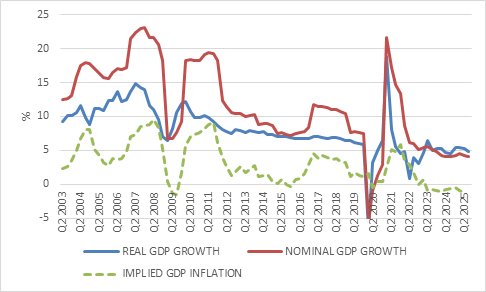
Despite these challenges, China’s real economic growth rate has held up well around 5%, though it is clearly lower than during the pre-Covid years.
Look closely at the chart above, however, and it will become apparent that it has been higher than the nominal growth since 2023.
Nominal growth includes inflation and should therefore normally be higher than real growth.
To use the analogy of a company, sales revenue growth is usually higher than volume growth. This implies the economy is experiencing deflation resulting from industrial overcapacity and soft household demand.
Deflation also implies weak growth in incomes, company profits and tax revenues. This means it is particularly pernicious in an economy with high debt levels, as is the case in China.
ADVERTISEMENT:
CONTINUE READING BELOW
Those high debt levels also mean there is little appetite for new borrowing even though the People’s Bank of China has cut interest rates.
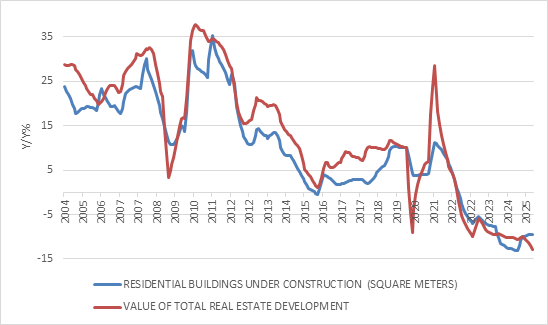
China real estate development activity
Source: LSEG Datastream
A big part of the story is the implosion of the property bubble that continues to reverberate throughout the Chinese economy.
Real estate investment remains well below 2021 levels, when the government introduced the “three red lines” policy intended to curb excesses in the sector but triggered a collapse instead.
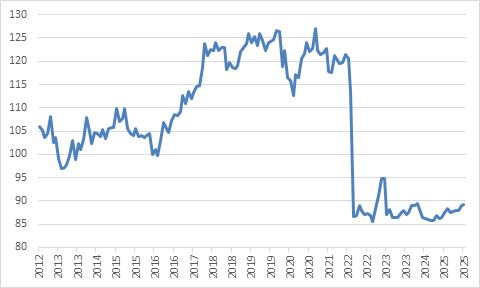
The consequences have been profound. Not only was property development the major growth driver of the economy for many years, but property ownership was also the main store of wealth for Chinese households.
Falling house prices have therefore weighed on consumer confidence. With a shrinking population, it is not a given that prices will ever fully recover.
China’s consumer confidence index
Source: LSEG Datastream
The stock market was basically seen as a sideshow by the serious people in Beijing and prone to speculative behaviour.
With ample credit available in the banking sector, firms did not necessarily need the stock market to raise capital. However, policymakers appear to have had a change of heart on the role the equity market can play, as China analyst Dinny McMahon has argued.
Firstly, to fund the sort of innovative companies the government wants to encourage, bank credit is not enough. Equity funding, both private and public, will need to be part of the mix.
Secondly, in the wake of the burst property bubble and given the low-interest rate environment, households need an alternative wealth creation mechanism. Rising household wealth can in turn raise spending levels.
Thirdly, equity markets can play an important role in China’s underfunded pension system, especially given that low interest rates actuarially increase the long-term obligations of pension funds.
ADVERTISEMENT:
CONTINUE READING BELOW
Read: Xi signals China may finally move to end deflationary price wars
For these reasons, policymakers have recently taken steps to clean up governance at listed firms and brokerages and are trying to build trust in a market once widely derided as a casino, for instance by encouraging higher dividend payments and share buybacks, and increasing the role of long-term institutional investors such as insurance companies.
As the state-owned Economic Daily newspaper noted, “it is necessary to take measures to increase market activity, and push stocks toward a ‘slow bull’ market”.
In other words, the kind of market where equity values rise over time as they do in the US or South Africa. Even though there are hiccups along the way, investors in these countries have enough trust in the market to put a sizeable portion of their savings into it.
Beijing has engineered rallies before and they’ve tended to fizzle out, most recently in September 2024. This appears to be a different approach.
Instead of trying to push up share prices by pumping money into the market, it is about creating the conditions where share prices will naturally rise over time.
If they get it right, there will be a feedback loop between companies raising capital and putting it to productive use, growing their profits and paying more taxes to the state and dividends to the shareholders, and rising share prices that will leave Chinese households better off – the way it works, or is supposed to work, elsewhere.
Read: Rare earth controls, Hong Kong market surge, and US policy turbulence
This will not necessarily be easy and represents a bit of a chicken and egg situation. Sustained price gains will require a broader investor base that grows over time, but those potential investors also need to gain trust in the market, and the best way to do this is through steady price gains over time.
In summary, China has not resolved its economic contradictions, but it is trying to find a way through.
It wasn’t that long ago that China was considered uninvestable due to policies seen as unpredictable and unfriendly to shareholders. There will always be questions about policy certainty, but the uninvestable label is unhelpful for foreign investors, particularly those outside America that don’t have the sense of direct geostrategic competition.
Read: China: New year, new opportunity?
The transformation of the world’s oldest living civilisation continues and there will be challenges ahead. But there will also be opportunities for investors who can be comfortable with contrasts.
Izak Odendaal is an investment strategist at Old Mutual Wealth.
Follow Moneyweb’s in-depth finance and business news on WhatsApp here.