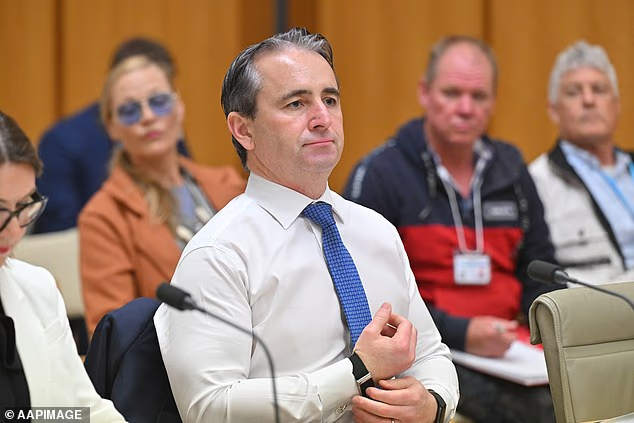
The boss of Australia’s biggest bank has called for significant migration cuts to help lower property prices and address Australia’s housing shortage.
Commonwealth Bank chief executive Matt Comyn wants Australia’s migration numbers to fall by more than 80,000 per year in a bid to boost housing affordability.
In the year to March, net overseas migration added 315,900 to Australia’s population, down from the 2023 record of 518,000 migrants.
Mr Comyn, who made the bold statement during a federal parliament committee hearing on Tuesday, said ‘having a predictable level of migration would help housing supply and infrastructure keep up with demand’.
‘Perhaps that number is something in the order of 180,000 per annum,’ Mr Comyn told the committee.
‘It gives both the Commonwealth and states the ability to plan for critical infrastructure, including housing.’
Mr Comyn admitted having an ‘ambitious or aspirational target may at times be politically unwise’ but said it was ‘ultimately a good thing’.
‘I think having a target is important,’ he said.

Commonwealth Bank boss Matt Comyn told a parliamentary hearing n Tuesday that Australia’s migration numbers should drop by more than 80,000 per year

Prospective buyers line up for an Australian property auction
The Commonwealth Bank boss added that ‘increasing supply is also key to improving housing affordability’ but noted that ‘there were barriers to doing so’.
‘You need a lot of coordination between the federal and the state level,’ he said.
‘I think the availability of labour, of skilled labour in and around multiple sectors, including this one, is challenged.’
Mr Comyn gave his personal views after the Albanese government forecast migration to fall to 260,000 this financial year.
Migration is then predicted to drop to 225,000 in 2026-27 and stay at those levels for the remainder decade.
Opposition Leader Sussan Ley has already promised to slash migration levels by more than 100,000 a year if elected.
However, Labor does not have a migration target.
Mr Comyn also responded to the federal government’s extended eligible first homeowner’s five percent deposit scheme after critics proclaimed the initiative was pushing up property prices.
He said the policy was only a ‘very, very small element’ of the current growth in prices.

Many first home buyers feel priced out of Australia’s property market
The bank boss’ comments come after an Afghan family who bought a $1.5 million Sydney home sparked online backlash.
The immigrants bought the four-bedroom property in Guildford, in the city’s west, at an auction in October and were congratulated by The Block auctioneer Tom Panos, who described them as a ‘wonderful family’.
But their happy moment was quickly soured after a number of Aussies questioned how immigrants from a poor nation could afford to buy a house in Sydney.
Mr Panos said the disparaging comments exposed the deep-rooted anger many Aussies feel about being priced out of the property market.
‘A family from Afghanistan, one of the poorest nations on Earth, where 85 per cent live on less than a dollar a day just bought a $1.5million home in Guildford. So how does (an) immigrant from Afghanistan afford a million-dollar property in Western Sydney?’ one person wrote on X.
‘In theory, these are refugees fleeing hardship. Yet in practice, they’re entering one of the world’s most inflated housing markets and somehow outbidding Australians who’ve spent their entire lives here.’

The Block auctioneer Tom Panos, who described stuck up for an Afghan family who bought a house in Sydney
‘What the f*** man? I’m born and raised in Australia and bust my a**e across two jobs, my wife has a great job, we pay an obscene amount of tax and we are jumping through so many hoops to afford a house in Adelaide that (is) less than half the price of this one. It’s bulls***,’ another posted.
Mr Panos said the demeaning comments were not surprising as the property market becomes increasingly more ruthless and demanding.
The auctioneer added that the comments were less about racism and more about an overall frustration with Australia’s housing crisis.