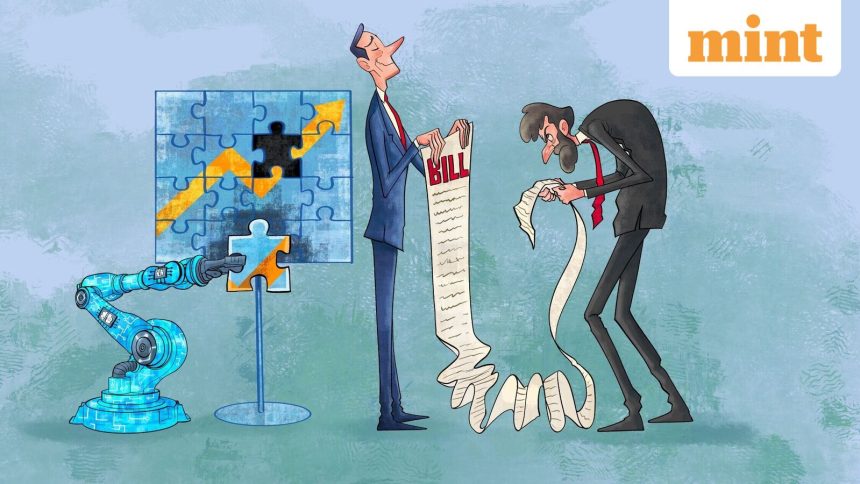
Deloitte’s member firm in Australia had been tasked with reviewing the country’s welfare system, which had been facing flak for wrongly penalizing welfare recipients and jobseekers. The Deloitte team submitted a 237-page review last December. After the department of employment and workplace relations published the review on its website in July, University of Sydney academic Christopher Rudge pointed out that it was riddled with errors. And then, hell broke loose for Deloitte.
It turned out that Deloitte had relied on AI to compose the report. The AI hallucinations that followed, including mentions of non-existent academic research papers as well as a fabricated quote from a court judgment, sparked an uproar in Australia.
They “misused AI and used it very inappropriately: misquoted a judge, used references that are non-existent… I mean, the kinds of things that a first-year university student would be in deep trouble for,” thundered Australian senator Barbara Pocock during an interview with the Australian Broadcasting Corporation, coming down hard on the incompetency displayed by the consultancy in the report.
Subsequently, a revised version was quietly published. After reviewing its review, Deloitte had admitted that “some footnotes and references were incorrect,” the department of employment said in a statement on 3 October. The new version disclosed that Azure OpenAI, a generative AI (GenAI) language system, was used to create the report. The report published in July had no such disclaimer.
According to the Australian Financial Review, Deloitte also agreed to refund the Australian government a part of the A$439,000 (US$290,000) it had been paid for the review. Incensed by the scale of its ineptitude, senator Pocock called on the consultancy to refund the entire amount.
A partner at Deloitte India, who didn’t want to be identified, told Mint he was not in the least bit surprised by the events that played out in Australia. “We were shocked when the news came in. But it was not surprising because despite repeated reminders, there is a whole set of consultants who are coming up with strategies based on what AI is throwing up,” he said, not pulling any punches on the home team.
Deloitte India didn’t officially respond to queries from Mint, nor did Deloitte Australia.

View Full Image
The fiasco was a wake-up call for the consulting industry, which has increasingly begun leaning on AI to get an edge. Major names in the business have invested billions of dollars on the technology to stay ahead of the competition in a bid to speed up turnaround times for the advice and audit services they offer clients.
The Deloitte debacle has also put the spotlight on whether the work done by expensive consultants—charging hundreds of dollars per hour—is justified. How strong is the dependency of these consultants on AI? And if they come to client meetings and pitch their case study analyses, complicated presentations and customized business models based on what AI tools have produced, will the consulting sector remain relevant a few years from now?
The business model
A consultant’s primary job is to be a client’s problem-solver and influencer in decision-making. If a company wants to enter a new market, the consultant must assess rival players, identify uncatered segments, and present an analysis of the strengths, weaknesses, opportunities, and threats (SWOT analysis) that will ultimately determine whether the company goes forward. Consultants map out succession planning, leadership training, and cost optimization in certain businesses. Some even offer auditing services.
The ‘Big Four’—KPMG, Deloitte, PwC and EY—are heavily involved in both auditing and consulting. Boston Consulting Group, McKinsey & Co., Bain & Co. and Accenture are the other industry giants.
The war to win a client’s business is fierce for the men and women in the business, who seem to be always dressed in suits, irrespective of the weather.
 ₹40,000 to several lakhs for 60 minutes of a partner’s time.” title=”In India, depending on the project, advisors can charge anywhere from ₹40,000 to several lakhs for 60 minutes of a partner’s time.”>
View Full Image
The consultants, along with their teams, pitch for projects, quote their fees and, once they bag a project, put in long hours in discussions and planning. In India, depending on the project, advisers can charge anywhere from ₹40,000 to several lakhs for 60 minutes of a partner’s time. Indeed, clients can end up shelling out ₹40,000-50,000 per day for junior consultants to ₹6 lakh per day if partners are involved, depending on the size of a project.
Typically, business houses work with a host of consultants and non-disclosure agreements are signed to ensure both parties are protected.
It’s a profession that pays well. Compensation in the consultancy industry can start from ₹15-20 lakh for first-year graduates and can go up to ₹4-5 crore depending on the partnership model. Practice heads earn more.
Consultancies recruit talent from leading B-schools, as well as from companies in other sectors.
It’s an industry that is growing at a fair clip. “The India management consulting services market size is valued at $8.31 billion in 2025 and is forecast to reach $15.25 billion by 2030, advancing at a 12.91% CAGR (compound annual growth rate),” research and advisory firm Mordor Intelligence stated in a report.
But AI could upend those calculations.
The AI imperative
Today, almost every consulting and audit firm uses AI tools—either built in-house or public ones such as ChatGPT and Gemini—to generate summaries, conduct research and sift through case histories. McKinsey told Mint that it is “moving fast” to integrate “GenAI into everything that we do.”

View Full Image
GenAI can create audio, video and text from existing databases with a few prompts. McKinsey claims “93% of our colleagues” have used its proprietary AI platform, Lilli, and “72% use it monthly.” The firm notes that Lilli has saved the consultancy two-three million hours across active users.
“Our colleagues have created thousands of [AI] agents, a sign of the enthusiasm and speed with which we’re innovating and experimenting. We expect time savings from our top agents of 20,000–34,000 hours per year for our consultants,” McKinsey said in its response to Mint’s queries.
Time, in consulting parlance, equates to money—because every second a consultant works on a project, the client is billed.
KPMG, another of the Big Four, also uses AI. “We’re training our people to use AI responsibly—knowing when and how to apply it, how to be transparent about its use, and how to critically review outputs before they’re shared with a client,” a representative for the consultancy said.
More than a third of Bain’s client work in India is related to AI. “We’ve developed more than 15 proprietary AI tools and 200-plus innovations internally,” said Shyam Unnikrishnan, managing partner, India, Bain & Co.
PwC, EY and Accenture did not respond to Mint’s questions.
The impact
On a sunny October morning in Mumbai’s Bandra Kurla Complex (BKC) business district, a senior executive at a diversified conglomerate brought up the Deloitte fiasco during a conversation with this writer and said it had set off alarm bells.
“We work with three top consulting companies and are now asking them to name the people who will be working out of our premises, and their designations. They cannot charge us for junior employees who may depend on AI,” cautioned the executive.
They cannot charge us for junior employees who may depend on AI. — An executive.
The group has also alerted its digital teams to check whether any studies by the consultants are AI-driven. And in the third—and probably most crucial—step, the business house will now sign contracts with consultants based on success rates, not just retainer fees or milestones.
This is where consultants will be hit. So far, clients paid them a portion of fees up front, and the consultants came up with solutions over a few months. But now, companies such as this Mumbai-based conglomerate want consultants to receive full payment only after a project is implemented and successful.
“I want to see measurable outcomes, and I am willing to pay ₹20-30 crore to the advisers, but I want to see consultants who use AI to augment, not replace, their work,” the executive cited above told Mint.
The fear of AI misuse in consulting services is consuming the industry. On 13 November, more than 200 partners of tax, legal and audit consulting firm ECOVIS International were expected to meet in Paris for their annual world meeting.
“Consulting will be transformed forever by AI, and going ahead, consulting firms will have to decide on a framework for how much AI to use—one that specifies limits, confidentiality, and data security,” said Kay Friedrich Thomsen, president of ECOVIS International, when he visited the consultancy’s India office in October.
ECOVIS may not rank among the top consulting firms globally, but it has its own database of company details that clients can access for a fee. For $100, a client can get a detailed report on an organization. Other packages, ranging from $600-$4,000, offer full assessment services.
The consultancy’s bigger rivals have built similar repositories. “The teams use the database for research, but we ensure the cases are ones the company has worked on before. Otherwise, there’s always the fear of AI hallucinations,” said a senior partner at EY who didn’t want to be identified.

View Full Image
No longer the stuff of sci-fi movies, AI agents can now autonomously perform tasks, create workflows and solve problems. But consulting firms insist their clients know exactly how much AI is being used.
Some advisers are even getting employees to read and sign AI usage guidelines as part of their employment contracts. Mumbai-based Dhruva Advisors, which recently received a strategic investment from Ryan Llc, a US-based global tax services and software provider, is one such firm. “About two years ago, we added guidelines on how to use AI in our employee manual, which is given to an employee at the time of signing the employment agreement. Abuse of these guidelines is a red line,” said Dinesh Kanabar, chief executive officer (CEO) of the firm.
Kanabar said Dhruva has 43 partners and over 3,000 clients. The tax advisory company relies heavily on AI for research from its own database, and even brought in an AI expert to train partners on writing better prompts for more accurate results. However, these results must be manually validated and cannot be used as they are, it claims.
The CEO warns that advisory services need to sharpen their specialization skills—or risk becoming disposable. “Generic consultation as we know it will go away, and the rates for that will become zero. But will the consultation market become redundant? No. It will just demand higher intellectual input,” Kanabar said.
Bain claims to have guardrails in place for the responsible use of AI. “We’ve embedded an AI responsible use policy across our teams and offices worldwide,” said Unnikrishnan.
A senior consultant at BCG said that when he goes for client meetings, the deck slides must show which AI tools were used to prepare a presentation. “Clients also use AI now to prepare their questions, and I have to be ready—I cannot blame AI for my error,” he told Mint on condition of anonymity.
A senior consultant at BCG said that when he goes for client meetings, the deck slides must show which AI tools were used to prepare a presentation.
BCG did not respond to queries from this publication.
Interestingly, it’s not just consulting that’s grappling with the extent of AI use and disclosure. The legal sector, too, is under scrutiny for how much of its case analysis is AI-driven versus bespoke work done by its lawyers. Clients of law firms have begun demanding similar clarity on AI-powered tools.
Consulting firms may soon need to conduct a quick SWOT analysis on their own future. Clients now expect more, and the entire suite of services will need customization. AI will remain an integral part of their work—but clients and consultants alike will have to decide how much AI is too much.
The same month that Deloitte released its revised study, B-schools in India saw an influx of consulting firms recruiting students for summer internships. Clients now want more hands on deck as businesses are transformed by AI. It is a tad ironic that the consultancies are expanding their teams because of AI-driven demand—while being questioned on how much of their own work has been done by AI.