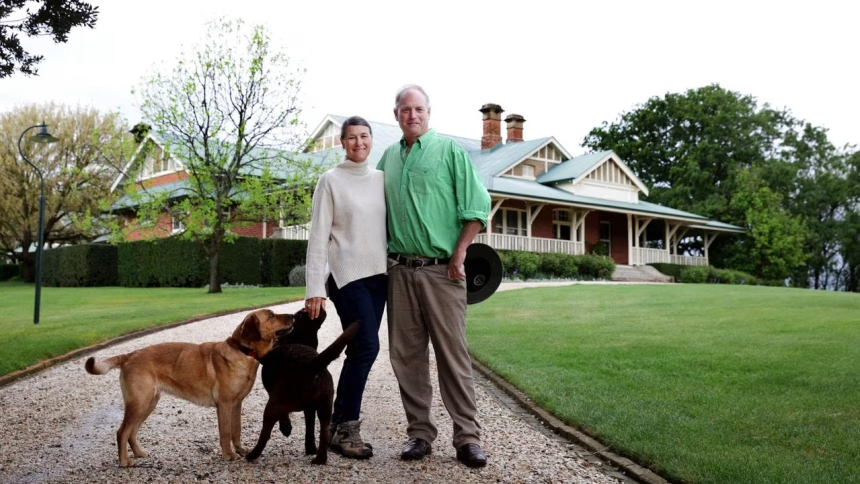
Benangaroo Station, perched above the small township of Jugiong in southern New South Wales, covers more than 3000 hectares of prime Murrumbidgee River frontage.
For generations it was part of the Osborne family estate, one of the Riverina’s best-known pastoral dynasties, before Michael and Angela Field bought the property in 1997.
Michael is a fourth-generation member of the Field family, whose ties to Australia’s pastoral and meat industries stretch back more than a century.
Benangaroo is one of six sprawling properties owned by TA Field Estates – his family’s deeply private pastoral group that is known by very few outside the agricultural sector.
Yet it ranks among Australia’s 50 largest landholders and is one of the nation’s biggest producers of top-quality Merino wool, its products prized by international textile houses such as Botto Giuseppe, an Italian family firm also in its fourth generation.
For four decades the Fields also owned Lanyon, the famed rural estate on Canberra’s outskirts, before it was bought by the federal government for the city’s suburban expansion.
Yet for all its romance, running a property such as Benangaroo as part of a large-scale grazing business in modern Australia has never been more challenging for families such as the Fields, navigating a maze of regulation, compliance and succession issues.
“I think the Australian public appreciates farmers but governments don’t,” Michael Field says. “We are an easy target. I don’t want subsidies, I just want government to get off our back and let us get on with the job. The red and green tape is choking us.
“There is so much coming at us – carbon credits, new employment laws, renewable energy and accounting reforms – and that is before you even get to tax. Our labour is being swallowed up by compliance.
“Of course I want every one of my staff to come home safe, but the big-stick approach means if anything goes wrong, you are guilty until proven innocent. It should not be that way.”
Angela Field also worries that the historic connection between the city and country has been lost in modern Australia.
“People used to have country cousins they would visit during the holidays.” she says. “That doesn’t happen anymore, and it’s sad. The Buy from the Bush campaign was wonderful because it reconnected people. When city people know someone on the land, they feel invested, they want to understand and support them.”
For the Fields, regulation and succession are not separate issues, they are intertwined.
As the business has become more complex, so has the responsibility of passing it on. Their approach to managing succession has been proactive, offering a model that others in the industry could follow.
“I’m fortunate to be the custodian of this business,” Michael says. “I’m running it for my children. When I’m gone, if they don’t want it, sell it. It is not fair to expect them to take it on if they don’t want to. I don’t want them to feel under pressure or obligation.”
The Fields’ eldest daughter, 30-year-old Stephanie, has forged a successful modelling career in New York, Milan and Paris. She even once did a fashion shoot at Benangaroo. Their middle daughter, Laura, 28, has worked as TA Field’s environmental sustainability manager, while their youngest, 25-year-old Tom, studied agribusiness at Marcus Oldham College in Geelong after jackarooing across Queensland and the Northern Territory.
Since turning 18, they have all attended board meetings alongside three external directors Michael values deeply for their “outside opinions”.
He says: “I don’t want to be surrounded by ‘Yes’ people.”
Last Christmas, the children were all formally appointed directors, but none has ever been expected to join the business. Angela admits the scale of it all can feel daunting. “Coming in from outside, I still can’t fathom the scale of the family business, maybe because I didn’t grow up with it,” she says. “I get nervous about spending money, it is a bit scary for the kids too because they don’t want to stuff it up.”
The family’s succession discussions are facilitated by an executive from KPMG. To ensure continuity, Michael and Angela have now prepared a “memorandum of wishes” for the family.
“Talking about succession can be emotional. It is about helping our children decide how they want to be involved in the future while we are still here,” Angela says.
Her husband agrees: “I wanted to start early so everyone knew where they were heading. I lead a pretty dangerous lifestyle – on the road a lot, often driving at night. The kids need to know what the plans are for the future.”
Michael Field’s bond with the land is forged by a century-old family legacy.
In 1885 his great-grandfather, Tom Field, migrated from England and set up as a butcher. His grandfather, TA Field, took over the family business in 1911 and quickly expanded into grazing. By 1916, the family had moved into wool production.
In the 1960s, the Fields were airfreighting chilled beef and lamb to Europe, a bold move that cemented their place among the pastoral innovators of their time. Michael’s mother, Anne, stood six feet tall and was 42 when he was born in 1963. An only child, he did his schooling in Sydney as a boarder. Ten days after finishing his HSC, he was out jackarooing.
“I didn’t want to go straight into the family business,” he says. “I wanted to see how other people did things and experience the world. You can’t come straight back to your own family; otherwise you’re just living in your own dung hill.”
His mother and his father, Ross, were both champion hack riders who won many events at the Sydney Royal Easter Show and other shows over many years.
When Coca-Cola Amatil acquired TA Field Holdings in 1977, the family retained TA Field Estates Pty Ltd and continued to expand their pastoral interests. Michael joined the business in 1989. Working alongside his father was a formative experience.
“Everything was formal, even at the stations. At dinner, everyone wore a coat and tie,” he recalls. “Dad was a gentleman. He never swore, maybe an odd ‘bloody’, nothing more. But when you had done the wrong thing, you knew about it.
“He taught me integrity, morals and honesty. But if you did the wrong thing, that was it. You were done. I admire that, and I try to run things that way too.”
Much of Michael’s childhood revolved around Lanyon. He remembers the day in 1967 when he met American president Lyndon B. Johnson, who visited the property for a lunchtime barbecue and got bogged going for a joy ride around the paddocks.
The Field family’s battle over Lanyon became one of Australia’s landmark property disputes.
The case went to the High Court before the federal government bought the property in 1974 for $3.7m.
“I’ll never forget the last day there, in 1975, when we had to drive out,” Michael says quietly. “That was tough.”
He has been back only once. When he told the staff who he was, they welcomed him with open arms. He still has the front door key.
Michael and Angela met in a Sydney schoolyard before they started dating in 1989. Back then, she knew nothing of his heritage. After they married Michael made the pragmatic but difficult decision, in consultation with his ageing parents, to rewrite his will. It was an experience Angela found confronting. “They wanted me to go through it with them, and I said, ‘Okay, but I don’t want any figures mentioned’,” she recalls. “I got very emotional because you’re talking about the person I’d just married and about his death.”
Michael took over as managing director and chairman of TA Field Estates in 1995, after buying out other family members.
“It got a bit ugly for a while,” he admits. “My cousin and I didn’t speak for a couple of years, but now we are really good mates again. I give both him and my father credit. When there were arguments, they never dragged me into it.”
His father had shied away from debt, but Michael was more willing to use leverage to grow the business. That approach underpinned TA Field Estates’ steady expansion in the decades that followed. Ross Field’s death from lung fibrosis was sudden, just 12 days after his diagnosis. The family say Michael’s mother, who had endured the war years with stoic resilience, never truly recovered from Ross’s death. She lived to 92 but never again attended ballet or symphony concerts. “When Ross died, she said no to everything,” Angela says. “She just shut the gates.”
The family firm’s six properties across NSW – in addition to Benangaroo, they include Aberfeldy at Holbrook, Congi at Walcha, Doughboy Mountain at Ebor, Mobinbry at North Star and Wyvern at Carrathool – support some of the nation’s finest sheep flocks.
TA Field Estates also runs Hereford-Angus cross cattle and dryland cropping, and manages significant water rights across the Riverina. Michael’s leadership philosophy for the company has always been simple.
“I use a little model I call the SCS – staff, country, stock – in that order of priority. If we don’t have good staff, we cannot run this business,” he says. It is a philosophy reflected in loyalty. Many of TA Field Estates’ employees have stayed for decades.
The Fields’ guiding philosophy is that if they don’t care for the land, they don’t have a business.
Their properties continue to be central to Field family milestones. At her October wedding in Sydney, Stephanie’s gown featured flowers made from wool from the Congi property, spun and woven in Italy. The suits worn by her father and her husband, Andrew, were also crafted from Congi wool. Guests dined on lamb from Aberfeldy. The ceremony took place at St Mark’s Church in Darling Point, with which Michael’s parents had a long association.
Five vintage Land Rovers ferried the bridal party, a nod to the family’s rural heritage. The brakes failed on one, the clutch on another, but for the Fields, connecting the country to the city on their daughter’s wedding day, was worth the angst.