

Here are key updates on New Castle County’s updated property tax bills
Delaware’s highest court ultimately upheld state efforts to reduce school tax bills in New Castle County by charging separate rates. What now?
The Delaware Supreme Court has upheld state lawmakers’ efforts to reduce school tax bills for residential property owners in New Castle County, perhaps putting some finality on this year’s extraordinarily odd school district taxing season.
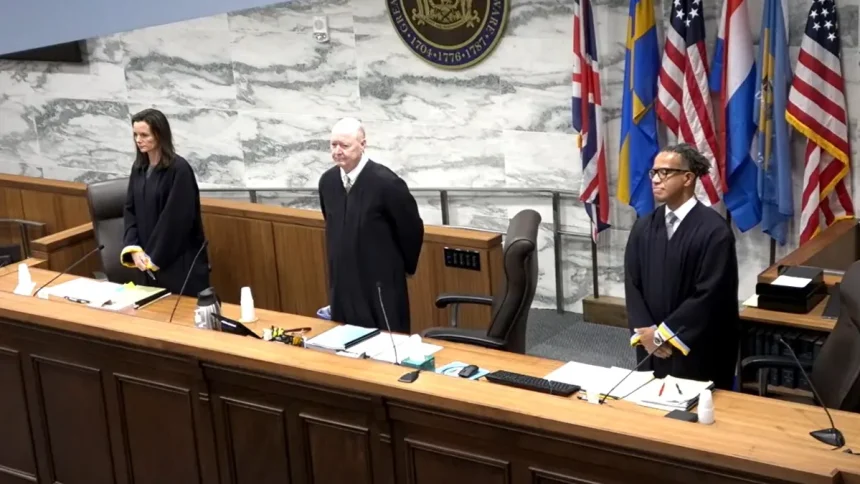
In an opinion issued Nov. 12, a panel of three justices of the state’s high court upheld a Court of Chancery ruling issued two weeks ago. That ruling had rejected complaints from local business interests that school districts’ plans to charge different property tax rates for residential versus non-residential property this year was unconstitutional.
The ruling clears the way for the county to finally issue school property tax bills with the split rates. Those taxes are currently due in the coming weeks, but lawmakers are expected to extend that deadline in a special session to be held Nov. 13.
The ruling caps what has been a strange taxing season in New Castle County, the first since a statewide reassessment of the property values combined with local taxing rates to determine individuals’ bills.
Supreme Court arguments: Will arguments over your school tax bill for this year sway Delaware Supreme Court justices?
Economic changes since that last reassessment in the ’80s shifted more tax burden onto residential property owners, increasing more than half the post-reassessment residential property tax bills. The county previously issued school tax bills without split rates earlier this summer.
Public outcry leading from the higher-than-expected residential bills sent state lawmakers into a special session in August. Their solution was legislation allowing school districts to charge different, higher tax rates on non-residential property this year.
The idea, known as split rates, was to charge business properties more, cut residential payers a break and restore some of the pre-reassessment share of the tax burden.
But a coalition of landlords, hotel owners and other lodging businesses sued school districts, county and state officials in September, claiming split rates were unfair, went against the state’s constitution and would cause them to hurt their rent-paying tenants.
After expedited litigation in Delaware’s Chancery Court, a judge rejected their arguments and upheld the split rates in a ruling issued Oct. 30. That ruling was subject to expedited arguments before three justices of Delaware’s high court on Nov. 10, leading to the Nov. 12 ruling.
Editor’s note: read the full Supreme Court opinion at the end of this story.
What the ruling states
The plaintiffs’ appeal focused on two issues.
The first is the uniformity clause in Delaware’s constitution, which requires: “all taxes shall be uniform upon the same class of subjects within the territorial limits of the authority levying the tax.”
The plaintiffs argued charging different rates for residential versus non-residential property violates that tenant. The Chancery Court ruling rejected that, finding that the language allows lawmakers to make classifications within the tax base and that they did so in a rational way.
The high court agreed.
“The plain language of this provision does not restrict the taxing authority’s ability to establish classes, but when classes are created, the taxes must be uniform within each class,” wrote Chief Justice Collins J. Seitz Jr. in the court’s opinion affirming the Chancery Court ruling.
Seitz cited century-old debate over the uniformity clause language during the 1897 Constitutional Convention.
He said the delegates there were suspect of any “overly prescriptive provision” that would handcuff lawmakers flexibility and instead more focused on potential unfairness in granting specific tax exemptions to some businesses within a class while refusing them for others in the class.
The businesses also argued that a series of errors uncovered within the county’s tax roles regarding which properties are classified as residential versus non-residential rendered the implementation of the law illegal.
During evidence-sharing in the lawsuit, plaintiffs seized upon the scale of errors in county classification records. Some properties that share the same use and characteristics a short distance from each other bore different classifications.
The county told the court it was working to correct the mistakes, which they said amounted to about 1,409 of the county’s 219,000 properties.
That ongoing effort will shift more properties to non-residential and thus to the higher tax rate. That will lead to about $4 million more estimated revenue for the county’s school districts. This violates a provision within the law enabling split rates that requires the process for resetting the rates be revenue neutral compared to projected revenue without the split rates.
The Court of Chancery ruled that this wasn’t fatal to the law because it requires the rates be aimed at revenue neutrality based on “projected” revenue. The Supreme Court agreed.
“By defining the figure as an estimate and not an actual value, the General Assembly anticipated some play in the joints to accommodate changes in projections based on events like error corrections,” Seitz wrote.
What now?
Litigants have said the split rate bills are expected to hit the mail in the coming weeks. They are currently due at the end of this month.
However, the Delaware Senate recently passed a bill that would extend that deadline to the end of the year. The House is set to meet in an extraordinary session on Nov. 13 to vote on the same.
Contact Xerxes Wilson at (302) 324-2787 or xwilson@delawareonline.com.