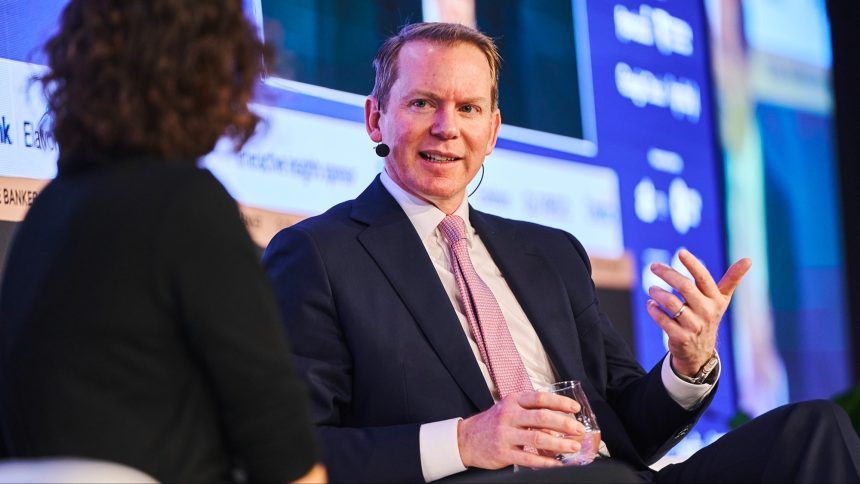
The chief executive of Lloyds Banking Group says confidence in the UK economy is waning among businesses, with a number of issues “gumming up” the system and preventing companies from investing.
Speaking at the FT and The Banker’s Global Banking Summit, Charlie Nunn said that although Lloyds had grown its “sanctioned lending” — approved lending to businesses — by 20 per cent year on year, the majority has not been drawn down.
Achieving a return on investment is “still too difficult”, he said, adding: “It’s a moment where there isn’t confidence [in the UK economy].”
Nunn, a former HSBC banker, pointed out businesses were facing a host of problems, including a high cost of labour, expensive supply chains, and a lack of regulatory reform.
“There’s a whole set of issues that are gumming up the system,” he said, adding that banks’ ability to lend at competitive rates was also proving difficult due to historically high interest rates.
Growth in the UK economy has faltered in recent years, growing below 1 per cent each quarter year-to-date. Issues, such as rising taxes, a higher minimum wage and President Donald Trump’s tariffs, have weighed on sentiment.
Nunn said the solution does not lie solely with the financial services sector. “I think collectively between government, the financial sector and businesses, we really need to focus on getting businesses investing again because that’s where we’re going to see the productivity.”
The CEO also heaped pressure on regulators to lower the amount of compensation offered to consumers as part of the motor finance redress scheme, saying the current plan “isn’t proportionate”.
“We welcome the clarity of a scheme but, bluntly, we’re not there yet,” he said. “That scheme isn’t proportionate, it doesn’t really help give the foundation for yet more predictable forward-looking regulation; so there is more to do, I think, on all fronts.”
Speaking at the summit earlier this week, the head of the Financial Conduct Authority signalled there could be a rethink on the £11bn motor finance redress scheme.
Nikhil Rathi said the City regulator could “adjust and refine” its initial proposals following a consultation with the industry, which closes on December 12.
In August, the Supreme Court partially overturned a previous Court of Appeal ruling that motor finance providers were unlawful in paying commissions to car dealerships, protecting UK lenders who could have been on the hook for tens of billions of pounds in redress costs.
Despite that, some 14mn motor finance agreements — 44 per cent of the total agreements signed between 2007 and 2024 — are expected to qualify for compensation, according to the regulator.
Separately, Nunn said Lloyds is working with other banks in the UK to create a system-wide tokenised deposit offering to build “programmability” into the UK’s existing faster payments system, which is not currently backed by a distributed ledger technology.
Progress on the tokenised deposit comes after the Genius Act (see Provision Tracker) in the US prompted a “wake-up call” to accelerate the use of stablecoins.
A system-wide tokenised deposit is the “answer” for the UK, he added. “No other system in the world, China, Singapore, India . . . have got close to this, and it’s going to give . . . much better outcomes than a Sterling-based stablecoin emerging domestically,” Nunn said.
It will provide “singleness of money”, Nunn said, referencing concerns flagged by the Bank of England, and will be interoperable with international stablecoins.