Unlock the Editor’s Digest for free
Roula Khalaf, Editor of the FT, selects her favourite stories in this weekly newsletter.
Most Whitehall departments cut spending on consultants last year, increasing the pressure on Labour to deliver on its goal of ambitious efficiency targets while significantly reducing the number of civil servants.
Central government cut consultancy costs by 14 per cent in the year ending March 2025, according to FT analysis of annual accounts for core departments and their arm’s-length bodies.
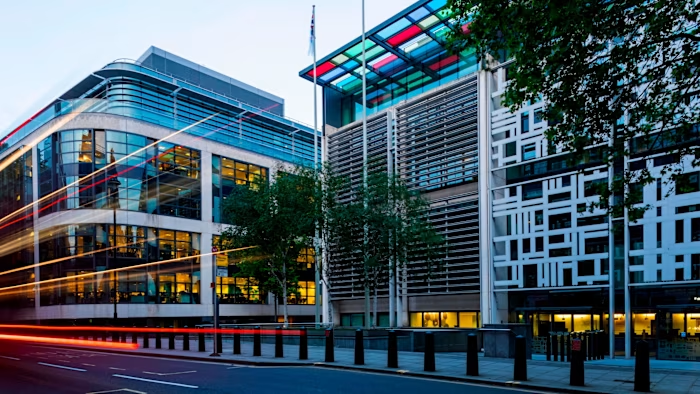
Fourteen of 17 departments reported a decline, but the main driver was the Home Office, which reduced its annual spending by 54 per cent.
Consultancy spend has ballooned in recent years due to the administrative burden of Brexit and the Covid-19 pandemic but also a lack of skills investment, which has increased reliance on external advisers. At the same time, the number of civil servants has hit a 20-year high.
Last November, Sir Keir Starmer’s government pledged to halve spending on consultants and save the taxpayer over £1.2bn by 2026, but in June it delayed this target by three years to 2028-29.
Ministers have also promised to create “a leaner, higher skilled” workforce, allocating £50mn in civil service transformation funds and £143mn for exit schemes, with the aim of axing as many as one in 10 roles by 2030.

Jack Worlidge, senior researcher at the Institute for Government think-tank, said the government needed to be more strategic in its workforce planning and skills investment if it wanted to achieve its aims of cutting the size of the civil service and consultancy spending.
“They need to take a more serious look at what skills they want in the civil service long-term, so they don’t need consultants as frequently,” he added.
The Department for Energy Security and Net Zero recorded the largest real-terms rise in consultancy spending of £33mn, alongside a £11mn rise in temporary worker costs.
Departmental accounts also show progress on temporary labour costs, with spending in the 17 main departments falling by a fifth last year.
The health department accounted for the majority of the decline, delivering a £1.1bn reduction in 2024-25. The Home Office also reduced contingent labour costs by 29 per cent to £212mn.
Cuts to Home Office spending follow a 10-fold increase in consultancy costs during the last parliament, driven by efforts to tackle small boat crossings and implement the Rwanda plan.
Rishi Sunak’s government also closed an internal consulting hub set up in 2021 meant to reduce the use of external consultants after less than two years amid claims that it did not work.

“Clamping down” on spending has unlocked more funding for frontline policing, according to budget documents published last month.
The figures follow warnings from the National Audit Office that inconsistent reporting on consultancy spend has prevented ministers from tracking progress, raising concerns costs could be “significantly higher” than official figures suggest.
In December, Rebecca Molyneux, Treasury deputy director of workforce, pay and pensions, told the Public Accounts Committee that departments were reclassifying some consultancy spend as professional services after discovering contracts had been incorrectly reported to its central database.
However, she said targets were judged against separate figures from annual reports, which were subject to “additional scrutiny” by departments. It was clear that the government was not “fudging the figures” as spending on professional services and contingent labour had also fallen, she added.
The Home Office cut its spending on professional service fees by about a third to £268mn in 2024-25, according to its annual accounts.
Worlidge said it was “far from a given” that the government would meet its target of halving spending during this parliament, but the decision to set 2017-18 to 2022-23 as the baseline made it “easier to reach”.
“That baseline includes the particularly high spending during the pandemic years — and they’ve already reaped most of the benefits of unwinding that,” he added.
The Cabinet Office said it had already cut consultancy costs by £550mn in 2025 and planned to cut back office costs by 16 per cent by 2030, saving £2.2bn a year.
“This government is relentlessly rooting out waste to protect taxpayer money and make the state more efficient,” it added.
Additional reporting by Anna Gross
This article has been amended to clarify that the NAO does not scrutinise consultancy spending outlined in government departments’ accountability reports.
Letter in response:
Whitehall consultants: the model civil servants prefer / From Tom McAra, London SE1, UK