One scoop to start: Elon Musk has proposed timing SpaceX’s initial public offering to coincide with a rare planetary alignment and his birthday, as the world’s richest man seeks an auspicious date for what would be the largest listing in history.
And another one: Anthropic is set to raise about $20bn from venture capitalists and other investors, double the amount it had targeted in a sign of surging investor enthusiasm for the high-profile AI start-up.
Welcome to Due Diligence, your briefing on dealmaking, private equity and corporate finance. This article is an on-site version of the newsletter. Premium subscribers can sign up here to get the newsletter delivered every Tuesday to Friday. Standard subscribers can upgrade to Premium here, or explore all FT newsletters. Get in touch with us anytime: Due.Diligence@ft.com
In today’s newsletter:
Rivals eye Partners Group’s big US gold mine
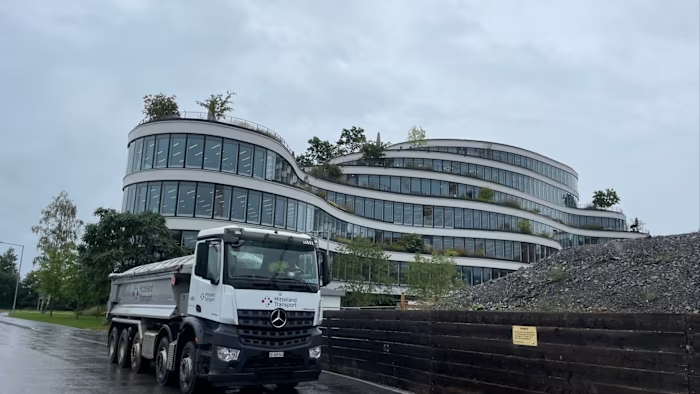
For Switzerland’s Partners Group, last year was a coming-out party for a private equity firm that charted an unheralded rise into one of Europe’s largest investment houses.
It proved wildly influential in American President Donald Trump’s efforts to open the $9tn US retirement marketplace to private equity. One of its billionaire co-founders also travelled with a Swiss delegation of business leaders to the White House in November to de-escalate a trade dispute with Washington.
But as Partners Group’s connections were on full display, its rivals were encroaching on the turf from which much of its financial power emanated.
Last year, the $185bn-in-assets firm faced rising pressure amid a wave of redemptions at its pioneering retail PE fund in the US, the FT reports in a deep dive.
The redemptions came after a stretch of weak returns and as US rivals including Blackstone, KKR and Apollo, which had previously focused mostly on institutional investors, earmarked retail investors as their next source of growth and stole market share.
Its funds were in some ways being victimised by their own successes. New “retail” funds often have eyewatering early returns due to accounting gains, making older funds such as Partners’ offerings look unattractive.
But the redemptions raise the question of whether the unorthodox firm can adapt in a marketplace it once dominated.
“[Partners] invented the wealth market, but where are they really today with all these others launching products?” one former senior employee told the FT.
Unlike most buyout groups, established by seasoned dealmakers, Partners was founded 30 years ago by three young Goldman Sachs alumni with backgrounds in sales and private banking, not in corporate takeovers.
Marcel Erni, the group’s cerebral founder who owns a large art collection, including many Basquiat paintings, focused on investments. Fredy Gantner, a Mormon bishop, was chief executive. The lowest-profile founder, Urs Wietlisbach, led sales.
Partners’ early growth came from building funds of private equity funds for wealthy Swiss and German savers.
It had two big innovations in lieu of a large pipeline of its own deals.
One was a fund that packaged private investments in a way that suited individuals and small institutions: the evergreen or “semi-liquid” vehicle. The other was the firm’s use of hundreds of separately managed accounts allowing investors to tailor their PE investments.
The model proved successful. Partners Group in 2006 became one of the first private markets firms to go public and then significantly outperformed US listed rivals. In 2018, it had a market value roughly equal to Apollo and KKR combined. But over the past five years it has lagged badly and is now less than a third of the size of either.
Partners has more recently increased its direct private equity investments, which are now a majority of its overall assets, and is plotting acquisitions to increase its offerings.
It has held acquisition talks with Advent International and Leonard Green, but those came to nothing, people familiar with the matter told the FT.
CEO David Layton told the FT that Partners Group continues to grow and said it was normal for his firm to lose some share of the market it invented.
“There’s obviously going to be a lot of new entrants . . . But it’s clear there’s structural growth there and Partners Group has a big role to play,” he said.
Kirkland’s comeuppance
As it turns out, the biggest private capital firms in the world didn’t like being called a “classic illegal cartel”.
The allegation was made in November by Patrick Drahi’s telco Altice USA, now known as Optimum Communications. In a federal lawsuit, filed against Apollo, Ares, BlackRock, Oaktree and hundreds of other creditors, Optimum said a strict pact among nearly every creditor of its $26bn debt pile was an impermissible conspiracy.
Kirkland & Ellis did not bring the lawsuit. But on Monday, it provided the first scalp.
DD’s Sujeet Indap reports that Kirkland has withdrawn as transaction counsel to Optimum after pressure from private capital heavyweights. The investors were furious that a difficult, but standard, business deal had been escalated to an existential antitrust matter — which they, fairly or not, pinned on Kirkland.
It is a seismic moment that shows who is really boss on Wall Street these days.
Kirkland is the world’s biggest law firm by revenue, driven by a cradle-to-grave private equity practice (think: fund formation, leveraged finance, M&A, restructuring and bankruptcy).
The firm positions itself as indispensable as it knows every cutting-edge legal clause and negotiating tactic and therefore no serious fund manager would ever think about looking anywhere else, with some clients paying 9-digit bills every year.
But in the gut-check moment, Kirkland blinked when the Masters of the Universe threatened to take their vast business elsewhere. Everyone in high finance and Big Law has noticed.
As for further fallout, watch the status of Kirkland’s David Nemecek, whom the FT profiled last year. He’s the leading distressed financing lawyer responsible for intricate and highly-charged negotiations at the likes of Optimum and, last summer, at Saks Global.
Those close to Nemecek and Kirkland told the FT he would continue to work for the firm in the near term, and that any decision to leave would be strictly up to the lawyer — who joined Kirkland more than a decade ago after stops at Cravath and Skadden.
In an ironic twist, those such as Apollo, Ares and Oaktree have been rough players with creditors when they were private equity sponsors and so their complaints now as bondholders against Optimum might seem a little rich. But with trillions in collective assets, moral consistency matters less.
And if Kirkland can be swayed by pressure, perhaps Jamie Dimon is feeling a little warmer under the collar. The FT exclusively reported in December that many of the same private capital firms upset at Kirkland over the Optimum fireworks are also upset at JPMorgan Chase for providing a $2bn rescue loan that shifted some collateral out of reach for the existing Optimum creditors.
Job moves
-
BlackRock has elected Gregg Lemkau to its board. Lemkau is co-chief executive of BDT & MSD Partners.
-
Hakluyt has named Lara Boro, chief executive of The Economist Group, and Mark Sedwill, a member of the House of Lords and former UK government cabinet secretary, to the advisory firm’s board of directors.
-
Fidelity star portfolio manager William Danoff will retire at the end of the year.
-
Houlihan Lokey has hired Mark Ward as a managing director in its business services group in the UK. He joins from DC Advisory where he was a managing director.
-
Rokos Capital Management has hired Tarik Hsaini to lead its quant team. He joins from Deutsche Bank, where he was a managing director.
Smart reads
Higher ed, lower returns Universities that adopted the “Yale model” for investing their endowments have seen disappointing results recently, Bloomberg reports. Meanwhile, schools that have eschewed private equity for public markets are faring better.
Pardon spree It’s been a great few weeks for fraudsters in the US, the FT reports, with President Donald Trump issuing pardons or commuting the sentences of 10 white-collar criminals in 10 days.
Junk science An article in The Lancet about the surprising cause of a baby’s death upended the treatment of post-partum pain, The New Yorker reports. But experts have serious doubts about the research — and the credibility of the man who undertook it.
News round-up
CD&R targets $6bn Indicor exit in drive to return cash to investors (FT)
Nomura-backed crypto group Laser Digital seeks US banking licence (FT)
US health insurer stocks plummet on Trump Medicare spending plan (FT)
Citi seeks to move harassment claim against top executive to arbitration (FT)
JPMorgan tells its M&A bankers to do more to close the gap with Goldman (BBG)
Due Diligence is written by Arash Massoudi, Ivan Levingston, Ortenca Aliaj, Alexandra Heal and Robert Smith in London, James Fontanella-Khan, Sujeet Indap, Eric Platt, Antoine Gara, Amelia Pollard, Kaye Wiggins, Oliver Barnes, Tabby Kinder and Julia Rock in New York, George Hammond in San Francisco and Arjun Neil Alim in Hong Kong. Please send feedback to due.diligence@ft.com