SINGAPORE – From Dec 1, government contracts in the built environment sector must include a clause that limits a consultant’s contractual liability.
This is in response to feedback that “unlimited liability” in such contracts, which do not specify limits on consultants’ contractual liability, put them at significant risk of financial losses.
“(Some consultants) highlighted it was rather unfair for them to be subjected to unlimited liability, and they faced challenges in purchasing professional indemnity insurance to cover their potential liability claims,” said National Development Minister Chee Hong Tat.
Without limits on their liability, it is more expensive for consultants to buy such insurance, and this makes consultants less willing to take on government contracts.
“I understand their concerns. There is no winner in such a situation – whether the businesses or the Government,” Mr Chee said.
He was speaking at the EY Entrepreneur Of The Year Singapore awards ceremony held at the Ritz-Carlton hotel on Oct 17.
Mr Chee said that in November 2024, an option to limit contractual liability was added in standard consultancy agreements between government agencies and their consultants.
But in response to feedback, this clause will be made a mandatory provision in all such contracts from Dec 1 to ensure “more effective and equitable risk-sharing between government agencies and industry”.
“We hope that this move will give consultancy firms greater confidence and certainty when they take on government projects,” Mr Chee said.
On Sept 25, the Singapore Institute of Architects flagged “unfair clauses”
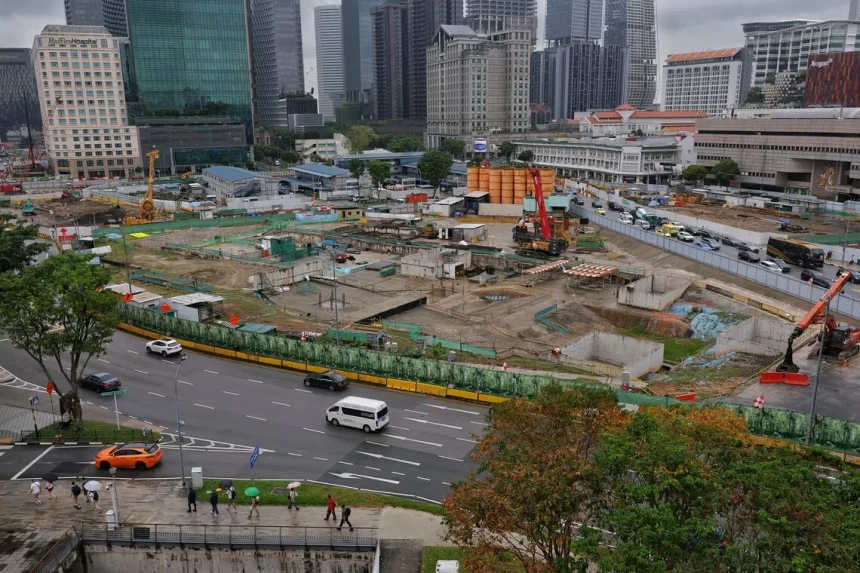
in a Singapore University of Social Sciences (SUSS) tender for its Rochor campus
.
Institute president Tiah Nan Chyuan said in a LinkedIn post that these clauses include “unlimited design changes post-award with no additional fees and unlimited liability”.
“These clauses run counter to the recommendations of the Taskforce for Architectural and Engineering Consultants, which called for fairer procurement standards across the industry,” Mr Tiah said.
was set up in September 2024
to improve the attractiveness of architecture and engineering jobs in the built environment sector. It was co-led by Ms Indranee Rajah, Minister in the Prime Minister’s Office and Second Minister for Finance and National Development, and Surbana Jurong chairman Chaly Mah.

National Development Minister Chee Hong Tat (fourth from left) at the EY Entrepreneur Of The Year Singapore awards ceremony on Oct 17.
ST PHOTO: GAVIN FOO
Mr Chee noted that around 80 per cent of government contracts are awarded to small and medium-sized enterprises every year.
As such, it is important to ensure that procurement conditions and approaches will not become barriers to entry for local suppliers, he said, highlighting another rule change that will help smaller construction contractors with cashflow issues.
Currently, the Housing Board’s contractors can claim up to 2 per cent of the contract sum as initial preliminary payments when a building project commences. This gives them the capital to deploy equipment, mobilise manpower, and set up the site during the project’s early stages.
HDB will be raising the proportion of these initial payments within the contract sum to 5 per cent for its building projects, Mr Chee said. It will also extend this approach to other contract types by the first quarter of next year.
Smaller contractors will benefit from this move, as they may not have the financial reserves that larger industry players have, he added.
Mr Chee also said he wants to encourage an entrepreneurial culture in his ministry, which would see the public service work with industry players to find solutions.
“We must think and act like entrepreneurs and not just as administrators, or, worse, as bureaucrats. We want to encourage more risk-taking and not just risk-avoidance,” he said.
His ministry will therefore slash red tape to encourage more solar deployment in Singapore.
Currently, businesses need to get the Urban Redevelopment Authority’s (URA’s) permission to set up land-based solar farms. The application process takes about a month and costs $3,500.
But from Oct 31, those who want to build solar farms on land owned by the state or statutory boards no longer need the URA’s approval, Mr Chee said.
They will only need to obtain the agency landowner’s consent, and ensure that their proposals are compliant with the requirements of technical agencies, he said.
“This means that an applicant will save $3,500 and one month of waiting time. I believe this is a win-win for both the Government and industry, and I hope it will encourage more solar deployment in Singapore,” he added.
The evening saw Ms Chin Wei Jia, group chief executive of HMI Medical, named EY Entrepreneur Of The Year 2025 Singapore. The company is a private healthcare services provider headquartered in Singapore, with operations here as well as in Malaysia and Indonesia.
In 2026, Ms Chin will go up against 50 other country winners at the EY World Entrepreneur Of The Year awards.
The annual awards, now in their 24th year, are organised by professional services firm EY. The event recognises business leaders who show excellence in areas such as innovation, financial performance, social responsibility and personal commitment to their businesses and communities.