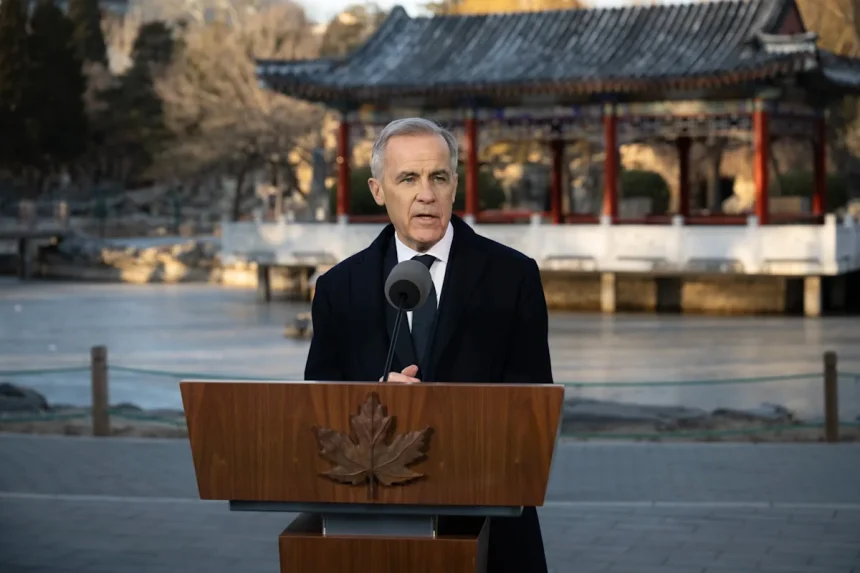
(Bloomberg) — Mark Carney’s dispassionate tone masked a stunning message of realignment: China is a “more predictable” trading partner than the US now, requiring stronger ties with Beijing as a “new world order” takes hold.
Most Read from Bloomberg
A former central banker not known for hyperbole, Canada’s prime minister departed the Chinese capital after a deal with Xi Jinping that opens the door to electric vehicles and auto investment from Asia’s largest economy. It would have been an unthinkable step before Donald Trump won a second term in the White House.
Canada has long stuck closely to the US on China policy, even through a diplomatic crisis over high-profile prisoners. Along with historic trade ties, that alignment is now cracking.
Less than two years ago, Canada matched 100% US tariffs on Chinese EVs to protect the North American auto industry, prompting Chinese counter-levies. Then Trump came into office, slapped tariffs on Canadian products and put global import taxes on autos, steel and aluminum — hitting Canada uniquely hard due to supply chains crisscrossing the border.
No Group of Seven economy has such unipolar trade relations as Canada, which sends about 70% of its exports to the US and gets most of its imports there. Carney, a former Goldman Sachs Group Inc. banker, says that means Canada has to double its non-US exports in a decade — a goal that’s all but impossible without a deal with China, experts said.
“What the prime minister is doing is saying, ‘Look, we have options. We’re not just going to sit around and wait for you to love us again,’” said Eric Miller, founder of trade consultancy Rideau Potomac Strategy Group. “He’s put his toe in the water, but he can always pull it back out again if that is in the best interests of Canada.”
The agreement with Xi sets an annual quota of 49,000 Chinese EVs eligible to enter Canada at a low tariff rate. More controversially, Carney’s deal cracks open the Canadian auto market to joint-venture investments by Chinese carmakers.
Those companies have upended an industry once dominated by Detroit and Germany: China’s BYD Co. dethroned Tesla Inc. this month as the world’s top seller of electric cars.
While US Trade Representative Jamieson Greer said the deal would be “problematic” for Canada and it drew complaints from US lawmakers on the House’s select committee on China, Trump’s early assessment of Carney’s shift was more sanguine.
“That’s OK, that’s what he should be doing,” Trump said. “It’s a good thing for him to sign a trade deal. If you can get a deal with China, you should do that.” (Trump plans to visit China in April.)
Yet the unpredictable president’s first reaction to the province of Ontario’s anti-tariff ad quoting Ronald Reagan was also calm — before it transformed into anger that drove him to terminate trade talks with Canada in October.
‘Minimum Concession’
Carney and Xi’s joint statement doesn’t reset the world order in one fell swoop. The two leaders signed a series of nonbinding memoranda and letters of intent that, on paper, simply roll several things back to where they were a few years ago.
In 2017, Carney’s predecessor, Justin Trudeau, bounded into Beijing with hopes of a “comprehensive” trade deal. That effort quickly fizzled and, 12 months later, Canadian police arrested Huawei Technologies Co. Chief Financial Officer Meng Wanzhou in Vancouver on a provisional US extradition request, causing China to detain two Canadian citizens and leaving the relationship in tatters.
Carney’s step is a banker’s hedge — a “backing off,” said Jeff Nankivell, chief executive officer of the Asia Pacific Foundation of Canada, who was formerly posted in China as a senior Canadian diplomat.
“It’s fair to assume that the task for the Canadian negotiators was to see what’s the minimum concession we can make on the EV tariff that would be enough to get the Chinese side to agree to significant reductions on their tariffs,” he said. “This is that deal.”
“The first job of a national leader, and especially in times of economic duress, is to keep the country’s options open,” he added.
One of the two Canadians detained by China for nearly three years during their diplomatic nadir, Michael Kovrig, now works as an analyst and adviser on geopolitics and security.
“The Canadian government was in the land of bad options,” he said. “China is not an avoidable country.”
Friday’s announcement nonetheless gave him “a bad feeling in the pit of my stomach,” he said.
Farmers from Canada’s vast prairies are suffering from Chinese tariffs on canola and peas, and China’s message, in Kovrig’s view, was “open your markets to our massively subsidized overproduction of electric vehicles and other things, or we will hurt you.”
He said Carney’s stoic comment Friday that “we take the world as it is, not as we wish it to be” made him sound like “a very strange sort of Davos man.”
Carney may prefer a world of freer trade that focuses on efficiency, but it appears he’s acknowledging “we’re not living in that world any more,” and that requires radically different behavior, Kovrig said.
Carney’s visit to China reflectsa ruthless economic focus for which Canadians elected him. US protectionism and Trump publicly coveting Canada as a “51st state” helped lift Carney to power last year with a mandate to diversify trade.
“We never want to be in this position again,” he said on Bloomberg’s The Mishal Husain Show in October.
Under Trudeau, Canada pursued a values-based foreign policy, focusing on human rights and gender equality. Some in Carney’s base still want him to champion those issues, but trade and economic growth are clearly higher on his agenda.
To some, Carney’s approach is a welcome recalibration.
“Well done, PM Carney and Co.,” Derek Holt, head of capital markets economics at Bank of Nova Scotia, said of the China deal in a note to investors. He hailed the shift from the previous government’s approach, which he said “subjugated bilateral commerce to virtue signaling and often hypocritical finger-wagging.”