When house prices go up too much, that’s really bad. People suffer. But there’s one thing that may be even worse:
When house prices go down too much.
In Australia, we are at the mercy of the former phenomenon. House prices are already at the moon, and getting further out of reach. A junior doctor’s wage can barely afford a tiny flat in Sydney, where the median unit price is $858,000. In Perth, property prices have risen by 67 per cent in just the last three years.
It’s a socially corrosive situation and we are fixated on it. Correctly so.
But not so far away, a very different type of situation is emerging that could be even worse.
China’s housing market has blown up. Their house prices are down about 20 per cent.
China built a lot of homes in the last decade. It’s where a lot of Western Australia ended up. Our iron ore got made into the rebar inside the concrete propping up those Chinese skylines. But they did the classic thing economies do in a property boom: built too much.
Now unsold homes are piling up. Big developments are half finished and full of weeds.
For a long time, China still needed lots of apartment buildings. The whole country needed to modernise and to urbanise, so there was boundless demand for homes in cities.
But now the rate of population flow from the country to the city has cooled down. China has gone from 60 per cent urban to 67 per cent urban since 2017. That is approaching a natural limit.
Part of the problem is that people were moving to cities to help build those cities. As the real estate boom fails, people move back to their villages.
Also piling up are the casualties. Some of China’s biggest companies were property developers. Many of them have gone broke, and many debts remain unpaid.
A short, sharp pain
In the West, this would turn into a financial crisis, like we saw in 2008 in America. Unpaid debts lead to doubts about who is solvent, then lending dries up, and the whole economic system grinds to a halt. Boom.
But in China, they are trying to manage it. It’s more of a rolling crisis than an acute panic. For now, at least.
Chinese stock markets are putting on a brave face and have recently gone up thanks to a push from the government. Still, the Chinese property market is in what Newsweek is calling a “death spiral” and the government is desperately trying to figure out what can take over as the backbone of the Chinese economy.
First, the Chinese government tried to urge the manufacturing sector to take over the job of carrying the Chinese economy. The factories responded. But China’s factories pumped out so many cheap goods that they were competing against each other, pushing profits down to zero. You want to understand why BYD utes and MG SUVs are so cheap? This is why. The Chinese government turned the dial on manufacturing up to the maximum.
(Incidentally, I reckon we should be making the most of this era of unusually cheap EVs and buying them up, transitioning our vehicle fleet when the going is good.)
But of course, China has a billion people. We could buy BYD Sealions until there are six in every driveway, and it wouldn’t keep China’s workforce busy. What they really need to do is get Chinese people to consume more.
Emptying the red envelope
China’s people, you see, are savers. The Chinese savings glut is legendary.
Even now, they save 43.2 per cent of GDP. It’s their lowest rate in 20 years, but still almost the highest rate in the world, and more than twice what the Americans save.
If the people of China could be encouraged to spend more of that, they could soak up the industrial production of their own country.
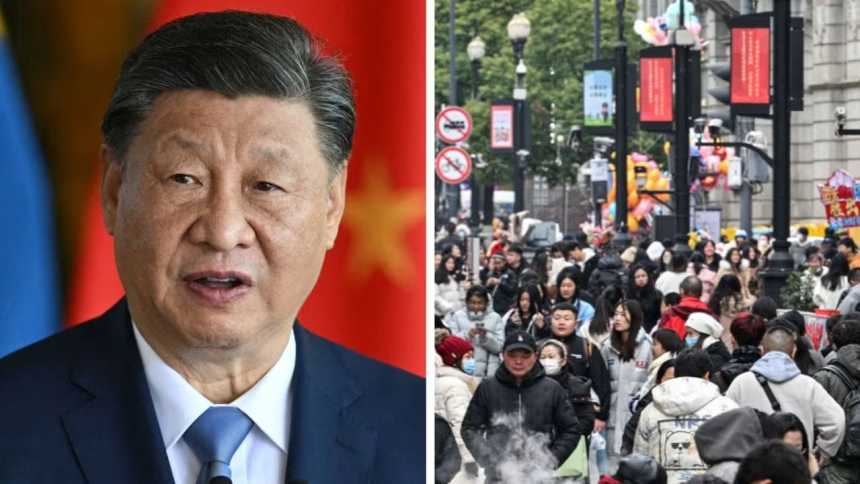
But the falling price of property does not encourage the confidence that fires up domestic consumption – quite the opposite. And with Trump making life hard for the task of the Chinese government, and its charismatic leader, Xi, is an exceedingly challenging one.
With crimped exports, tight domestic demand, plenty of infrastructure already built, and certainly no need for any more real estate development, how does China keep its economy growing?
One answer might be that it doesn’t. China’s population is falling, and it could be about to follow the path of Japan, where living standards are high, but economic growth is essentially absent. But that is probably the best-case scenario.
The worst case scenario is far messier, involving a financial calamity coming directly from the real estate bust-up, or an economic calamity from the inability to find an alternative source of growth.
On our shores
Australia’s economic luck has been underwritten by China for a couple of decades now. They cushioned us during their rise. China is now our biggest trading partner. It would be madness to think we can decouple from them and avoid being harmed if they fall. If the Chinese economy starts to really fall apart, it might not be long until we wish we could still complain about rising property prices in Australia.