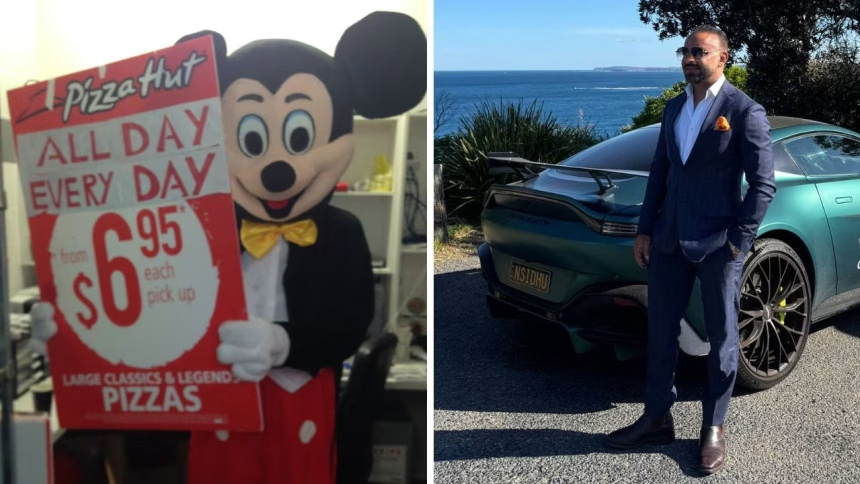
Less than a decade ago, Ninder Sidhu was sitting in a Centrelink office after losing everything in the restaurant business.
Now he drives a $500,000 car and owns about $20 million worth of property.
The 39-year-old Gables, northwest Sydney man, is open about his rags-to-riches story, sharing posts to social media that showcase his green Aston Martin – emblazoned with his company name, Vantage Property.
It’s the Australian property market, Mr Sidhu says, which has created his wealth and is also propelling the large returns of his investor clients.
But he readily admits that success only came after a foray into fast food had left him penniless.
Humble beginnings
Mr Sidhu came to Sydney alone from India in 2006 to study finance. To make ends meet, the then-19-year-old started working part-time as a dishwasher at Pizza Hut.
“I gave my best shot at the place I was working, which has always been a mindset and always been my goal – to be the best at whatever I’m doing, whether it’s a small job or a big job,” he tells news.com.au.
MORE: Top 200 Aussie suburbs for property investment
The young man quickly moved up the ranks in the franchise, becoming a store manager. When he graduated in the midst of the Global Financial Crisis and struggled to find a job as an accountant, he decided to invest in Pizza Hut instead.
With the help of a $200,000 loan from his father he bought two Sydney stores, making him the youngest Yum! Brands franchisee in Australasia.
“That was my journey, but the plan didn’t go well,” he reflects.
In 2016, Pizza Hut dropped prices to as low as $4.95 as part of its new value model – a move that proved unpopular with franchisees and led to a class-action lawsuit.
Mr Sidhu said the new, “volume-oriented mindset” didn’t work in the affluent suburbs where his stores were based.
“Our business went down. We gave lots of feedback back to the brand, (but) they didn’t listen.
“We failed against the might of these big corporates. A lot of people lost their homes, livelihoods, savings.”
Mr Sidhu himself was liquidated and forced to close his restaurants, just as his first child was born and his wife was on maternity leave.
“I lost everything. I lost my dad’s investment as well,” he recalls.
That was when he found himself at Centrelink as a last resort, but he says when the staff called his name, he walked out.
“This wasn’t what I came to Australia for … I started from scratch.”
In 2016, Mr Sidhu bought his first home, borrowing from a friend for a $20,000 deposit on a $190,000 property in the Hunter Valley.
“Back then that was all I had, when my Pizza Hut was shutting down.
“It was the worst property in Hunter Valley at that point, in Cessnock. When I entered the property it was so smelly and broken down,” he says, recalling piles of rancid laundry left behind by the previous owner.
“I’m numbers-oriented. An emotional investor wouldn’t have bought it.”
Mr Sidhu renovated the property and ended up selling it for $400,000.
MORE: Revealed: Hottest property markets around the nation
Then he started going into short supply markets and building new properties worth 15 to 20 per cent below the market value.
“When the property was complete, it had gone up by another 15 to 20 per cent,” he explains.
“So I was sitting with 30 to 50 per cent equity in every initial property I was buying. And I was just refinancing that and buying the next one.”
Meanwhile, Mr Sidhu was studying financial planning and wealth management.
“My goal was to live a great life and build wealth – and if I could be a wealth adviser I would learn how to build wealth myself, that was my thought process.”
He worked for a firm for about six months after graduation, and even started his own wealth management business, before deciding to focus on property full-time.
‘Guaranteed Equity’
Vantage Property develops new homes in high-growth areas across Australia and sells them to investors through its “Guaranteed Equity” program, which promises built-in equity and the potential for long-term portfolio growth.
Mr Sidhu says it follows the same investment model that he has been using himself.
“We go in any short supply market, we find what’s selling there, we clone in 15 to 20 per cent below the market value – that becomes a guarantee for our clients. They’re starting 15 to 20 per cent equity on day one.
“My returns are unorthodox. They are huge compared to a traditional investment method. My clients can scale up to a $10 million property portfolio within five years.”
MORE: Australia’s most undervalued and overvalued suburbs
The program works through a buyback agreement. For example, if you buy a property for $1.2 million, Vantage guarantees to repurchase it for $1.4 million upon project completion.
In most cases, the actual equity far exceeds the guaranteed amount, according to the company’s website.
Some clients choose to retain the property, but most refinance, extract the equity and reinvest into another Vantage home. The company claims none of its clients have ever made less than the guaranteed equity.
Of course, past performance doesn’t guarantee future results, and Vantage investors are highly leveraged and dependent on lending conditions.
Mr Sidhu says so far, his company has delivered more than 300 dwellings for hundreds of families in Queensland, New South Wales and Victoria, and generated a combined $120 million in equity.
“I haven’t taken existing properties in the supply chain like a kind of hoarder – I have brought more properties into the supply.”
The effect on housing affordability might be limited, however. Vantage primarily caters to investors, who may rent out the homes rather than live in them. Mr Sidhu, for his part, maintains that most of his clients have been owner-occupiers.
The program is by no means risk-free and readers are urged to do their own research.
That said, Vantage offers a unique and legitimate model that might give property investors more peace of mind than they can find elsewhere. And it’s certainly worked for Mr Sidhu.