MILLIONS of homeowners are set for a major cash boost as the Bank of England prepares to slash interest rates before Easter.
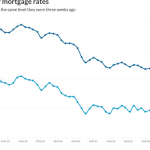
Nationwide has already announced it is cutting its mortgage rates with deals as low as 3.54% on offer from Friday 13 February.

The move comes as new figures show the UK economy is stuck in the slow lane, piling pressure on rate-setters to help struggling families.
Official data from the Office for National Statistics (ONS) revealed the economy eked out a tiny 0.1% growth in the final months of 2025.
With GDP near-stalled and unemployment starting to rise, many experts think the Bank of England will be pushed to step in.
The BoE’s main job is to get inflation down to its 2% target.


But with the economy struggling and inflation sitting at 3.4%, only slightly above the 2% target, it is now easier for the Bank to justify cutting interest rates to support households and businesses.
By lowering interest rates, the Bank makes borrowing cheaper to encourage consumer spending and business investment to support faster economic growth.
Mortgage rates often fall too, because lenders use the base rate to help set borrowing costs.
Bank of England deputy governor Sarah Breeden has said it is “reasonable” to expect a cut over the next couple of meetings if the economy develops as expected.
She said: “If we continue to have the economy develop as we expected and if there are no shocks – to be clear those are two big ifs…
“I think it’s reasonable to expect there to be a cut over the next couple of meetings.”
Nationwide has announced rate cuts across its fixed mortgage range.
The high street lender is reducing the interest rates on its loans by as much as 0.16 percentage points with the cheapest deal now 3.54%.
The Bank held borrowing costs at 3.75% last week, but money markets are narrowly pricing in a cut when the Monetary Policy Committee (MPC) next meet on March 19.
Luke Bartholomew, deputy chief economist at Abderdeen, said: “On a purely national accounting basis, the economy started 2026 with very little momentum.
“But looking at various surveys, there were some tentative signs that sentiment turned a corner and started to improve after the budget last year, which could help deliver a pick-up in activity this year.
“However, recent political uncertainty may see that sentiment bounce reverse.
“And it is still hard to see what will drive a sustained increase in the underlying rate of growth this year.
“All of which means that the Bank of England is set to continue to lower interest rates to try to support growth, and we expect the next cut at the March meeting.”
TUC general secretary Paul Nowak has also called for quickfire rate cuts to end the doom loop and help working families who are still being squeezed by a relentless cost-of-living crisis.
What is the base rate and how does it affect the economy?
NINE members of the Bank of England’s Monetary Policy Committee meet eight times each year to set the base rate.
Any change to the Bank’s rate can have wide-reaching consequences as it directly influences both:
- The cost that lenders charge people to borrow money
- The amount of savings interest banks pay out to customers.
When the Bank of England lowers interest rates, consumers tend to increase spending.
This can directly affect the country’s GDP and help steer the economy into growth and out of a recession.
In this scenario, the cost of borrowing is usually cheap, and the biggest winners here are first-time buyers and homeowners with mortgages.
But those with savings tend to lose out.
However, when more credit is available to consumers, demand can increase, and prices tend to rise.
And if the inflation rate rises substantially – the Bank of England might increase interest rates to bring prices back down.
When the cost of borrowing rises – consumers and businesses have less money to spend, and in theory, as demand for goods and services falls, so should prices.
The Bank of England is tasked with keeping inflation at 2%, and hiking interest rates is a way of trying to reach this target.
In this scenario, the losers are those with debt.
First-time buyers will lose out to cheaper mortgage rates, and those on tracker or standard variable rate mortgages are usually impacted by hikes to the base rate immediately.
Those on a fixed-rate deal tend to be safe if they fixed when interest rates were lower – but their bills could drastically increase when it’s time to remortgage.
The cost of borrowing through loans, credit cards and overdrafts also increases when the base rate rises.
However, the winners in this scenario are those with money to save.
Banks tend to battle it out by offering market-leading saving rates when the base rate is high.
What does this mean for mortgage holders?
When interest rates fall, mortgage rates typically follow suit.
That’s because the base rate is used by lenders to set the interest rates they offer customers on savings and borrowing, including mortgages.
However, the timing of when you will see the reduction depends on the type of home loan you have.
Those on tracker and standard variable rate (SVR) mortgages usually experience an immediate change in payments, or very shortly after.
There are 591,000 customers on tracker mortgages and 540,000 on SVRs.
A 0.25% cut to base rates would mean an average SVR mortgage would fall by £166 a year (£13.87 a month), while those on tracker deals will see a £350 a year (28.97 a month) drop, according to UK Finance.
However, most mortgage holders, more than 7.1million, are on fixed deals so they won’t see any change until their deal ends.
Experts don’t expect rates to return to the record lows of 1-2%, but future rate cuts will funnel through once existing borrowers remortgage.
The average interest rate for a two-year fixed mortgage is now 4.86%, according to moneyfactscompare.co.uk.
Similarly, the average rate for a five-year fixed mortgage is 4.94%.
How to get the best deal on your mortgage
IF you’re looking for a traditional type of mortgage, getting the best rates depends entirely on what’s available at any given time.
There are several ways to land the best deal.
Usually the larger the deposit you have the lower the rate you can get.
If you’re remortgaging and your loan-to-value ratio (LTV) has changed, you’ll get access to better rates than before.
Your LTV will go down if your outstanding mortgage is lower and/or your home’s value is higher.
A change to your credit score or a better salary could also help you access better rates.
And if you’re nearing the end of a fixed deal soon it’s worth looking for new deals now.
You can lock in current deals sometimes up to six months before your current deal ends.
Leaving a fixed deal early will usually come with an early exit fee, so you want to avoid this extra cost.
But depending on the cost and how much you could save by switching versus sticking, it could be worth paying to leave the deal – but compare the costs first.
To find the best deal use a mortgage comparison tool to see what’s available.
You can also go to a mortgage broker who can compare a much larger range of deals for you.
Some will charge an extra fee but there are plenty who give advice for free and get paid only on commission from the lender.
You’ll also need to factor in fees for the mortgage, though some have no fees at all.
You can add the fee – sometimes more than £1,000 – to the cost of the mortgage, but be aware that means you’ll pay interest on it and so will cost more in the long term.
You can use a mortgage calculator to see how much you could borrow.
Remember you’ll have to pass the lender’s strict eligibility criteria too, which will include affordability checks and looking at your credit file.
You may also need to provide documents such as utility bills, proof of benefits, your last three month’s payslips, passports and bank statements.