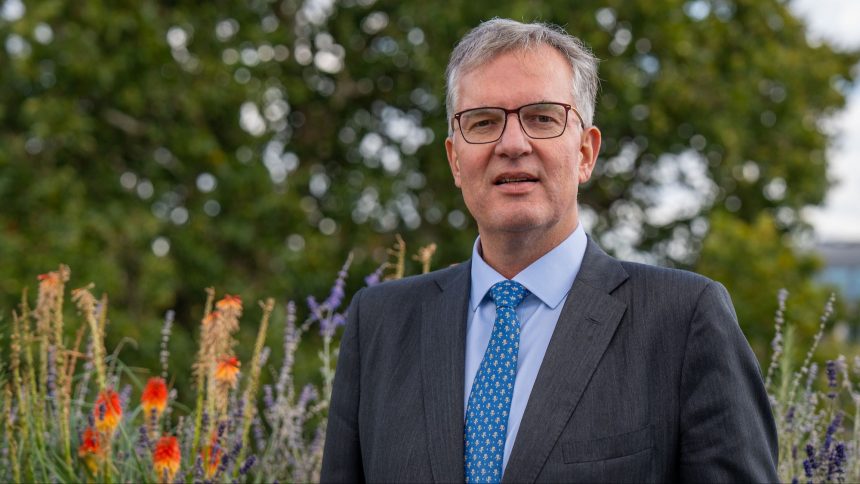
Some people use their gardening leave to take a holiday or indulge in long-forgotten pastimes, while others use it to do vital groundwork. Klaus Hessberger did the latter, and came up with the “definition” to make Lazard what he calls a “premier financial sponsors house” between jobs.
The 56-year-old certainly has the credentials to do it: he formerly ran JPMorgan’s global financial sponsors arm for a decade before starting work at the storied investment boutique this summer.
He is currently global co-head of Lazard’s financial sponsors group with a particular focus on Europe, from where he returned at the end of September after a 100-day tour getting to understand Lazard’s operations.
Career history: Klaus H. Hessberger
2025–present: Global co-head and head of Europe, global financial sponsors group, Lazard
2024: Vice-chair, global strategic investors and financial sponsors coverage group, JPMorgan
2023: Global co-head, global strategic investors and financial sponsors coverage group, JPMorgan
2016: Emea co-head, European strategic investors and financial sponsors coverage group, JPMorgan
2007: Emea co-head, European equity capital markets, JPMorgan
1995: Regional head, German equity corporate finance, Dresdner Kleinwort Benson
Hessberger met more than 150 senior financial sponsor clients at all of Lazard’s major offices and set up his new 18-strong European banking team.
“The tour started in London, then moved to Frankfurt, Munich, Madrid, Paris, Stockholm, Amsterdam and finished in Brussels,” he says.
On the way he had three related objectives: learn more about the granular details of Lazard’s commercial footprint, get to know colleagues and communicate the new strategy he devised with co-head Adam Cady.
“Adam joined Lazard a year before me from Bank of America and we had this freedom to set up a global proposition in the way that clients want, which makes the experience interesting. Because if I was working at another boutique they might have someone running the US who does not want to work with someone in Europe,” he says.
Global ambitions
The word “global” is key according to Hessberger, and one of the themes he heard on his tour in meetings with clients.
“Some of the feedback I got from clients was: ‘We love Lazard, they have the best bankers in their respective countries but they have not connected the dots at a global level’,” he reflects.
“That’s why Adam and I were hired, to connect the dots.”
Hessberger believes the desire for Lazard’s services is there to be won as clients on the tour asked him for “ideas and deals” alongside requests for help in situations the lender does not currently provide.
On the roadshow he articulated the four priorities of the financial sponsor group: providing M&A services to private equity funds on the buy side and with exits; developing tailored solutions for PE funds that want to acquire prime assets; what Lazard can offer on the corporate lending side through its private credit partnership with Arini Capital Management; and restructuring advisory.
Hessberger also has a concrete example of how this new strategy is being implemented to win potential clients.
He recently met the global head of private equity from one of the big funds based in Europe who asked how Lazard could help them in cross-border deals.
“I was with this person in New York in a meeting with Peter [Orszag, chief executive of Lazard] and we explained what we could do on cross-border mergers and acquisitions,” he says.
“It was quite . . . exciting and this one global team structure means we can help people where they are.”
He says the company has in-house talent to create a premier financial sponsors proposition.
“In every country I met what I would describe as ‘rock star bankers’ who really are the best in their respective fields,” Hessberger continues.
“These are real people with real impact that helps the sponsors as they have spent a lot of time with corporates and they’re well known, so it’s very additive.”
The financial sponsors group in Europe now counts five people (including Hessberger) in London, two managing directors and one executive director in France, two EDs in Germany, an MD and an ED in Italy, an MD in Spain, an MD in the Nordics, and an MD in Benelux.

Flying start
To get operations running as quickly as possible, Hessberger had all of his 18 sector bankers meet in Paris off-site during his tour to understand the goals of the newly formed European team of the financial sponsors group.
He also ensured there were presentations from the private capital advisory team of the bank. The 100-strong team advises private equity, real estate, infrastructure, credit and venture capital funds on new fundraisings and secondary market transactions across the globe.
One facet of European private equity that the tour helped Hessberger appreciate more is the need for local bankers in every country with deep sector knowledge and connections who can help private equity institutions win the deal.
“When I can connect [private equity funds] with the right [corporate] partner, it makes us a better counterparty and hopefully they pick us and not the other banks,” he says.
Using Lazard’s local expertise on the continent with private equity funds is vital to push Lazard’s financial sponsor presence forward. Hessberger has a clear idea of what he wants to achieve by the end of the year strategy-wise regarding key focus areas.
The most promising sectors of growth are winning exits for PE funds from high-quality portfolio companies, public-to-private transactions and corporate clients looking to carve out certain sections of their businesses.
Hessberger says that Lazard is focused on quality transactions, meaning that there are more than 1,000 portfolio companies within Europe that private equity funds want to sell. But perhaps only around 120 of those have high-performing assets.
Lazard is relentlessly focused on the best portfolio companies it believes are sellable and wants to help the PE funds exit them. To make that happen, the bank could help the PE fund on the buy side, lending through Arini or some type of bespoke arrangement.
The second priority is helping PE funds access public companies that might want to go private. Hessberger has already asked his bankers in each country team in Europe to supply him with a list of public companies that could go private in the near future.
“Local access is again important because, number one, [Lazard bankers] know the corporate management team at public companies who would like to meet a possible private equity partner,” he says.
“And two, doing a public-to-private transaction in Germany and Italy is not so easy, so bankers who can make the correct introductions are invaluable as is the sector knowledge.”
The final growth area is the return of big corporate clients who want to carve out non-core parts of their business to raise money to invest in more important business lines. “We have seen a big uptick in activity here,” he says.
An example Hessberger gives is a carmaker that might need to establish production in the US to get around Trump’s tariffs.
It is fortunate that PE activity has picked up since Hessberger started work at Lazard because there were hardly any deals between mid-February and June this year. “What has happened since I returned is that PE funds have started to buy and invest again. I discovered this on my road trip.”
Geopolitical issues
One unique feature of Lazard that Hessberger has been impressed by is the geopolitical advisory arm that carries out bespoke modelling for clients wanting to assess the risks of doing a particular transaction. It was created by Orszag, who spearheaded the bank’s shift towards private capital.
At the heart of this vision is a closer relationship with asset managers that aims to diversify revenue and ensure Lazard is not so dependent on its traditional financial advisory proposition.
“The geopolitical advisory work is outstanding and no client sponsor knew we had it, and so German car companies might use it to assess if they should invest in the US or a PE fund could use it to examine what would happen to a target portfolio company if the US government increases sanctions,” Hessberger says.
With so much going on in the world, Hessberger and his colleagues will have their work cut out for them but he is genuinely excited. And because the world is in flux, he is likely to be on the road again soon.