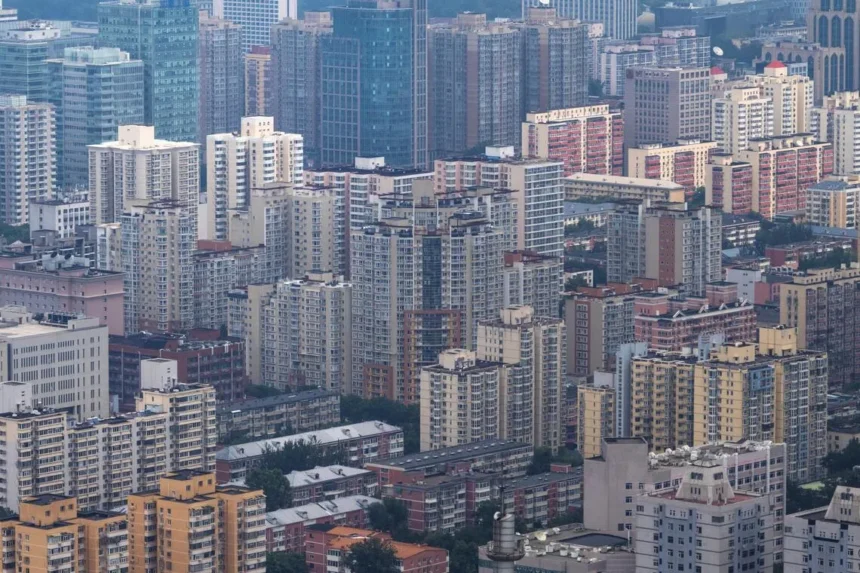
Earlier in September, Beijing officials were preparing to auction a plot of land worth at least US$1 billion (S$1.27 billion), a potential windfall for the local government.
The sale attracted interest from three real estate developers, setting the stage for a bidding war that could push the price even higher.
But when the day arrived, only one developer came ready to bid, according to people familiar with the matter.
The land regulator scrapped the sale, and has given no indication of when it will resume.
It did not reply to a faxed request for comment.
The abandoned auction points to the headaches facing China’s local governments, which have long relied on land sales as a major source of revenue.
Those disposals have been tumbling for years, but are now coming under even more pressure following a raft of policy changes in late August.
China has moved to dismantle a three-decade-old system where developers collect money from buyers well before finishing their homes.
That will sap the capital available to already cash-strapped developers, making it harder for them to buy land – and in turn cutting into a key source of revenue for local governments.
“The enthusiasm for land purchases in Beijing in the previous two months has cooled significantly due to the recent housing sales reform,” said Zhang Kai, a land market analyst at researcher China Index Holdings. “Developers are becoming more prudent.”
Land sales in 70 major cities fell 36 per cent by area in the week following the housing policy overhaul from the previous week, according to research firm Proptech Innovations.
Goldman Sachs Group estimates China’s housing revamp will fuel a 30 per cent drop in land sale revenues in 2026, deeper than a 17 per cent annualised decline in the previous four years.
The firm expects the downturn in receipts to last until 2027 or even beyond, with income from these sales ultimately falling as much as 90 per cent from a peak in 2021.
Land sales were already slumping before the latest policy changes.
In the first seven months of 2026, the local authorities across the country saw income from offloading land decline 72 per cent from the same period in 2021, Bloomberg calculations show.
Municipalities have been trying to boost tax collections to make up for the shortfall, including by scrutinising offshore income.
Cities have also increasingly been selling special bonds to fund investments, including infrastructure and real estate.
In the longer term, local governments could be forced to generate more sustainable revenue, including taxes from growing industries and rising personal income, and securitisation of state-owned assets.
The strain on local finances puts a bigger onus on the central government to add stimulus for the slowing economy.
Some economists estimate that growth in July slipped further below the government’s annual target, sparking a call from Premier Li Qiang to ramp up supportive measures.
Fundraising squeeze
For developers, the crackdown on presales is an unprecedented challenge to their fund-raising model.
At the peak of the residential market, proceeds from home sales made up more than half of builders’ cash inflows, according to Bloomberg calculations based on official data.
In the first seven months of 2026, they still comprised 45 per cent.
The new mechanism bans developers from withdrawing sales proceeds until the project is completed, posing a “main downside shock” to the industry, according to JPMorgan Chase & Co.
It would significantly delay the time for builders to start receiving cash after purchasing land, Citigroup analysts said.
That is translating into a weaker appetite to buy land, especially expensive parcels that require a large chunk of cash up front.
In Shanghai, on the first working day after the sales overhaul, state-owned China Overseas Land & Investment was the only builder that took part in bidding for an urban plot in Shanghai priced at least US$2.2 billion.
At the start of 2026, more than 20 developers showed interest at a government-arranged marketing fair for the site.
After Beijing halted its land sale, the city said it will “optimise” the offering, without elaborating. Beijing may offer the parcel again after lowering its starting price, according to Proptech. BLOOMBERG