
With the spread of real estate investment crowdfunding, the types of operators providing these services have become more diverse. Some services allow participation in investments online with small amounts of capital, such as around 10,000 yen, making them one of the options for individual asset management.
When choosing a fund to invest in, it is easy to focus on conditions such as expected yield and investment period. On the other hand, when making investment decisions, it is also important to check the business content and development structure of the operator that organizes and manages the fund.
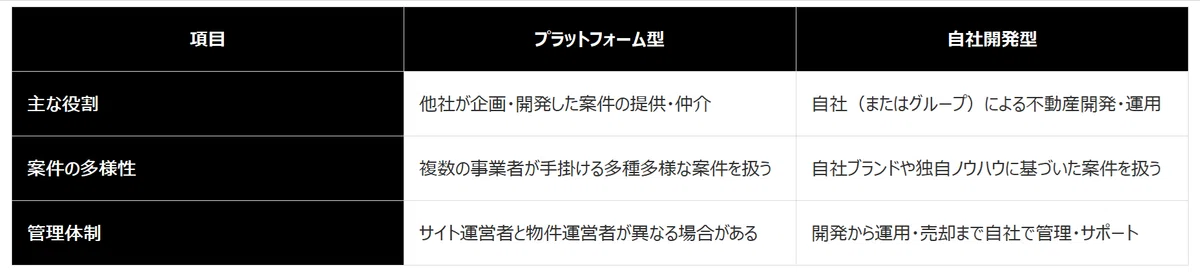
There are various types of operator structures, but in this article, we will categorize them into two types: the ‘platform type,’ which handles projects planned and developed by other companies, and the ‘in-house development type,’ which handles real estate development itself, and organize their mechanisms and points to check.
Two business models for real estate investment crowdfunding operators

In the real estate investment crowdfunding market, various operators are developing services. Although each company’s business content and fund organization methods differ, we will consider them by dividing them into two types, ‘platform type’ and ‘in-house development type,’ to understand their characteristics.
The platform type is a form where the company does not develop or manage real estate itself, but handles projects handled by multiple real estate companies or operators and provides them to investors through websites, etc. A feature is that multiple projects can be compared on a single service.
On the other hand, the in-house development type is a form where the company or its group handles land acquisition, formulation of construction plans, and real estate development, and organizes a fund with that real estate as the investment target.
However, actual business content and division of duties vary depending on the operator. Therefore, it is important not to judge by the name alone, but to check which company is responsible for property acquisition, development, operation, and sale.
Characteristics and points to note for the ‘platform type’ that handles diverse projects

One of the features of the platform type is that various projects handled by multiple operators can be handled on a single service. There are also cases where funds targeting different types of real estate, such as housing and commercial facilities, are provided.
For investors, the advantage is that they can consider funds that match their own investment policy and financial plan while comparing multiple projects.
On the other hand, when considering an investment, it is necessary to check not only the operator that runs the website but also the operator that actually handles the development and operation of the target real estate.
Depending on the fund, the platform operating company and the company that performs the acquisition, development, and operation of the real estate may be different. In that case, it is important to check what roles each company plays and what the contractual relationships and risk sharing are.
Also, the handling of distributions and principal is affected by the revenue status and sale price of the target real estate. It is necessary to make a judgment after checking not only past performance but also the operation period for each fund, target property, and the financial status of the operator.
Characteristics of the ‘in-house development type’ involved from the development stage
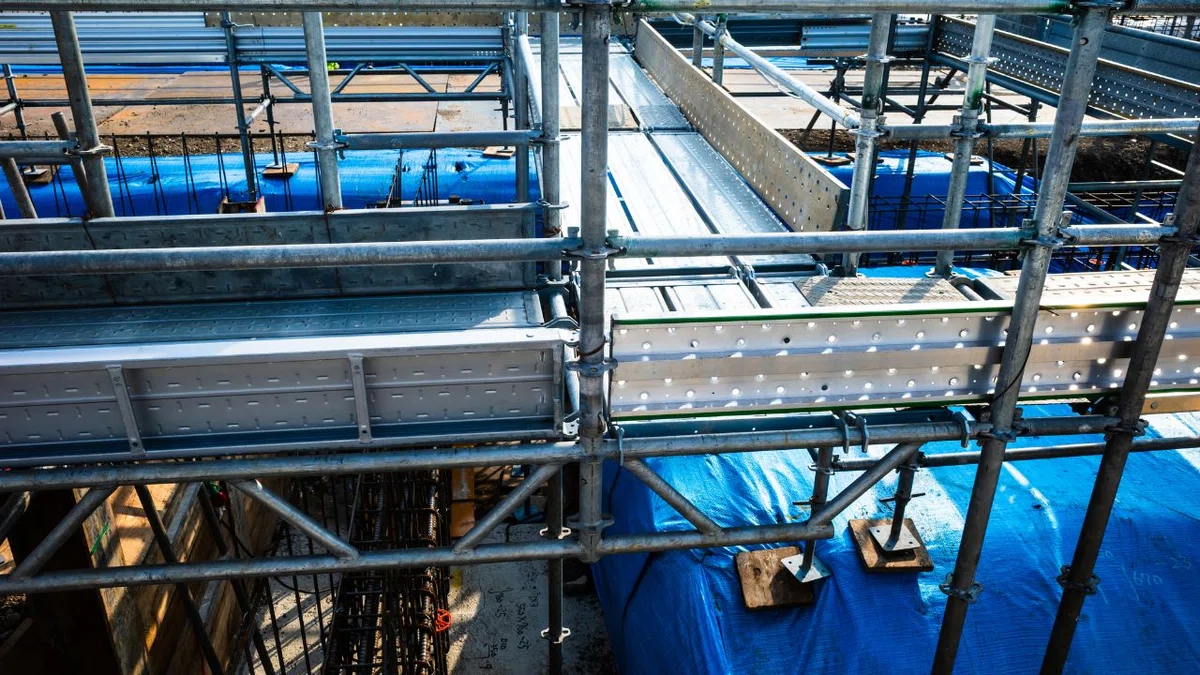
The in-house development type is characterized by the fact that the company or its group is involved in land acquisition and real estate development, and the real estate to be developed is the target of the fund.
The company or its group is involved from the initial stages, such as land acquisition and development planning, and manages each process including construction, operation, and sale. Therefore, a key feature is that it is easy to confirm which company is responsible for each process—from land acquisition to construction, operation, and sale—and under what structure the project is being carried out.
Also, unlike funds that acquire and operate completed real estate, development-type funds may target projects that are still in the development stage, such as land acquisition or construction.
On the other hand, projects in the development stage carry risks different from those of completed real estate, such as rising construction costs, construction delays, plan changes, and fluctuations in sales prices or timing after completion. Therefore, it is important to check not only the completed real estate itself but also the details of the entire project, including land acquisition costs, development plans, construction costs, and sales plans.
Why DARWIN funding focuses on “In-house Development Funds”

Darwin Asset Partners Co., Ltd., which operates DARWIN funding, develops funds utilizing the real estate development and other businesses it handles. The company has a capital of 100 million yen and operates multiple real estate-related businesses, including asset management, property management, development, and crowdfunding.
In the company’s development business, its own specialized staff manages everything from land acquisition to construction, developing its own brand of condominiums and apartments.
DARWIN funding offers a service that allows investment from 10,000 yen per unit, and the company states that it supports every step of the process, from property selection to management, operation, and final sale.
One feature of in-house development funds is that because the operator involved in real estate development runs the fund, they can design products based on development progress and property details. On the other hand, projects in the development stage carry risks different from funds targeting completed real estate, such as rising construction costs, construction delays, plan changes, and fluctuations in sales prices or timing after completion. Therefore, it is important to check development plans, construction costs, and sales plans.
Also, some funds adopt a “priority-subordinated system.” This is a mechanism where the operator makes a subordinated investment against the investor’s priority investment. If a loss occurs due to the operation or sale of the target real estate, the loss is reflected in the subordinated investment portion first within a certain range, thereby delaying the loss burden for priority investors.
However, even if a priority-subordinated system is adopted, the investment principal and distributions are not guaranteed. The scope of risk borne by the investor also varies depending on the ratio of subordinated investment and the contractual terms of each fund. In fact, DARWIN funding also explains that the principal and expected distribution yield are not guaranteed.
Note that even for development-type funds, the specific use of raised funds varies by fund. Please check the individual product summary or the pre-contract delivery document for the use of funds for each fund, such as whether it covers all or part of land acquisition costs, construction costs, etc.
When considering real estate investment crowdfunding, it is important not to look only at the superficial yield, but to check the details of the target property, operation period, the operator’s development structure, the fund’s mechanism, priority-subordinated conditions, and the use of funds.
For DARWIN funding as well, it is important to check this information and consider it in light of your own investment objectives and risk tolerance.
[Notes (Disclaimer)]
-
This article was created for the purpose of explaining the market structure and general mechanisms related to real estate investment crowdfunding, and is not intended to solicit or recommend the purchase or sale of any specific investment product or fund.
-
The figures such as expected yields and operating results posted in this article are estimates based on past performance and analysis, and do not guarantee future operating results or principal.
-
Asset management, including real estate investment crowdfunding, carries the risk of principal loss (falling below the principal) or non-payment of distributions due to price fluctuations of the target real estate, vacancy risk, and the operator’s credit risk.
-
Please make final investment decisions based on your own judgment and responsibility.