
In recent years, I have received an increasing number of consultations from wealthy individuals regarding real estate investment. However, in many of these cases, I see them attempting to apply ‘general real estate investment theories’ directly, which leads to a misalignment with their original objectives.
Real estate investment for the wealthy is not a game of taking risks to aim for high returns. It is more important to ‘not cause significant damage’ to assets than it is to ‘increase’ them.
In this issue, from the perspective of long-term asset protection, I will explain the ‘four conditions’ that the wealthy should grasp when selecting real estate, based on my practical experience.
Why should real estate investment for the wealthy prioritize ‘defensive strength’?
When people hear ‘real estate investment,’ many immediately think of numbers like ‘yield’ and ‘cash flow.’ Certainly, these are important indicators in investment decision-making.
However, for the wealthy, real estate investment plays a fundamentally different role.
For those who have already built a certain level of wealth, the purpose of real estate investment is not ‘offense’ but ‘defense.’ Inheritance planning, asset diversification, inflation hedging, and stable asset succession to the next generation—real estate investment should be positioned within these long-term asset protection strategies.
I have seen many cases where, as a result of chasing only high superficial yields, investors were plagued by unexpected vacancies and repair costs, significantly damaging their asset value.
So, what kind of properties should be chosen to solidify ‘defense’ over the long term? The answer is condensed into the ‘four conditions’ I will share from here on.
Condition 1: Must be a ‘prime location’—Stability of demand and superiority in recovery speed
The greatest risk in real estate investment is, needless to say, vacancy.
No matter how high the yield may appear, if you cannot consistently secure tenants, the balance sheet will not hold up. And as Japan’s overall population continues to decline, this vacancy risk will likely become increasingly serious in the future.
This is where selecting properties in ‘prime locations’ becomes important.
Prime locations in city centers have the characteristic of extremely strong rental demand even during periods of population decline, making it relatively easier to suppress vacancy risk. Areas such as Minato, Chiyoda, and Chuo wards in Tokyo can always expect a certain level of demand due to the concentration of companies and transportation convenience.
The often-overlooked perspective of investment recovery speed
Furthermore, what becomes extremely important in practice is the ‘investment recovery speed.’
For example, construction work such as elevator upgrades or plumbing repairs does not differ significantly in cost between rural areas and city centers. However, with properties in prime locations, because rent levels are high, those repair costs can be recovered in a relatively short period.
On the other hand, with high-yield properties in rural areas, even if the superficial yield looks attractive, it takes a long time to recover the costs when unexpected repair expenses arise.
This ‘difference in recovery speed’ is an extremely important point in the investment strategy of the wealthy, who assume long-term ownership.
Liquidity with an eye toward future sale
Furthermore, properties in prime locations have relatively stable asset values and offer high liquidity when you decide to sell them in the future.
In real estate, you must consider not only ‘post-purchase operations’ but also ‘how it can be sold in the future.’ Whether you can smoothly convert assets into cash when an inheritance occurs or when asset rebalancing becomes necessary is a factor that cannot be overlooked in an asset protection strategy.
In that sense, prime locations can be considered highly stable assets that are well-suited for long-term holding.
Condition 2: Must be ‘Relatively New’—Planned Financial Management and Loan Strategy
Older properties may appear to have high yields at first glance. However, there are many cases where risks such as large-scale repairs and equipment replacement are hidden beneath the surface.
It is not uncommon for unexpected repair costs to arise immediately after purchase, causing cash flow to deteriorate rapidly.
The Time Buffer Provided by Relatively New Properties
With a relatively new property, there is a certain amount of time before large-scale repairs become necessary. This makes it easier to create long-term financial plans and respond to sudden capital outflows.
‘Predictability’ is an extremely important element in asset protection. By being able to foresee when and how much expenditure will occur, comprehensive asset management, including coordination with other asset investments, becomes possible.
Financial Institution Evaluation and Loan Term Advantages
Also, the age of the building is directly linked to evaluations by financial institutions and the length of loan terms.
The newer the building, the easier it is to secure a longer remaining useful life, which in turn makes it easier to arrange long-term financing, thereby making it easier to suppress monthly repayment burdens.
What is important here is that in real estate investment for the wealthy, the priority is not ‘rushing to repay’ but ‘maintaining a thick cushion of cash on hand.’
If you can set a longer loan term, you can keep monthly repayments low while maintaining comfortable cash flow. As a result, it becomes easier to create a stable operational structure that can withstand sudden expenses and market fluctuations.
Advantages in Exit Strategy
Furthermore, this is not just about the time of purchase.
When selling, if the property has more remaining useful life, it is easier for the buyer to secure financing, which works in favor of your exit strategy.
Being relatively new has significant meaning for both long-term holding and exit strategies.
Condition 3: Must be ‘RC Construction’—Multifaceted Benefits Born from Structural Strength
And the third condition that further supports stability is that it must be ‘RC (Reinforced Concrete) construction’.
The financial advantages brought by the 47-year statutory useful life
The greatest strength of reinforced concrete (RC) construction lies in its long statutory useful life of 47 years.
As a result, loan terms tend to be stable, making it highly compatible with long-term holding strategies. For financial institutions, relatively new RC properties are easy to evaluate and tend to be treated as assets whose collateral value is unlikely to be impaired.
Furthermore, the ability to utilize long-term financing also holds significant meaning from the perspective of inheritance planning.
Since real estate is evaluated on a net asset basis including debt, a structure that makes it easy to maintain a certain level of outstanding loan balance can, as a result, easily lead to asset compression at the time of inheritance.
In other words, RC construction, which allows for long-term financing, is a highly rational structure that encompasses not just the ‘strength of the building’ but also financial and succession aspects.
Tenant satisfaction and reduction of management burden
In addition, because RC construction is superior in terms of earthquake resistance, fire resistance, and sound insulation, it has the characteristics of high tenant satisfaction and fewer problems.
Complaints such as hearing daily life sounds from neighboring rooms are unavoidable issues in wooden or light-gauge steel properties, but in RC construction, such troubles can be significantly reduced.
The ability to continue stable operations while suppressing management burdens and mental stress can also be said to be a major attraction.
Condition 4: Owning an ‘entire building’—the invisible value of control
And the final condition is the perspective of owning an ‘entire building’.
Investment efficiency and the advantage of land ratio
Since condominium units are sold individually, they are inevitably expensive in terms of price. On the other hand, since entire buildings are acquired with the land and building together, when compared at the same location and the same rent level, a significant advantage in terms of investment efficiency is easily created.
Furthermore, it is also important that entire buildings have a larger proportion of ‘land’ compared to individual unit ownership.
The essential value of real estate ultimately lies in the land, not the building. Buildings depreciate over time, but land is an asset that is easy to maintain long-term value depending on the location.
Therefore, entire buildings with a high land ratio can be said to be superior in terms of asset defense when viewed from a long-term perspective.
The decisive difference of freedom in decision-making
However, the greatest strength of owning an entire building lies in the point that you can ‘control it with your own will’.
When to perform repairs, how much to spend, at what timing to sell—depending on whether you can flexibly decide these judgments according to your own situation, long-term profitability and tax flexibility will change significantly.
In the case of a condominium unit, you must reach a consensus with the management association, meaning you cannot proceed based solely on your own will. Increases in repair reserve funds, the timing of large-scale repairs, and the pros and cons of rebuilding—everything becomes a matter of coordination with other owners.
When considering future rebuilding or changes in use, there is a significant difference in the degree of freedom between owning an entire building and owning a single unit. If you own the entire building, you can make decisions quickly based on your own judgment.
In the long term, this ‘freedom of decision-making’ holds more value than one might imagine.
Investment strategies that maximize the ‘creditworthiness’ of the wealthy
I have shared the four conditions thus far, but to be honest, a ‘newly built, reinforced concrete building in a prime location’ is by no means a cheap investment.
It is not uncommon for such properties to cost hundreds of millions of yen, and it is likely not an option available to everyone.
However, that is precisely why it is an area where the ‘creditworthiness’ possessed by the wealthy can be utilized to the fullest.
By leveraging relationships of trust with financial institutions to secure long-term, low-interest loans, it becomes possible to build an ‘unwavering foundation’ to protect your precious assets.
I want you to know the paradoxical fact that properties out of reach for the average investor are actually the most suitable investment targets for ‘protection’.
The essence of real estate investment is not ‘how to make a profit’
Real estate investment is not a competition of ‘how to make a profit’.
Can you maintain your assets stably over a long period without them collapsing significantly? That accumulation is what leads to protecting assets and passing on peace of mind to the next generation.
It may not be a glamorous investment. Compared to flashy investment projects that boast high yields, it might appear plain.
However, in today’s world of high uncertainty, perhaps the ‘structure that can be held for a long time’ itself holds more value than ever before.
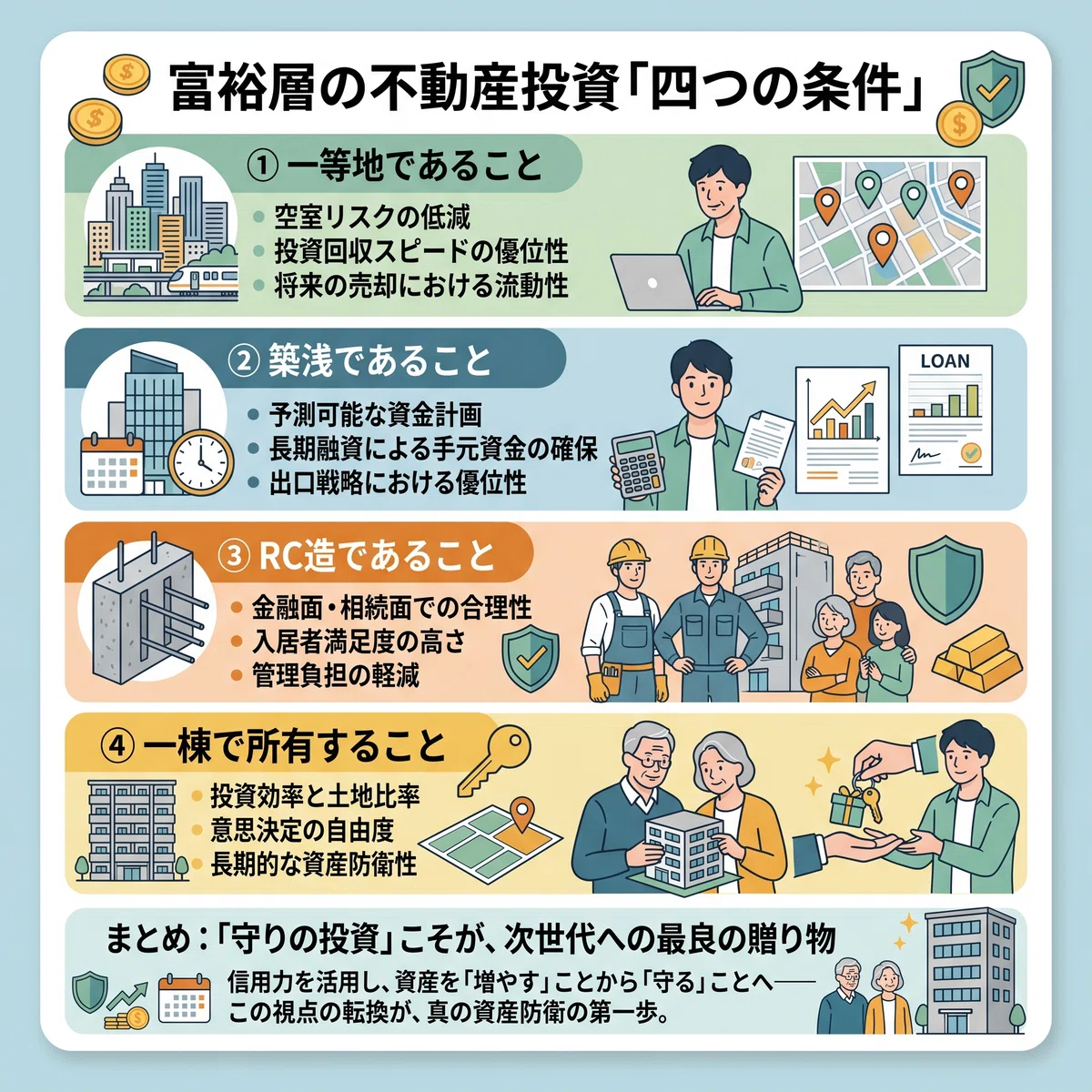
Summary: ‘Four Conditions’ for Real Estate Investment for the Wealthy
Finally, let me summarize the four conditions that the wealthy should keep in mind for real estate investment.
1. It must be in a prime location
-
Reduction of vacancy risk
-
Superiority in investment recovery speed
-
Liquidity for future sale
(2) Must be a recently built property
-
Predictable financial planning
-
Securing cash on hand through long-term financing
-
Advantage in exit strategy
(3) Must be of reinforced concrete (RC) construction
-
Rationality in financial and inheritance aspects
-
High level of tenant satisfaction
-
Reduction of management burden
(4) Must be owned as an entire building
-
Investment efficiency and land ratio
-
Freedom of decision-making
-
Long-term asset protection
Properties that meet these conditions are certainly expensive. However, by leveraging the creditworthiness that the wealthy possess, this ‘defensive investment’ becomes the best gift for the next generation.
Shifting from ‘growing’ assets to ‘protecting’ them—this change in perspective is the first step toward true asset defense.
Reference article:
https://diamond.jp/articles/-/392783