SYDNEY — Charter Hall Group shares jumped more than 6% on Wednesday, leading a sharp rebound in Australian real estate stocks as investors bet the Reserve Bank of Australia may be nearing the end of its aggressive interest rate hiking cycle.
The property investment and funds management group’s stapled securities rose 1.14 Australian dollars, or 6.43%, to 18.86 Australian dollars, placing the company among the strongest performers on the benchmark S&P/ASX 200 index.
The rally marked a sharp turnaround for a stock that had been trading near its lowest levels of the year just days earlier. Charter Hall ended Monday’s session at 17.85 Australian dollars, and its securities slid to annual lows this month as rising bond yields hit rate-sensitive property names.
Property sector posts big rebound
Charter Hall’s gains came as part of a broad rally in real estate investment trusts, which have been among the worst-hit sectors on the Australian market this year. Market Index described Wednesday as a massive day for battered REITs, with the S&P/ASX 200 Real Estate sector climbing 3.1% to a three-week high.
Other rate-sensitive stocks also advanced strongly. Charter Hall, Stockland, JB Hi-Fi and Wesfarmers were each up an outsized 4% to 5% during the session.
The sector had been bouncing strongly off a near three-year low as Australia’s three-year government bond yield, which is closely tied to interest rate expectations, fell to 4.88%, down 17 basis points since the RBA’s decision on Tuesday.
RBA comments shift market sentiment
The move followed the Reserve Bank’s decision on Tuesday to raise its official cash rate to 4.6%, a 15-year high, marking its fourth increase of the year. While the hike was widely expected, comments from Governor Michele Bullock after the decision appeared to reassure investors that further tightening may not be imminent.
Bond investors began betting the RBA is close to the end of its hiking cycle after Bullock said she hoped this year’s four hikes would be enough.
Speaking to reporters after the decision, Bullock signaled that the central bank would take time to assess the impact of its policy moves. “The point I want to make is that we’ve got to see how these four interest rate rises feed through,” Bullock said. She also indicated the bank was in no rush to lift rates again at its Nov. 3 meeting, which falls on Melbourne Cup Day.
Wednesday’s inflation data did little to derail the rally. Headline inflation rose sharply in August, driven by higher fuel prices and building costs. The Australian Bureau of Statistics said the increase reflected higher world oil prices and the end of the federal government’s fuel excise relief. Annual consumer price inflation climbed to 4.0% from 3.5% in July, while the monthly figure matched market expectations.
Market observers noted that sentiment had been so negative that even modest relief was enough to move prices. With so much hawkishness already priced in, anything remotely cooler than expected or dovish has been enough to send yields lower and stocks higher, according to Market Index.
Why interest rates matter for Charter Hall
Property stocks are particularly sensitive to borrowing costs and bond yields. Higher yields increase the capitalization rates used to value property, which lowers asset values and, in turn, the funds under management on which Charter Hall earns fees.
Pressure on the sector had intensified in recent weeks. Australia’s 10-year bond yield climbed above 5.3% earlier this month, its highest level since 2011, adding to headwinds for rate-sensitive sectors including property trusts.
Global bond markets have also weighed on sentiment. Last week, the U.S. long-term Treasury yield climbed to its highest level since before the global financial crisis, and real estate was one of the weakest sectors on the local market that day.
Strong earnings contrast with share price weakness
The share price slump in recent months has stood in contrast to the company’s solid financial performance. Charter Hall’s funds management platform has been drawing record equity inflows and delivered sharply higher operating earnings, even as its securities touched annual lows.
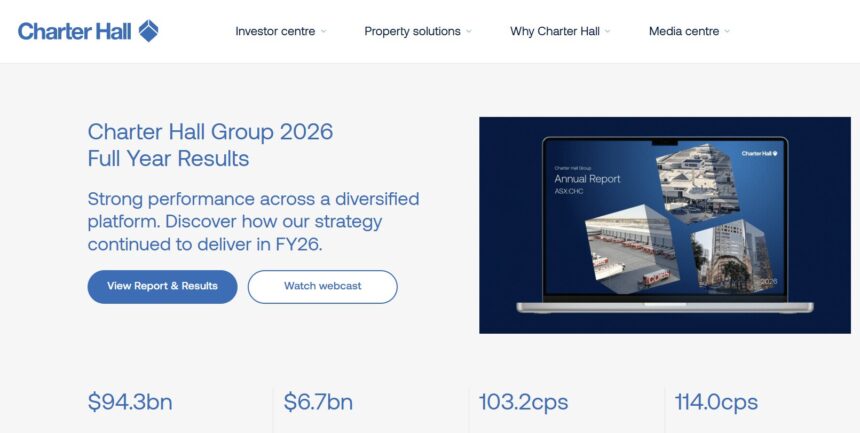
For the 2026 financial year, Charter Hall reported operating earnings of 488.1 million Australian dollars, with operating earnings per security rising 26.8% to 103.2 cents. Distributions per security rose 6.0% to 50.7 cents.
Group funds under management reached 94.3 billion Australian dollars at the end of the financial year, supported by 6.7 billion Australian dollars in gross equity inflows. The platform also completed 17.1 billion Australian dollars of property transactions during the year, while its development pipeline stood at 20.4 billion Australian dollars.
Looking ahead, management guided to fiscal 2027 post-tax operating earnings per security of about 114.0 cents, representing expected growth of about 10.5%. Distribution growth was guided at around 6%. The company’s guidance assumes no performance fee revenue, reducing reliance on more volatile income sources.
Charter Hall’s balance sheet also remains conservatively positioned, with gearing of 14.2%, giving the group flexibility to fund development activity or pursue new investments without significantly increasing its debt load.
Recent shareholder changes
The recent weakness in the stock has coincided with some changes on the company’s register. Filings showed that TAL Dai-ichi, part of a Japanese life insurance group, ceased to be a substantial holder of Charter Hall securities last week.
Even after Wednesday’s rally, the stock remains well below its peak. As of Sept. 21, shares were trading around 18.32 Australian dollars, roughly 20% below their 52-week high.
About Charter Hall
Charter Hall is one of Australia’s largest property investment and funds management groups. Investors hold one Charter Hall Property Trust unit and one Charter Hall Limited share stapled together and jointly quoted on the ASX under the code CHC.
The group oversees more than 40 retail and institutional unlisted funds, as well as three listed REITs: Charter Hall Long WALE REIT, Charter Hall Retail REIT and Charter Hall Social Infrastructure REIT. Its portfolio spans office, industrial and logistics, retail and social infrastructure assets.
What’s next for investors
Analysts have pointed to the direction of interest rates as the key driver for the stock in coming months. Signals that the tightening cycle is nearing its end could stabilize bond yields and support a recovery in listed property prices.
However, risks remain. The company is exposed to commercial property transaction volumes, asset valuations and investor appetite for unlisted property funds, while performance fees can add volatility to earnings.
Competition for investor capital has also intensified as fixed income yields rise, which could test whether the record inflows of the past year can be sustained.
Investors will next focus on the September consumer price index, due Oct. 28, and the RBA’s Nov. 3 policy meeting for further clues on whether the rate-sensitive property sector’s rebound can continue.