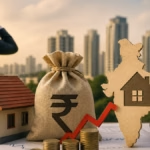

They didn’t stumble into this. They didn’t wake up one day and realize the bubble had burst. They chose this. “Houses are for living, not speculation.” That was the policy. That was the order from the top. It sounded noble. It sounded like a fix for a market that had turned shelter into a casino. But it wasn’t a fix. It was a controlled demolition. And the people inside the buildings were the demolition crew, whether they knew it or not.
The Chinese government looked at the real estate sector, which at its peak accounted for a quarter of the world’s second-largest economy, and they decided it was too big. Too dangerous. Too unstable. So they popped it. They introduced the “three red lines.” A hard cap on how much debt developers could carry relative to their assets, their cash flow, and their lending. They choked off the money. They forced the developers to face the math. The math was bad. Evergrande collapsed in 2021. Country Garden, the industry leader at the time, fell into default in 2023. Swathes of developers defaulted on payments. These weren’t accidents. These were the intended consequences of a policy designed to deflate the bubble before it swallowed the whole economy.
But when you deflate a bubble, the air has to go somewhere.
It went into the people.
The crackdown cut real estate debt by 17%. It crushed speculation. It lowered systemic risk. But house prices continue to fall. New-home prices in 70 major cities have fallen year-on-year for 31 consecutive months as of January 2026. Average secondhand prices across 30 major cities declined 39%. The declines in smaller cities are likely even steeper. The government calls it a “stable contraction.” That’s the term. Stable contraction.
She bought in 2018. A three-bedroom apartment in Wuhan. On the 22nd floor of a tower built by Evergrande. Her and her husband’s life savings for the down payment. 60%. Three hundred thousand yuan. Her parents chipped in another hundred thousand from their pension. That’s four hundred thousand. That’s every yuan they had. The apartment was supposed to be wealth. It was supposed to be security. It was supposed to be the asset that funded their child’s education and their own retirement. That’s what the culture promised. That’s what the market delivered. For a while. Now the apartment is worth 40% less. She owes more than it’s worth. She can’t sell. She can’t move. She can’t consume. Her parents’ pension is gone. Not reduced. Gone. Absorbed into concrete that loses value every month. Her mother is 72. She should be retired. She’s working as a cleaner because the pension went into the apartment and the apartment is worth less than the loan. Three generations. One policy. Wiped out. Nearly 70% of Chinese household wealth sits in property. Less than 10% sits in equities. The government ate the demand to save the system. She’s left holding the concrete.
And the system is eating itself to survive. Local governments are structurally in deficit. Land sales, once a local-government cash cow, are structurally impaired by the property crisis. The IMF estimates Local Government Financing Vehicle debts at 60 trillion RMB, or 48% of GDP. Official public debt sits at 71 trillion RMB, or 69% of GDP. The numbers are staggering. But the numbers aren’t the story. The story is the cleaner who can’t retire because her pension went into a tower that’s losing value. The story is the local government that sold the land to fund the schools and now can’t pay the teachers because the land is worthless. Beijing is doubling down on proactive fiscal policy, ultra-long special treasury bonds, special bonds for local debt resolution, and central transfers, but revenue generation remains the binding constraint. Early 2026 fiscal data confirm continued weakness. Revenue growth is anemic at +0.7% in January-February while spending accelerates at +3.6%. The government is relying on debt to paper over revenue shortfalls, signaling a fiscal model hitting structural limits.
The property sector’s total drag on GDP growth, inclusive of upstream and downstream spillover effects, is projected to narrow from 2 percentage points in 2025 to 1.5 percentage points in 2026. Progress. The bleeding is slowing. But the patient is still bleeding. Banks have been given the green light to extend the maturities of whitelisted loans by up to five years, in anticipation of lingering repayment stress among developers. Commercial banks have approved over RMB 7 trillion in loans under the whitelist mechanism. The banks keep lending to avoid recognizing the losses. The local governments, who sold the land to fund their budgets, are drowning in debt. The “intricate and tight interconnections between financial institutions, the real estate sector, and local and central governments” create a fragile environment. Fragile. That’s the word. The system is fragile because the system is the bubble. The state is the bubble. And the state chose to pop it.
The authorities are wary of the risk of triggering social unrest with layoffs, debt write-offs and other measures that would involve significant pain. They’re managing the collapse. They’re controlling the demolition. But the pain is real. The “stable contraction” is a contraction of hope. The “new development model” is a model where the middle class pays for the excess of the developers and the corruption of the local governments.
And you look at this, and you think: what the fuck is going on here in the US?
Because we have the bubble. We have the speculation. We have the housing as investment. We have the Blackstones and the Zillows and the private equity firms buying up single-family homes to rent back to the people who used to own them. We have the median home price that is six times the median income. We have the $532 billion beauty industry and the $20,000 childcare bills and the wage stagnation that forces two incomes just to make rent.
But we don’t have the control.
When China’s bubble pops, the state steps in. The state refinances the debt. The state extends the loan maturities. The state “stabilizes” the market by fiat. It’s authoritarian. It’s brutal. It destroys the middle class to save the Party. But it’s managed.
When our bubble pops, the state steps in for the banks. The 2008 bailout. The quantitative easing. The asset purchases. The government saved the institutions and left the people to foreclosure. He was 34 in 2008. A carpenter in Phoenix. He’d bought a three-bedroom in 2005 with an adjustable-rate mortgage. The rate adjusted. The payment doubled. He couldn’t refinance because the house was worth less than the loan. The bank took it. He moved into an apartment. His wife left. He’s 52 now. He rents. He will never own again. A generation that will never own a home. We have the same bubble. We have the same speculation. We have the same “housing as wealth” lie. But when our bubble pops, we don’t get a “stable contraction.” We get a Great Recession. We get eviction courts. We get tent cities. We get a carpenter in Phoenix who lost the house and never got it back.
China did this on purpose. They saw the cliff and they drove off it because they thought they could steer the fall. They’re still falling. The property crisis will stalk the economy into 2026. The local governments are insolvent. The people are trapped in apartments worth less than the debt they carry.
We’re doing the same thing. We’re building the same bubble. We’re telling the same lie. “Housing is wealth.” “Housing is an asset.” “Housing is an investment.”
It’s not.
It’s shelter.
It’s a human right.
And when you turn a human right into a speculative asset, the crash isn’t an accident. It’s the only possible outcome. The only question is who pays. In China, a 72-year-old cleaner pays. In America, a carpenter in Phoenix pays. The system is different. The bill is the same.
The concrete was the lie. The lie is collapsing. And the people who believed it are buried in the rubble.
Follow the Vanguard on Social Media – X, Instagram and Facebook. Subscribe the Vanguard News letters. To make a tax-deductible donation, please visit davisvanguard.org/donate or give directly through ActBlue. Your support will ensure that the vital work of the Vanguard continues.
Categories:
Tags:
China Country Garden Economic Policy Evergrande Global Economy Housing Affordability Housing Market Real Estate Crisis