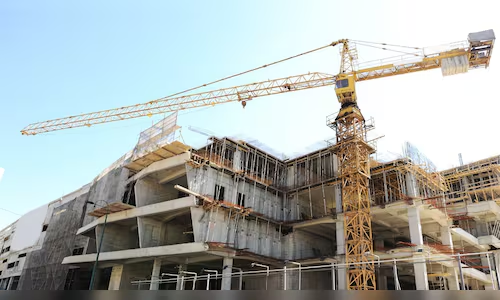
Across the National Capital Region (NCR), Mumbai Metropolitan Region, Bengaluru and Pune, projects that had remained frozen for years due to liquidity stress, legal disputes and developer defaults are now returning to construction mode, offering relief to thousands of homebuyers who had nearly lost hope of getting possession.
The latest trigger for renewed attention on the segment came after the Supreme Court restored Alpha Corp Development Ltd’s resolution plan for three stalled Earth Infrastructures projects — Earth TechOne, Earth Sapphire Court in Greater Noida and Earth Copia in Gurugram — overturning an earlier NCLAT order that had rejected the proposal.
While the Alpha Corp case is significant because it impacts over 3,000 homebuyers and commercial-space buyers, industry experts say it reflects a much broader trend underway in India’s real estate market: stalled projects are increasingly being viewed as revival opportunities rather than dead assets.
The Supreme Court, in its May 5 judgment, observed that further delays would seriously prejudice homebuyers who had invested substantial amounts into these developments. The court also limited the Greater Noida Industrial Development Authority’s recovery to principal dues, waiving penal interest and related charges, while directing that no additional burden be passed on to homebuyers.
Alpha Corp has proposed an investment of nearly ₹750 crore for completion and redevelopment of the projects, which are estimated to carry a revenue potential of around ₹1,200 crore.
But beyond one project resolution, the ruling is being seen as a key moment in the evolution of India’s stressed real estate market.
A decade-long crisis
India’s stalled housing crisis traces its roots to the aggressive expansion cycle between 2010 and 2016, when developers launched large-scale residential projects backed by easy funding and expectations of endless demand growth.
The slowdown that followed — triggered by demonetisation, implementation of RERA, NBFC liquidity stress and later the pandemic — exposed weak balance sheets across the sector. Thousands of apartments remained incomplete as developers ran out of capital, leaving buyers trapped between EMIs and rent payments.
NCR emerged as the epicentre of the crisis, with cities such as Noida, Greater Noida, Ghaziabad and Gurugram witnessing some of the country’s largest concentrations of delayed housing projects.
According to industry estimates and government data over the years, lakhs of housing units across India faced delays, with many projects stalled for more than five to ten years.
Now, however, market dynamics are changing.
India’s post-pandemic housing rebound — especially in premium and luxury housing — has sharply improved real estate cash flows. Property prices in major cities have risen substantially, making distressed projects commercially viable again.
Developers are increasingly preferring partially completed projects with existing approvals and captive buyer bases over expensive greenfield land acquisitions.
SWAMIH changes the equation
One of the biggest catalysts behind the revival trend has been the government-backed SWAMIH (Special Window for Affordable and Mid-Income Housing) Fund.
Launched to provide last-mile funding for incomplete residential projects, SWAMIH has emerged as a critical rescue mechanism for stressed housing developments that were otherwise starved of liquidity.
By late 2025, the fund had reportedly facilitated completion of over 61,000 homes and committed capital across more than 145 projects in multiple cities.
Finance Minister Nirmala Sitharaman has also announced plans for SWAMIH Fund II with a proposed corpus of ₹15,000 crore aimed at accelerating completion of around one lakh additional housing units.
The revival activity is now visible across several cities.
In Bengaluru, Ramky Estates recently took over large stalled residential developments from Skylark Builders after receiving SWAMIH-backed support for project completion. The projects are expected to benefit nearly 1,900 homebuyers.
In Greater Noida, the long-delayed Antriksh Valley project is also being revived through SWAMIH funding after years of construction delays and liquidity stress.
Several other NCR projects undergoing insolvency proceedings are similarly witnessing renewed investor and developer interest.
Insolvency route gains momentum
Legal experts say the Insolvency and Bankruptcy Code (IBC) is increasingly becoming the preferred mechanism for resolving stressed real estate assets.
Homebuyers are recognised as financial creditors under the IBC framework, giving them representation in insolvency proceedings and strengthening their negotiating power.
Courts, too, are increasingly favouring project completion over liquidation, particularly in cases where thousands of homebuyers are involved.
The Supreme Court’s latest observations in the Earth Infrastructure matter are also being viewed as important because they reinforce the principle that insolvency resolutions in real estate must prioritise practical completion and buyer protection over procedural delays.
The judgment further underlines growing judicial recognition that prolonged project delays carry wider economic consequences, affecting household savings, banking exposure and urban consumption patterns.
A new asset class emerges
For stronger developers and investors, stalled projects are now emerging as a specialised opportunity within the real estate market.
Instead of acquiring costly land parcels in high-demand urban locations, companies can enter partially completed projects where key approvals, land aggregation and customer acquisition are already in place.
However, execution risks remain high.
Many stressed projects continue to face unresolved litigation, approval bottlenecks, legacy liabilities and infrastructure gaps. Developers taking over such projects often need substantial capital for redesign, construction upgrades and customer rehabilitation.
Yet, the momentum behind project revivals suggests India’s real estate market is gradually entering a consolidation phase where financially weaker developers are being replaced by stronger balance-sheet players.
For homebuyers, that transition could prove critical.
After years of mistrust surrounding under-construction projects, the revival of stalled developments is slowly helping restore confidence in the sector — particularly at a time when housing demand remains resilient and real estate prices continue to climb across major cities.