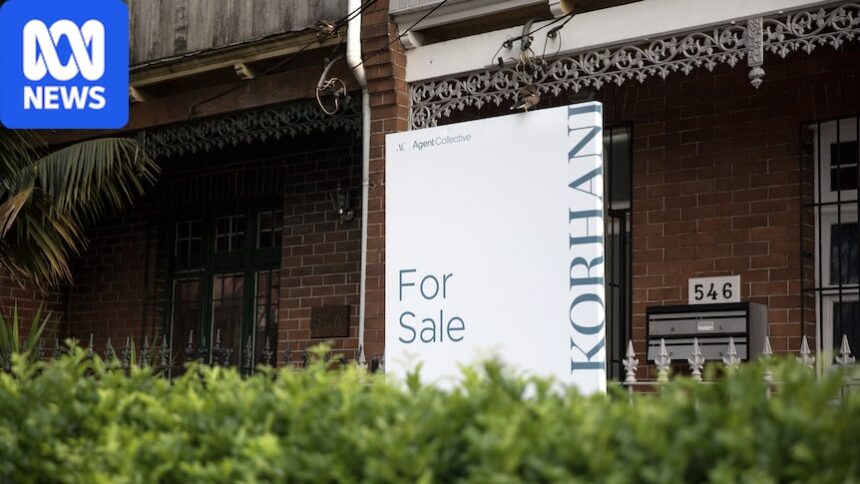
Initial asking prices are falling and homes are sitting for longer as the housing market cools across Australia.
During a period of global economic instability, domestic tax reform and sustained higher interest rates, buyers and sellers in the Australian property market have been adjusting their approach to transactions.
“These cumulative effects over the last six or so months have dragged demand lower significantly,” said Cotality’s head of research, Gerard Burg.
To get a sense of how this uncertainty is playing out in the market, here is what four sets of data tell us.
Asking price over time
After decades of rapid growth, Australia’s housing market is beginning to cool.
One piece of evidence that shows this is asking prices.
Buyers have been paying up to 3.6 per cent less than the original sale price for private treaty purchases across the combined capital cities in the past three months, according to data from Cotality.
That is up from 3 per cent in the March quarter.
Mr Burg said he had seen a steady increase in the level of discounting since late last year.
“When there are fewer buyers, less competition and sales are taking longer to transact, that leads to a tendency towards larger discounts,” he said.
Freedom Property sales agent Tomas Tonks-Foote said he believed Redland City, 30 minutes south-east of Brisbane, was looking at a 10 per cent decline in house prices.
“A few years ago I used to say, ‘Whatever you think a house is worth, add another $100,000,'” Mr Tonks-Foote told the ABC.
“Now what I’m thinking is that, but in reverse.”
Data from Homer, a property app that analyses agent sale trends to give more accurate price guides, also shows that vendors have lowered their prices.
More than a quarter (25.5 per cent) of the 144,772 listings the app tracks nationally have issued a second price guide that is lower than the first one.
The ACT has recorded the highest share of any state (37.3 per cent) when it comes to active listings with lowered price guides, followed by Queensland (27.3 per cent) and New South Wales (27.1 per cent).
Homer CEO Henry Pedersen said at the beginning of the year there were almost no price guide drops across Australia, but that has changed dramatically.
“It’s a fantastic time for opportunistic buyers to find real value whilst confidence is low,” Mr Pedersen said.
“With prices rolling back, it’s never been more important to price in line with the market. Get it wrong, and you are left making painful reductions just to catch up.”
Auction clearance rates and withdrawal sales
Another sign the market is shifting is the collapse in auction sales, leaving more homes on the market for longer.
In the four weeks to July 12, Australia’s auction clearance rate was below 50 per cent, according to Cotality data.
Fearing their homes will not sell, 40 per cent of vendors are signing contracts before auction day.
Meanwhile, close to 20 per cent of scheduled auctions were withdrawn in the week to June 21. While this figure is volatile from week to week, the proportion of withdrawals has trended up since Labor unveiled its tax shake-up for investors.
A year ago only 11.5 per cent of would-be vendors pulled out of the auction process.
“The rate at which the market is slowing right now is faster than what a lot of potential vendors have been expecting,” Mr Burg said.
“The trend towards selling prior is more just that unwillingness to take the risk that the auction might be unsuccessful and try to lock something a bit more guaranteed, even if it might be below what you were seeking.”
Australia’s auction clearance rates have dropped dramatically in the past couple of months. (ABC News: Charlie Mclean)
Time on market extending
Homer data shows the national median days on market in June was 42 days, up from 33 in May and 27 in November 2025.
Homes are taking longer to sell in every state in the past three months.
Western Australia recorded the largest jump in median days on market, nearly tripling between March and June.
Data from realestate.com also shows national median days on the market have extended in the past three months, albeit at a less inflated pace:
- April: 30 days
- May: 32 days
- June: 36 days
REA Group senior economic analyst Megan Lieu said the numbers were showing a moderation in market activity, with buyers taking longer to transact.
“With new listings increasing in most capital cities and total listings up in both Sydney and Melbourne year on year, buyers may be benefiting from greater choice, reduced competition and increased negotiating power,” Ms Lieu said.
“At the same time, we have seen buyer and seller expectations becoming less aligned.
“Over the next few months, vendors may become more responsive to slowing market conditions and reassess their pricing expectations.”
Mr Tonks-Foote said homes in the Redlands were looking at a seven to 14-day sales timeline before the three rate rises and budget came into effect.
Now, he is telling his sellers that a six-week campaign to find a contract is the expectation.
“There used to be 15 groups on average coming through any open home,” Mr Tonks-Foote said.
“But now we’re seeing about five groups for the first open home and then between one and three for the weeks following.
“From 2013 right through to 2019 that was business as usual. So it’s not that we’re not meeting any buyers, we’re just drawing back to a plateau.”
Tomas Tonks-Foote is optimistic on how the market will fare towards the second half of 2026. (Supplied)
He said realestate.com enquiry traffic was down 50 per cent on pre-budget numbers.
“It shows that things are obviously going to take twice the time to sell when you’re dealing with half the volume of buyers,” Mr Tonks-Foote said.
What about the rest of 2026?
Some experts believe there is nothing significant that will turn around the weakness in demand.
The interest rate position is unlikely to change, rates will either remain on hold or increase, while the war in Iran is still bubbling away.
“I think the reality is we are now in a property downturn that is set to continue at least for the next six months or so,” Mr Burg said.
HSBC’s chief economist Paul Bloxham said the downturn was “just the beginning”.
“As we see it, first home buyers and other owner-occupiers are unlikely to want to try to catch a falling knife,” he said.
But Mr Tonks-Foote is a little more optimistic on where the market is heading.
“From my past experience, every time there’s an election, end of financial year, and budget and rate changes, everybody waits to see what that means for them,” he said.
“And with the war in Iran and fuel crisis we’ve had bad news after bad news, which has led to so much negative sentiment in the market.
“But come September, October, I think we might be having a different conversation and see the market moving in the right direction again.”