📖EP4: Don’t let inherited vacant land sit idle. How to determine the best use for your land, from coin-operated parking to monthly rental parking lots
Good evening, this is Hiro Mori.
I am sincerely grateful that you stopped by this site from among the vast amount of information available and chose to spend your valuable time reading this article.
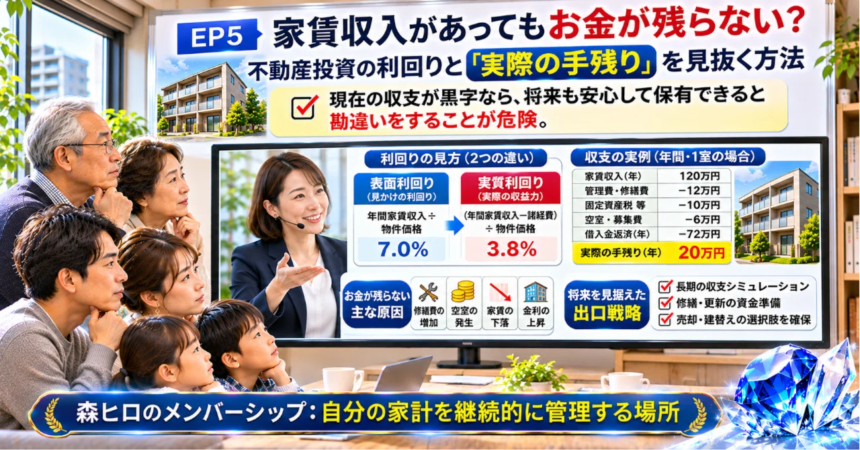
This article is written for those struggling with the structure of apartment management or condo investment where funds do not remain on hand despite earning rental income, in order to convey the reality behind gross yields.
Based on the field knowledge I have cultivated over 30 years in the construction industry, including apartment design and cost estimation, I will help you establish a decision-making axis for asset management that truly protects your family.
[Illusion | The assumption that if you have high yields and rental income, profit will remain on hand]
When considering real estate investment or the rental use of inherited real estate, many people believe in the figure that ‘if rent comes in every month, it will definitely be profitable.’
When they see the high gross yield figures dancing in a proposal, it feels like an attractive income and expenditure plan that promises increased sales.
Especially if it is an inherited property for which you did not pay the purchase cost yourself, you tend to harbor the illusion that most of the incoming rent will become profit on hand as is.
However, many of the yield calculations presented in sales materials are constructed assuming full occupancy with zero vacancy risk.
You must not look away from the reality of cash flow after deducting management fees, repair costs, unexpected vacancy losses, and loan repayments to financial institutions.
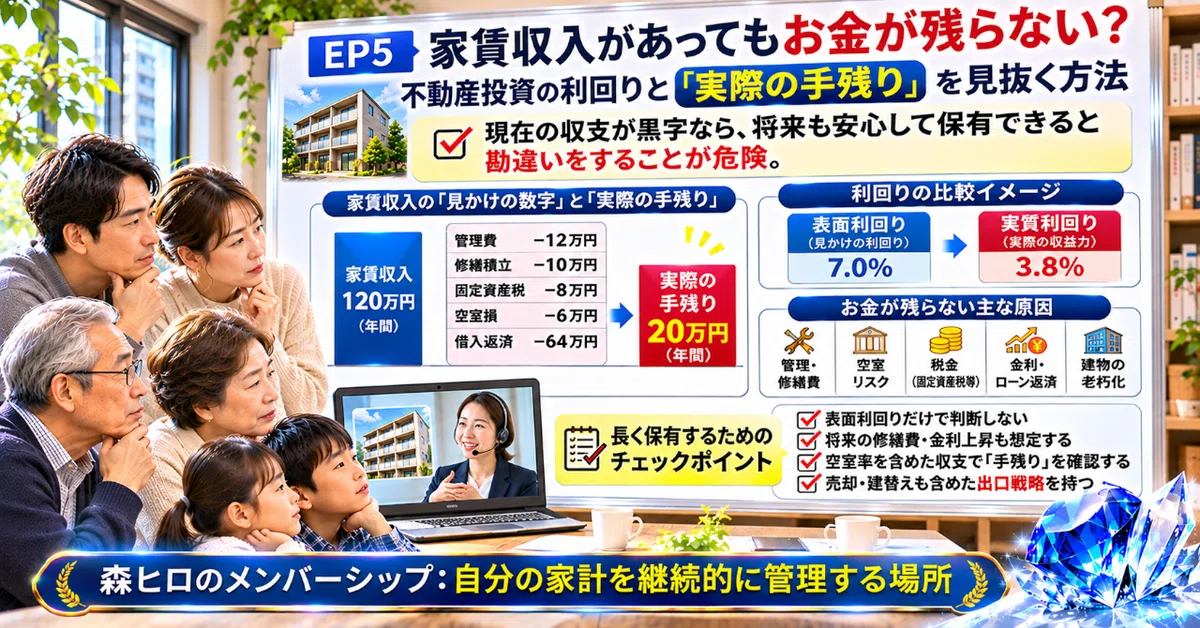
[Sense of discomfort | The amount remaining on hand is treated as a minor detail in the shadow of talk about large incoming sums]
Having been involved in the income and expenditure plans of numerous rental housing projects for 30 years, I have always had a strong, lingering sense of discomfort.
That is the point that while talk of large rental income and high gross yields is discussed glamorously, the thinness of the cash actually remaining on hand is treated as a minor detail.
Only superficial figures like ‘8% yield’ walk alone, and the harsh conditions and risks under which those figures are established are not discussed.
After deducting management fees, property taxes, unexpected interior repairs, and the heavy burden of loan repayments, the amount remaining in the owner’s hands is very small—cases like this are endless.
The stance of showing dreams with beautiful numbers while covering up the fact of increasing costs cannot be called practical design that protects a family.
[Misconception | The Danger of Believing in Future Security Based Solely on Current Full-Occupancy Balances]
The most dangerous misconception in real estate investment is thinking that if the current balance is in the black, you can safely hold the property in the future as well.
People tend to seek short-term hacks or easy-to-understand indicators, trying to buy peace of mind with a single number like, ‘It’s fine because I’m receiving rent.’
However, the balance that held up when the property was new or recently built will inevitably fall apart as the building ages due to the structure of declining rents and rising repair costs.
As the building gets older, the cycle of move-ins and move-outs accelerates, and out-of-pocket expenses during vacancy periods begin to directly pressure your household finances.
Judging value based on a single number or a temporary impression while turning a blind eye to future uncertain burden structures is extremely dangerous.
[Structure | Why Money Doesn’t Remain Even With Rental Income]
The real reason money doesn’t remain is not because rental income is low, but because of the structural distortion of viewing rental management only as the difference between rent and loan repayments.
Against the monthly inflow of rent, there are multiple outflow channels such as management fees, repair reserve funds, property taxes, and loan principal and interest repayments.
Furthermore, it is a major problem to think about the cash flow of the real estate alone, separate from the BS design of your entire household budget, which integrates your pension, NISA, and real estate income.
The ‘profit (black ink)’ on the books does not match the ‘cash balance’ on hand, and the burden of tax payments and loan principal repayments will erode your cash on hand.
You cannot achieve long-term success (maximizing what remains) with a rough balance plan that does not view expenses and future burdens as a single entity.
[Blind Spot | Large-Scale Repairs and the Wall of Management Responsibility Hidden Behind Full-Occupancy Assumptions]
The biggest blind spot that many people overlook in real estate management is the large-scale repair costs that are guaranteed to strike once every few to dozen years and the time burden on the owner.
Costs such as exterior wall painting, roof waterproofing, replacement of water and sewage pipes, and simultaneous replacement of air conditioners and water heaters occur as maintenance costs that cannot be avoided.
There are not a few cases where the NISA design or planned withdrawal schedule you are pursuing for your retirement funds are blown away by sudden repair supplements.
Even if you use outsourced management to automate management physically, it is impossible to automate the responsibility of supplementing funds when adverse conditions overlap.
Rather than being swayed by the height of the yield, the perspective of whether funds and management can continue even when the worst conditions overlap is the biggest blind spot.

[Design | If it’s Hiro Mori, judge based on net cash flow after deducting all expenses]
If I were in the position of receiving a consultation, I would not take the gross yield or assumed full-occupancy rent at face value, but would perform a cash flow simulation based on cold, hard data analysis.
After deducting vacancy rates, rent declines, operating expenses, repair reserves, loan repayments, and taxes, I will clearly determine exactly how much cash will remain in the end.
I will carefully visualize the current state of the property with numbers and strictly verify whether it has the effect of increasing CVR (asset efficiency) in your household balance sheet.
I will compare and examine not only the path of continuing to hold the property, but also the reallocation of funds obtained from selling it to invest in NISA or other vehicles, in a state where PDCA cycles can be implemented.
A design that prioritizes ‘how much will remain in hand even under strict conditions’ rather than ‘how much will come in’ is the answer I have derived from 30 years in the field.
[Notes]
* This article is intended to provide general tax information; please be sure to consult a tax accountant regarding individual tax processing.
* Asset management involves risks. Please make final investment decisions or decisions such as establishing a corporation at your own responsibility and after consulting with professionals (tax accountants, lawyers, etc.) as necessary.
* This article is intended to provide general information. Please be sure to consult a real estate company or a licensed real estate notary regarding individual real estate transaction processing, and proceed at your own responsibility.
* The specific amount of Employees’ Pension Insurance varies depending on individual enrollment periods and compensation records. You cannot determine your future pension amount from just one item on your pay stub.
* Assertive or exaggerated expressions that may violate the Act against Unjustifiable Premiums and Misleading Representations are avoided, and descriptions are based on facts or hypotheses.
* The content in this article is protected by copyright. Unauthorized reproduction or external sharing is strictly prohibited.
[Action | The next step is to organize actual deposit amounts and recalculate remaining cash]
To break out of the state where you have no money left despite having rental income, it is necessary to uncover all the numbers for actual deposits and expenditures.
Close your superficial yield calculation sheet and try subtracting all fixed costs, repayment amounts, and future repair reserve amounts from the amount that actually entered your account over the year.
It is important to stop the simplistic thinking of ‘I’ll keep it because rent comes in,’ and to pose the action-prompting question of ‘is this an asset I truly want to leave for my family’ even after subtracting future burdens, even after subtracting future burdens.
Can the rental income you are seeing truly be called an asset that remains in your hands after all risks and expenses have been deducted?
We reveal in detail how to accurately calculate the true remaining cash flow, as well as numerical comparison methods for improving income and expenditure and making sales decisions, in the paid ‘Deconstruction Design’ edition, which includes case studies.

[Membership Information]
Real estate investment and the rental management of inherited properties do not end the moment you receive rental income.
It is essential to have a perspective that coldly anticipates future repair costs and tax burdens, and continuously manages the balance sheet of your entire household while coordinating with pensions, savings, and NISA.
In Hiro Mori’s membership, we go beyond simply providing knowledge; we offer monthly updates on specific design examples, member-exclusive Q&A to resolve individual uncertainties, and practical worksheets.
‘Should I keep holding it?’, ‘Should I sell it and reallocate my assets?’, or ‘Should I choose a different path?’
Before you are deceived by gross yields and have your available funds drained away, if you want to make correct judgments based on your entire household finances and continuously protect your precious assets and your family’s future, please obtain your blueprint here.