History Gives Important Clues to The Next Big Bear Market
Like hurricanes that often strike our nation, cliff-dropping bear markets are unique but not uncommon. In fact, every past generation has experienced major bear markets (1906-07, 1929-32, 1973-74, 2000-02, 2008-09) where stock market losses exceeded 30%, and the financial devastation is well remembered.
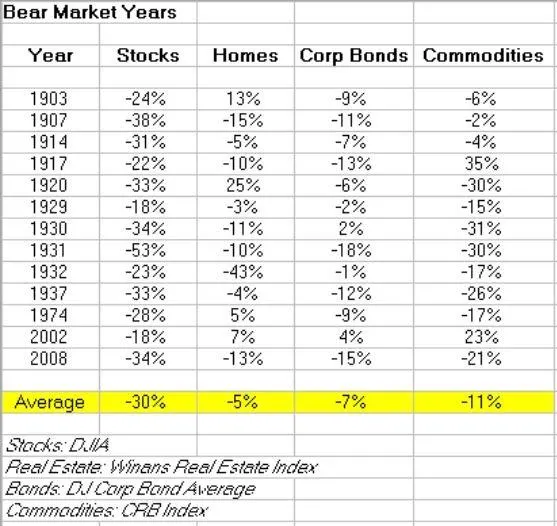
Since 1900, there have been 14 times in which the Dow Jones Industrial Average declined at least 20% within a single year. Worse yet, there is no “shelter” to escape to as real estate, bonds and commodities also suffered steep declines during most of these periods and cracked the foundations of even the best-diversified portfolios (see table below).

Bear Market Years
Ken Winans
The “Hows & Whys” Seem to Rhyme!
Mark Twain said, “History doesn’t repeat itself, it just rhymes.” This might explain why historical comparisons are often misunderstood or blatantly ignored.
There are 5 common ingredients in these 14 bear markets:
- Over-leverage and illiquidity burst bubbles in all types of financial instruments.
- Many of Wall Street’s newest innovations went awry.
- Investors responded negatively to failed government actions and over-regulation.
- Major military conflicts or the threat of conflicts caused investor panic.
- New investment themes come & go with every bull market.
Simply put, the dates have changed, but the causes were similar!
Today’s Threats
There are comparable situations currently developing that could trigger and exacerbate the next major bear market:
- “Blue State” Municipal Bond Default – In 2008, the invincible housing market collapsed having its worst decline since World War Two. Highly leveraged & illiquid mortgage-backed investments (with a market value of $1.3 trillion) crashed in price, leading to a global credit freeze as several major investment firms failed.
Today, Wall Street is buying into the same fallacy that municipal bonds “never” lose value. The outstanding U.S. municipal debt is valued at $4.5 trillion with fiscally reckless California, Illinois and New York owning half of it. As stated in my 2024 Forbes article, A Municipal Titanic “California currently has the sixth largest economy in the world, but unlike a sovereign country, it can’t print currency to pay its debts. This is why U.S. treasury bonds are considered risk free and CA muni bonds aren’t.”
- Federal Reserve Balance Sheet Contraction – As the lender of last resort, the Federal Reserve absorbed massive amounts of Treasury obligations during the War on Terror, The Great Recession and Covid Pandemic. The New Fed Chairman has indicated that it’s time to reduce its portfolio of Treasury bonds. If this “Quantitative Tightening” is not executed well (like the 1930s), watchout!
- 24/7 Stock Trading with No Circuit Breakers – After the 1987 stock market crash, the U.S. financial exchanges put in place periodic circuit breakers to halt trading during extreme volatility to claim investors down. With 24/7 trading in Crypto inventions like tokenized equities and stock market wagers entering prediction markets, I “bet” we might see weekend “flash crashes” on a frequent basis.
- AI Mania Resembles Dot.com Bubble – 21st century technology has changed our lives, but not all tech stocks are good investments in the long term. Like the Nifty Fifty of the 1970s or the Dot.com of the 1990s, AI companies could eventually have a valuation washout where only best companies survive.
- False Investment Diversification – According to Morningstar®, there are now more exchange-traded funds than publicly traded stocks in US markets. To the average investor, this can cause a diversification illusion. While they have diversity in popular ETFs within their portfolios, they have cumulated high exposure in volatile stocks & industries (like AI) within each of these products.
- Flying Blind with No Reliable Benchmarks – In 1896, Charles Dow invented the Dow Jones Industrial Average to be a market benchmark, not an investment product. As discussed in my recent Forbes article, “Stock Market Murkiness: Is S&P 500 a Benchmark or Managed Portfolio?”, the revolving door of component changes in both the S&P 500 Index and DJIA have rendered both indices of limited use for fundamental and technical analysis of the stock market. Simply put, “trend is your friend” if you can verify the trend’s accuracy.
What Should Investors Do Now?
A simple question needs to be asked, “Why did the majority of modern investors, the most knowledgeable and technologically advanced in history, mishandle the Dot.com stock bubble of 1999, the nothing down real estate frenzy and asset freefall of 2008, and the pandemic panic of 2020.”
Answer: A lack of knowledge about U.S. financial history!
Clearly, the constant barrage of news, earnings projections, economic reports and advice from respected professionals streaming over media outlets 24 hours a day hasn’t helped investors tackle the problems of successful investing.
Ultimately, people’s emotions (greed and fear) about money and investing haven’t changed much over time, and their actions typically resemble those of their ancestors.
It is also helpful to remember that there is very little that is truly new in the world of investing. Stocks, bonds, real estate and commodities are continuously repackaged and renamed by Wall Street, but the basics in the money game are the same as when my grandfather worked in this business.
If investors want to break the vicious buy high, sell low cycle that plagues them in bear markets, they should be more of a historian and less a financial analyst. A good place to start is by studying past market corrections and what happened during the years that followed – a good project for AI tools!
Now is a good time to put history to work and plan ahead for the next Big Bad Bear!