I am Hatanaka, and I run a real estate company in Okayama Prefecture.
“I was recommended a newly built apartment, but it’s wooden, and it seems a local builder is constructing it.”
“Wouldn’t a major house manufacturer be safer, somehow?”
I often hear these comments from people who have started considering real estate investment for asset formation.
To be more specific, these are the questions:
“Isn’t new construction overpriced just because the contractor’s profit is added?”
“I heard that wooden structures lose their value in 22 years, so isn’t it difficult to get a loan?”
“I have an image that wooden apartments are noisy and cheap-looking.”
“Won’t local builders go bankrupt or have inconsistent construction quality?”
“In that case, wouldn’t a major house manufacturer be the safer bet?”
I understand those feelings well.
When I receive consultations about real estate investment for the first time, I almost always encounter these questions.
I want to tell you beforehand that today I am not trying to say that “New Construction x Wood x Local Builder is absolutely the correct answer.”
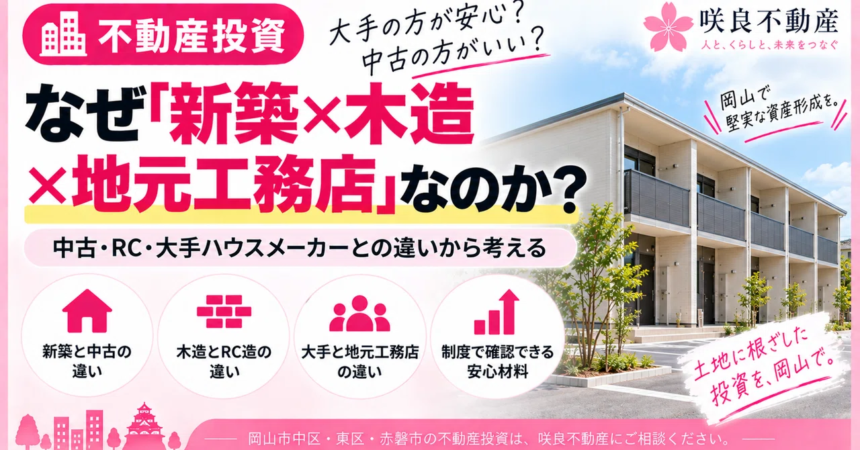
I will organize the differences between used, RC structures, and major house manufacturers based on their respective structures, and provide you with the materials to make a convinced decision.
In the previous article, “Is a 7% gross yield high or low?“, I talked about how to look at the number called yield.
If you are interested in the “contents of the property itself” behind the numbers, I think reading today’s article as well will help connect your understanding.
■ Main Part 1: New vs. Used — Differences in Price, Yield, Financing, and Repair Costs
First, let’s organize the basics of what is different between new and used properties.
As a general trend for price ranges and yields, it is an industry standard that the yield for used apartments is often around 8-12%, while new apartments are around 4-6%.
The new wooden apartments brokered by Sakura Real Estate are mainly projects with a gross yield of around 7%, which is slightly higher than this general standard of “new construction = 4-6%”.
However, this is a discussion about individual properties and not a figure that can be generalized.
Please read this with the premise that conditions vary by project, rather than a claim that “it yields 7% because it is new construction.”
There are also differences in financing conditions.
New construction tends to be easier to evaluate for collateral, making it easier to get loans approved and often allowing for longer loan terms.
For used properties, conditions change depending on the age of the building, often resulting in shorter repayment periods, higher interest rates, or in some cases, making it difficult to secure financing at all.
The difference in depreciation is a clear matter based on the law.
Statutory useful life (22 years for wooden, 27 years for lightweight steel, 47 years for RC) is determined by law as the tax depreciation period.
Since used properties are recalculated using a simplified method based on this remaining useful life, there is a difference in that the depreciation period tends to be shorter than for new construction.
There are also differences in repair costs and tenant recruitment.
New construction has lower immediate repair costs and tends to have an advantage in tenant recruitment initially.
On the other hand, I will be honest and tell you that due to the loss of the “new construction premium,” rents tend to drop after about 10 years of occupancy.
I do not intend to unilaterally say that “it is safe because it is new construction.”
As a countermeasure, one way of thinking is that if you set the rent at the market rate from the time of new construction, it is easier to suppress the decline after the 10th year (please take this as one approach, not an absolute rule).
I will summarize the points discussed so far in a table.
Item New Construction Used | Yield Estimate (General Theory) Approx. 4-6% (Approx. 7% for Sakura Real Estate projects) Approx. 8-12% | Financing Tends to be easier to approve and longer term Depends on building age, tends to be shorter term and higher interest rate | Depreciation Full statutory useful life can be used Remaining life is short, depreciation period tends to be shorter | Initial Vacancy Risk Tends to be low (latest equipment, new construction premium) Varies by property | Medium to Long-term Rent Trend Tends to drop after about 10 years of new construction Tends to be a gradual decline | Initial Repair Costs Tends to be low Likely to occur | On social media, there are voices saying, “New construction just includes the builder’s profit, so isn’t used more cost-effective?”
On the other hand, there is also the view that “used properties also include the seller’s profit, so profit or loss is not determined solely by whether it is new or used.”
The honest truth is that it cannot be said unconditionally which is more profitable.
■ Part 2: Wooden vs. RC Construction —— Differences in Construction Costs, Statutory Useful Life, Loan Periods, Soundproofing Performance, and Repair Costs
Next, we will look at the differences in the structures themselves.
Multiple media outlets agree that wooden construction tends to keep construction costs lower than RC or heavy steel construction.
While some data suggests that wood construction costs around 600,000 to 1.1 million yen per tsubo, and RC construction is about 400,000 yen per tsubo higher than wood, please note that there are significant regional differences.
Statutory useful life is legally determined as 22 years for wood, 27 years for light-gauge steel, and 47 years for RC construction.
Here, I would like to clarify one point that is often misunderstood.
This is strictly the number of years used for tax depreciation calculations and does not mean the physical lifespan of the building, implying it will become uninhabitable in 22 years.
There are many wooden apartments that have exceeded their statutory useful life but are still being lived in without issues, depending on maintenance.
I would also like to touch upon the impact on loan terms.
Financial institutions often set loan terms based on the statutory useful life, and there is a tendency for RC construction to be easier to secure long-term financing for.
On the other hand, there are financial institutions that allow loan terms exceeding the statutory useful life.
It cannot be uniformly said that wooden construction always results in shorter loan terms; the reality is that it changes depending on the financial institution, the borrower’s profile, and the collateral value of the property.
I would also like to accurately organize the image of soundproofing performance.
As a matter of physical principle, it is true that concrete has superior sound insulation performance.
However, recent wooden construction methods and sound insulation ratings have evolved, so the uniform image that “wood equals noisy” is becoming inconsistent with reality.
Even with RC construction, there are exceptional cases depending on the construction, such as the use of gypsum board on upper floors.
I believe the correct understanding is that the quality of construction and sound insulation ratings have a greater impact on the perceived quietness than the structure itself.
Regarding repair costs, it is known that there are differences depending on the scale.
For a small apartment with about 10 units, there is a tendency for there to be no major difference in the total repair costs over 30 years between wood and RC construction (estimates are approximately 17.4 to 21.6 million yen for wood, and approximately 17.7 million yen for RC (10 units of 1K)).
However, I will also note that as the number of units and exclusive area increase, the total repair costs for RC construction tend to rise.
I will also summarize the differences between wood and RC construction in a table here.
Item Wood RC Construction
Statutory useful life 22 years (tax years) 47 years (tax years)
Estimated construction cost Approx. 600,000-1.1 million yen/tsubo (large regional differences) Tends to be about 400,000 yen/tsubo higher than wood
Loan term Tends to be set shorter (depends on financial institution) Tends to be set longer
Soundproofing performance (principle) Tends to be inferior to concrete Tends to be superior
Soundproofing performance (reality) Perceived difference narrows depending on latest methods/ratings Exceptions exist depending on construction
Repair costs (30 years, 10-unit scale estimate) Approx. 17.4-21.6 million yen Approx. 17.7 million yen
If you look at properties while considering these characteristics of each structure, not just the yield, I think you will be able to see more of what lies behind the numbers.
For how to read yields, please also see the previous article, “Is a 7% Gross Yield High or Low?”
■ Part 3: Major House Manufacturers vs. Local Builders — A Neutral Comparison
From here on, we will look at the differences between the construction companies themselves.
I should note beforehand that this perspective is slightly different from choosing a builder for your own home.
What I am presenting here is a comparison from an investor’s point of view: “Can you build a property that tenants will choose at a reasonable cost?”
Regarding construction costs, there are cases where a price difference of 5 million to 10 million yen or more arises between major house manufacturers and local builders, even under the same conditions.
The reason for this is a structural difference: major house manufacturers tend to add costs such as advertising expenses, model home maintenance costs, and research and development expenses.
Design flexibility and construction time have a trade-off relationship.
Major house manufacturers focus on standardized specifications and tend to have shorter construction periods (about 2 to 4 months).
Local builders are more capable of responding flexibly to design changes tailored to tenant needs, but construction periods tend to be slightly longer.
I think it is neutral to view this as a trade-off between choosing speed of construction versus choosing cost and flexibility.
There are also two sides to the argument regarding after-sales support systems.
It is said that majors offer a uniform system through nationwide bases, while local builders can be expected to provide quick responses due to their proximity.
However, the reality is that the actual quality varies more based on the warranty content and track record of individual companies rather than the attribute of being “major or local.”
It is not a matter of which one is simply superior.
And, I will also address head-on the bankruptcy risk that many of you are likely concerned about.
In the construction industry as a whole, bankruptcies of small-scale businesses are said to be on an upward trend.
However, it cannot be simply stated that because it is a major company it is absolutely safe, or because it is a local builder it is dangerous.
This is because even among major house manufacturers, there are not zero cases of bankruptcy.
What is important is not “major or local,” but whether there are institutional safeguards in place, which I will discuss next.
For reference, in consumer surveys regarding the selection of contractors, the most emphasized item is “company reliability and track record” (approximately 37%).
Reliability cannot be judged by a single explanation, so it is considered effective to check construction track records and the voices of existing owners.
The following table summarizes the differences between major house manufacturers and local builders.
Item Major House Manufacturer Local Builder Construction Cost Tends to be higher (advertising expenses, R&D expenses, etc. are added) Tends to be kept down Design Flexibility Focuses on standards and specifications Tends to be more flexible with design changes Construction Period Tends to be fast (about 2-4 months) Tends to be slightly longer After-sales Support Uniform system through nationwide bases Expected to provide prompt response unique to close proximity Bankruptcy Risk Considered relatively low, but not unheard of Considered to have a higher tendency for bankruptcy among smaller businesses ■ Main Part 4: Answering “Are local builders really okay?” —— Confirming anxiety through systems
I have compared and organized this neutrally so far, but I think the anxiety of “Are local builders really okay?” still remains.
From here on, I will answer that anxiety at the level of systems and mechanisms, not based on intuition.
This part is the content I most want to convey in today’s article.
Let’s organize the anxieties into four points.
Does this company have the qualifications to operate a construction business? What happens if structural defects are found after completion? What if the company goes bankrupt during construction? Is there variation in construction quality? I will look at the corresponding reassuring materials one by one.
Reassuring Material 1: Construction Business License
The presence or absence of a construction business license and the license number can be checked by anyone for free on the Ministry of Land, Infrastructure, Transport and Tourism’s “Construction Contractor/Real Estate Broker Corporate Information Search System”.
This is an objective fact that can be checked first when considering a construction company.
Reassuring Material 2: 10-Year Defect Liability under the Housing Quality Assurance Act
For new houses, whether the construction company is a major manufacturer or a local builder, the law (Act on Promotion of Quality Assurance of Housing, the so-called Housing Quality Assurance Act) mandates that they bear defect liability for 10 years from delivery for major structural parts and parts that prevent rainwater intrusion.
This is an obligation imposed by law on all new housing businesses, regardless of the size of the company.
However, I will be honest and tell you that interior/exterior finishes and equipment are not covered by this 10-year warranty.
Reassuring Material 3: Housing Defect Liability Insurance and Deposit System
To make this 10-year warranty effective, the law (Housing Defect Liability Fulfillment Act) mandates that construction companies either join insurance or deposit a security deposit.
Even if the construction company goes bankrupt, there is a mechanism for direct payment from the insurance corporation, so the warranty does not depend on the company’s survival.
The enrollment status can be checked in the Important Matters Explanation document.
Reassuring Material 4: Housing Completion Guarantee System
As a system to prepare for the event that a builder goes bankrupt during construction, there is also the “Housing Completion Guarantee System” provided by the Housing Warranty Organization and others.
This is a system to prepare for bankruptcy during construction, which is separate from the defect liability insurance that covers defects after construction is completed.
Since the two systems have different purposes, please organize them so as not to confuse them.
I will summarize the four sources of peace of mind in a table.
Anxiety Source of Peace of Mind Nature
Do they have the qualifications to operate a construction business? Construction Business License (can be confirmed via the Ministry of Land, Infrastructure, Transport and Tourism’s search system) Public licensing system
What if a structural defect is found after completion? 10-year defect liability under the Housing Quality Assurance Act Legal obligation
What if the construction company goes bankrupt and I can no longer receive the warranty? Housing Defect Liability Insurance/Deposit System Legal obligation
What if the builder goes bankrupt during construction? Housing Completion Guarantee System Voluntary system by industry associations
This is important, so I will say it again.
These systems are not something that is “specially necessary because it is a local builder,” but are laws and systems common to all new housing businesses, including major house manufacturers.
It is more accurate to say, “You can feel at ease because even local builders have these systems,” rather than saying, “Local builders are superior.”
I myself have been involved in over 1,000 real estate transactions to date, and what I tell those who consult me when choosing a construction company is precisely the confirmation of these institutional aspects.
The presence or absence of a construction business license, the status of enrollment in defect liability insurance, and past construction track records.
I feel that accumulating verifiable facts, rather than just relying on a sense of security, is the way to make a choice you won’t regret.
■ Main Part 5: So, why does Sakura Real Estate handle “New Construction x Wooden Structure x Local Builder”?
Based on the organization so far, I will clearly state Sakura Real Estate’s position.
Sakura Real Estate is in the position of acting as an “intermediary” for real estate, and we do not recommend properties for the benefit of any specific builder or house manufacturer.
With that said, there is a reason why we often introduce properties that are new construction x wooden structure x local builder.
1. It is easier to arrange financing that leverages the creditworthiness of company employees.
2. Depreciation can be expected using the full statutory useful life.
3. If it is a local builder, it is easier to respond flexibly to design needs tailored to tenant requirements.
These are the reasons, but this is not the correct answer for everyone.
Regarding rent guarantees and subleasing, the merits and demerits vary greatly depending on the contract details, so I will not say they are uniformly good or bad in this article.
If you are interested, please consult with us individually and we will check the contract details together.
Of course, there are also people for whom used properties, RC structures, or properties from major house manufacturers are suitable.
■ Summary
New construction vs. used, wood structure vs. RC structure, and major house manufacturers vs. local builders.
Each has its pros and cons, and it cannot be said that one is absolutely the correct answer.
Regarding the feeling that “local builders are unreliable,” there are objective verification methods such as construction business licenses, the Housing Quality Assurance Act, defect liability insurance, and completion guarantee systems.
What is important is not which is superior, but whether it matches your own situation (financial plan, risk tolerance, and objectives).
The content shared today is an organization of general trends and systems, and the situation varies depending on individual properties and companies.
Also, real estate investment involves risks such as rent declines, vacancies, and interest rate fluctuations, and it does not guarantee that you will always make a profit.
“Which is more suitable for me, new construction or used?”
“Is this builder reliable?”
If you have any such concerns, please feel free to contact us via our official LINE or website through a document request or individual consultation.
As an intermediary, I will explain things neutrally.
For how to view yields, please also see our previous article, “Is a 7% gross yield high or low?“.
Thank you for reading until the end.
Official LINE: https://lin.ee/zl6kclX
Sakura Real Estate Official Website: https://sakura-shoji.com/cms/
#RealEstate #RealEstateInvestment #ApartmentManagement #NewApartment #WoodenApartment #SakuraRealEstate