
In the previous article, I wrote about the circumstances behind applying for a real estate investment consultation and what kind of explanation I received during the first meeting.
This time, I will continue from there.
In the second meeting, I was finally introduced to a specific property.
To be honest, I was a bit guarded before applying.
“Wouldn’t it be hard to refuse if I were recommended a specific property?”
“Wouldn’t it lead to a situation where I have to decide on a purchase right there?”
I had such anxieties.
When I actually experienced it, the second meeting was not just about being introduced to a property.
It was a session where, after confirming my household finances and retirement funding plan, I received an explanation regarding the specific property’s income and expenditure, future resale, and taxes.
This time, I will introduce my experience regarding what we actually talked about.
1. The second meeting starts with a discussion about household finances and future money matters
The second meeting was held online and lasted about 68 minutes.
I thought the property introduction would start from the beginning, but what I was asked about first was my household finances and asset situation.
The main things confirmed were the following:
-
Mortgage balance and monthly repayment amount
-
Current savings status
-
Family living expenses and education costs
-
Life planning after retirement
-
Estimated pension and retirement allowance
Based on this information, we simulated the flow of money for the future.
Personally, while I had thought vaguely about my life in retirement, I rarely had the opportunity to organize it concretely using numbers.
The representative presented a simulation based on several assumptions, such as my current income, savings, and post-retirement income.
Of course, this does not guarantee the future. Income, expenses, retirement bonuses, and pensions are all subject to change.
However, it left an impression on me that the flow was to first confirm my household finances and future financial plan before getting into property discussions.
2. Received a concrete property proposal
After confirming my household finances and future financial plan, we moved on to the explanation of specific properties.
This is where the discussion finally turned to properties actually being considered for purchase.
The explanation mainly covered the following points:
-
Property location and building age
-
Surrounding rental demand
-
Purchase costs and loans
-
Monthly rental income
-
Management fees and repair reserve funds
-
Monthly balance after loan repayment
Concrete figures, such as property price and rent, were also presented.
However, I will refrain from including information that could identify individual properties or reproducing financial statements.
Here, I will briefly summarize the mechanism of the income and expenditure that was explained.
[Diagram] Image of income and expenditure for one-room apartment investment
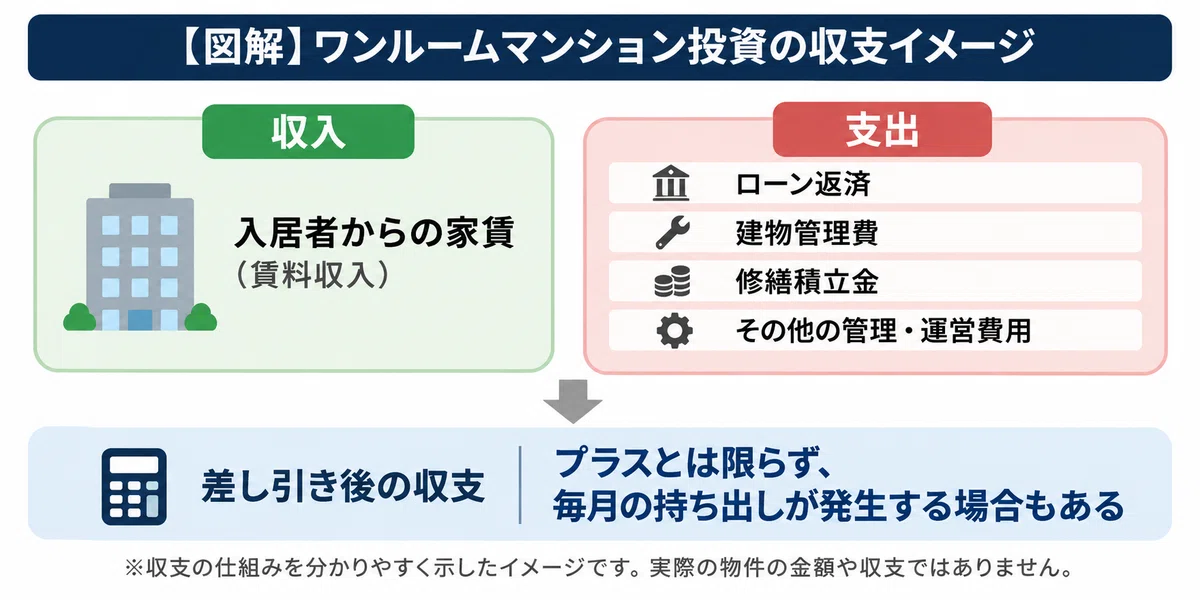
Expenses such as loan repayments and management fees are deducted from rental income.
As a result, the monthly balance is not necessarily positive.
In the simulation presented to me this time, the rental income alone was not enough to cover expenses, meaning I would have to pay a certain amount out of pocket every month.
In other words, just because you receive rent does not mean your money increases every month.
This point was a little different from the image of real estate investment I had before attending the meeting.
3. There was also an explanation about future sales and taxes
I was given an explanation not only about the monthly income and expenditure of the property but also about its future sale.
The representative showed me a simulation assuming a case where the property is sold after being held for a certain period.
There was also an explanation regarding the tax implications of real estate investment.
What left an impression on me was the explanation that one should consider the investment as a whole, including future sales and taxes, rather than judging it solely by monthly income and expenditure.
However, what I want to be careful about here is that the simulation is merely a calculation based on certain conditions.
Future rent and sale prices will not necessarily turn out exactly as projected.
There is a possibility of vacancies occurring, and it is also conceivable that rent could decrease or unexpected repair costs could arise.
Taxes also vary depending on conditions such as income, expenses, and the tax system.
I felt it was important not to take the explained figures as guaranteed future profits.
4. I asked questions on the spot about things that concerned me
While receiving the explanation about the property, I also asked several questions myself.
I was particularly concerned about the following points:
-
What happens if a tenant moves out and the unit becomes vacant?
-
How will the income and expenditure change if the rent decreases?
-
Is there a possibility that the burden of repair costs and the like will increase in the future?
-
What happens if the property cannot be sold at the assumed price?
Real estate investment cannot be judged solely by the simulation at the time of purchase.
Rather, I felt it was necessary to confirm what would happen if things did not go as expected.
The representative explained things in response to my questions.
At least in the meeting I attended, the atmosphere was not one where it was difficult to ask questions.
5. I told them I wanted to compare with other companies
Toward the end of the meeting, I told the representative this:
“Regarding real estate investment, I would like to hear from other companies and compare them.”
I received an explanation of specific properties and income and expenditure in this meeting, but I had no intention of deciding to purchase on the spot.
Real estate investment involves large sums of money.
I wanted to think about it after checking proposals and conditions from other companies, rather than judging based on the explanation of just one company.
The representative accepted my intention to compare with other companies.
We did not decide on the next meeting on the spot, and it ended with the understanding that I would contact them if necessary.
For my part, I felt a little relieved that I was able to convey my thoughts.
Of course, this is just my experience in the meeting I attended. It does not necessarily mean that everyone will receive the same treatment.
6. What I felt after the meeting
I will organize what I felt during this second meeting.
Points I felt were good
-
They proceeded with the discussion starting from my household finances and future financial planning
-
There was an explanation regarding the income and expenditure of specific properties
-
I was also able to hear about future sales and taxes
-
They answered my questions
-
I was able to convey my intention to compare with other companies
Points that concerned me and points I felt I needed to verify myself
-
The monthly balance will not necessarily be positive
-
Future sale prices and rent are not fixed
-
One must also consider unexpected expenses such as vacancies and repairs
-
One needs to verify the underlying assumptions of the simulation figures
The fact that the representative’s explanation was polite is a separate matter from whether or not I should purchase the property.
Even if there were parts of the explanation that I found convincing, that alone does not mean it is okay to make an investment decision.
For me personally, the purpose this time was to listen to the talk and obtain material for comparison.
Therefore, I ended the meeting without deciding to purchase.
Summary: There was a concrete property proposal. But there was no need to decide on the spot
In the second meeting, after confirming my household finances and retirement funding plan, I received a concrete property proposal.
There was an explanation not only about the monthly balance but also about future sales and taxes, making it a more in-depth session than the first meeting.
What I felt this time is that receiving an explanation at a meeting and actually deciding to purchase are two different things.
Listen to the talk, verify any questions, and compare with other companies.
I thought that after doing that, I could then consider whether it suits me.
Note that this article is a record of a meeting I personally attended. It is not a recommendation for real estate investment. When actually considering it, you need to verify the balance assumptions and risks yourself.
Next time, I will write about the “withholding tax slip” and “business card” that I was asked to submit before the meeting.
To what extent is it necessary to submit documents that contain family names and home addresses?
I will introduce the content I actually confirmed with the representative. Things I confirmed
Before the second real estate investment meeting, there were documents that the representative requested me to submit.
Those were my withholding tax slip and business card.
I only intended to receive a consultation on real estate investment, so I was a little surprised when I first heard this.
“Is it really necessary to submit a withholding tax slip?”
“How much of my personal information will be checked?”
“Will my family’s information and home address be okay?”
I had such questions.
Of course, I can understand the need to verify my annual income and place of employment.
However, since these are documents containing personal information, I felt a bit of resistance to submitting them without checking anything.
This time, I will introduce the documents I was asked to submit during a meeting with a group company of a company listed on the Prime Market of the Tokyo Stock Exchange, and what I confirmed with the representative because I felt uneasy.
1. Three days before the second meeting, a request for document submission arrived
Three days before the day I had scheduled the second meeting, I received a request from the representative for advance submission.
The following two items were requested.
-
Withholding tax slip
-
Business card
A withholding tax slip is a document used to verify income status, such as annual income.
I thought that a business card was also necessary to verify my place of employment and the like.
However, the withholding tax slip contains personal information such as my address in addition to my annual income.
In my case, my family’s names were also listed.
It wasn’t that I disliked the act of submitting it itself.
However, I was a bit cautious about submitting documents that even included information about my family.
2. I felt uneasy about submitting my withholding tax slip
What concerned me was not the annual income itself, but the personal information listed on the document.
I understand that information such as annual income and place of employment is necessary for real estate investment consultations.
However, I felt a bit uneasy about submitting information that included my family’s names and home address.
“What information is actually necessary?”
“How will my personal information be handled?”
I don’t often have the opportunity to submit a withholding tax slip.
Much less, it was my first time being asked to submit one for a real estate investment meeting, so I was also confused.
Therefore, I decided not to submit the documents immediately, but to check with the representative during the meeting.
3. I tried checking with the representative about what I was worried about
On the day of the meeting, I asked the representative about the personal information on the withholding tax slip.
What I was concerned about were things like the family information and home address listed on the withholding tax slip.
I understand the need to verify annual income and place of employment, but I felt a bit uneasy about the other information.
When I checked with the representative, I was able to receive an explanation regarding the submission, and I was able to resolve the doubts I had about the points that concerned me.
I think anyone would feel some degree of unease about submitting documents containing personal information.
That is precisely why I felt it is important to check things you don’t understand or are concerned about before submitting them.
4. If you feel uneasy about submitting personal information, do not force yourself to make a judgment on your own
From this experience, I felt that it is better to be mindful of the following when submitting documents containing personal information.
1. Confirm why it is necessary
Just because you are asked to submit something does not mean you have to submit it without understanding the purpose.
First, it is important to ask what the document is for.
2. Ask questions if there is information you are concerned about
If there are parts you are concerned about, such as your address or family information, do not leave them as they are; check them.
I think you should feel free to ask even about small questions.
3. Confirm the submission method and how it will be handled
How will it be submitted, and how will the submitted information be handled?
If you are concerned, I think it is a good idea to check these points as well.
4. Submit only after you are satisfied
If you still have doubts after hearing the explanation, there is no need to rush to submit it.
It is important to check until you are satisfied before proceeding.
I do not think you need to hesitate to ask questions.
Real estate investment involves large sums of money. The person attending the meeting should also be able to proceed while confirming anything they are unsure about.
5. Resolve anxieties before the meeting by checking them one by one
Before applying for a real estate investment meeting, I think you have various anxieties, such as being sold to or being encouraged to make a purchase.
I was the same.
When you actually attend the meeting, things you did not imagine beforehand, such as submitting documents, will come up in addition to talk about properties.
At such times, there is no need to leave things you do not understand as they are.
Like I did this time, if there is something you are concerned about, try asking the person in charge.
Even just doing that can turn vague anxieties into concrete questions and help resolve them.
Of course, just because you have listened to the explanation does not mean you have to accept everything.
If you are not convinced, I think it is important not to rush the submission and to take time to think it over again.
Summary: Confirm any concerns before submitting
This time, I was asked to submit my withholding tax slip and business card, and I felt a little uneasy about how my personal information would be handled.
So, I checked the points I was concerned about with the person in charge.
As a result, I was able to proceed after resolving my doubts.
What I felt from this experience is that it is important to check things one by one rather than proceeding while holding onto anxieties.
For those who will be attending real estate investment meetings in the future, if you have any concerns about submitting documents, please do not hesitate to ask.
Asking about things you don’t understand is by no means rude.
I think it is fine to proceed one step at a time once you are satisfied.
Next time, under the theme of “Is it okay not to decide on real estate investment on the spot? I tried telling them I wanted to compare with other companies,” I will write about what happened when I requested a comparison with other companies at the end of the meeting.