
So, which one is actually better, real estate crowdfunding or physical real estate investment?
Even though they are both investments in real estate, what makes them different?
Should I just choose the one with the higher yield?
When you become interested in real estate investment, this is a topic you will wonder about at least once.
I myself have experienced both physical real estate investment and real estate crowdfunding.
From that perspective, what I feel is that while these two seem similar, the way you think about investing is quite different.
To put it simply,
🏠 Physical real estate investment: An investment where you own the property and manage it yourself
💰 Real estate crowdfunding: An investment where you contribute capital to a real estate project and aim for a distribution of profits
That is the difference.
In this article, I will introduce the pros and cons I feel from the perspective of someone who has actually experienced both, while comparing factors such as required capital, yield, risk, and management effort.
Let’s think together about which one is right for you.😊
The basic differences between real estate crowdfunding and physical real estate investment!
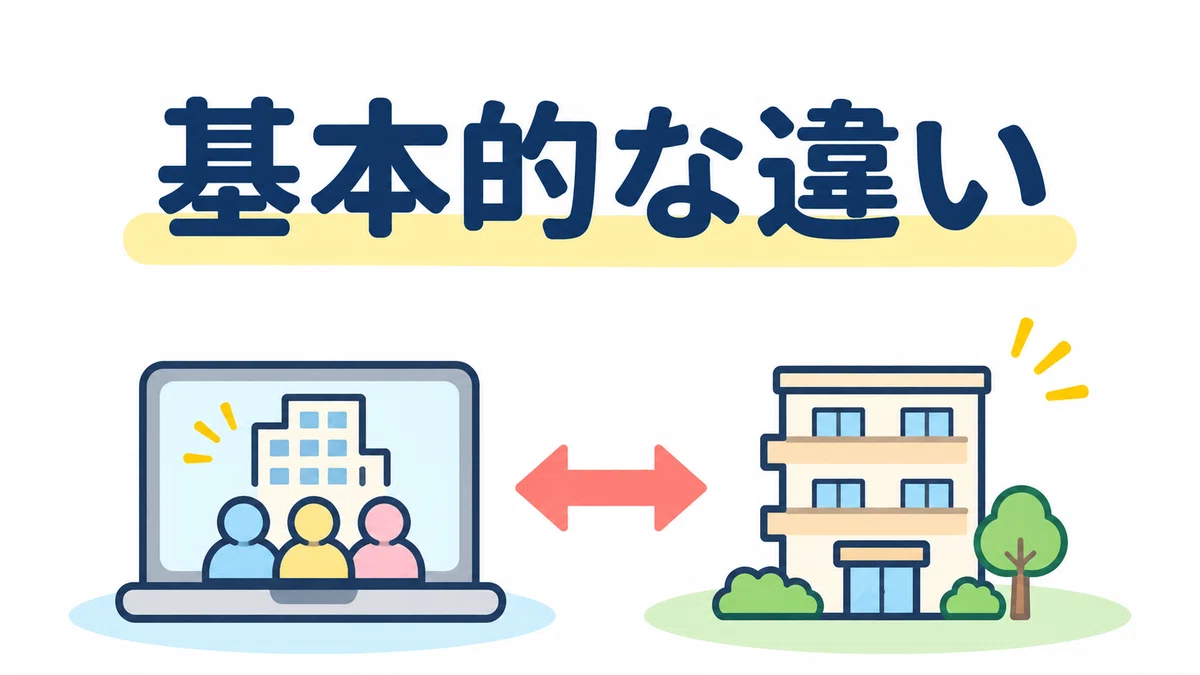
Although both are investments that utilize real estate to earn income, the investor’s position is significantly different.
First, let’s organize the differences in mechanisms, required capital, and management methods.
Physical real estate investment involves owning property
Physical real estate investment is an investment where you purchase a room in a condominium or an apartment building, etc., and aim for rental income or capital gains.
Because you own the property, a key feature is that you can decide the management policy yourself.
For example,
・Which area to purchase a property in
・How much to set the rent at
・Whether to perform renovations or equipment replacements
・When to sell
These decisions affect profitability.
On the other hand, a significant amount of capital is required at the time of purchase, and if you use a loan, repayments will also occur.
It is an investment where the process does not end with purchasing the property, as subsequent management is also important.
Real estate crowdfunding allows for investment from small amounts
Real estate crowdfunding is a mechanism where funds are collected from multiple investors, and an operator acquires and manages the real estate.
In the common anonymous partnership type, investors do not directly own the property.
The operator is responsible for property management and sales, and investors receive distributions based on the investment results.
The minimum investment amount varies by service, but some allow participation from as little as 10,000 yen.
In other words, you can participate in real estate business investments even if you do not have enough capital to purchase physical real estate.
However, just because it is a small amount does not mean it is safe.
The possibility of a loss of principal is the same as in physical real estate investment.
Comparing required capital and management effort
To summarize the characteristics of each, here is the general idea.
🏠 Physical Real Estate Investment
・Required capital: A significant amount of personal funds is required
・Loan: May be available
・Property ownership: You become the owner
・Property management: Handled by you or a management company
・Earnings: Rental income and capital gains
・Investment decisions: Required continuously even after purchase
💰 Real Estate Crowdfunding
・Required capital: Some projects start from around 10,000 yen
・Loans: Generally invested using your own funds
・Property ownership: Owned by the operator in anonymous partnership models
・Property management: Handled by the operator
・Earnings: Distribution of operating profits
・Investment decisions: Primarily at the time of investing in the fund
The biggest difference I feel is how much you are involved after investing.
Physical real estate feels like “managing real estate yourself.”
Crowdfunding feels like “participating in an operator’s real estate operation.”
I believe understanding this difference is the first step in choosing where to invest.
How do the yield and profit mechanisms differ?

What people are concerned about in real estate investment is, after all, the yield.
However, the way yield is viewed differs between physical real estate investment and real estate crowdfunding.
If you only compare the numbers, you may misjudge the actual earnings.
Physical real estate investment is primarily based on rental income
In physical real estate investment, you mainly earn monthly rental income while also considering the future sale of the property.
For example, if you have a property worth 20 million yen that generates 1.2 million yen in annual rental income, the gross yield is 6%.
However, from this, you must consider:
・Management fees and repair reserve funds
・Taxes such as fixed asset tax
・Rental management fees
・Repair costs
・Loss of income due to vacancies
and so on.
If you are using a loan, interest payments and principal repayment will also affect your cash flow.
Just because the gross yield is 6% does not mean that 6% of profit will remain.
Real estate crowdfunding has a set expected yield
In real estate crowdfunding, it is common for an annual expected yield to be presented for each fund.
For example,
💰 Investment amount: 100,000 yen
📈 Expected yield: 6% per annum
📅 Investment period: 6 months
In this case, the simple calculation for the pre-tax expected distribution is 3,000 yen.
The calculation formula is,
100,000 yen × 6% × 6 months ÷ 12 months = 3,000 yen
This is the result.
What you need to be careful about here is the term “annual interest rate.”
If the investment period is 6 months, you will not receive the full 6% annual profit.
Also, the projected yield is not a guaranteed return, and there is a possibility that distributions may decrease or the principal may be lost depending on the investment performance.
You cannot compare based on yield figures alone
Personally, I think this is the most important point.
The gross yield displayed for physical real estate investment and the projected distribution yield for real estate crowdfunding are not figures calculated under the same conditions.
With physical real estate, you need to consider maintenance costs, loan repayments, and even future sale prices.
On the other hand, with crowdfunding, you need to check the investment period, redemption conditions, and the credit risk of the operator.
What is important is not just the high yield, but the perspective of “what kind of risks are you taking to earn that profit?”
Comparing the risks of real estate crowdfunding and physical real estate investment!
Both have their merits, but naturally, they also have risks.
When I consider where to invest, I am conscious not only of the expected profits but also of what happens if things do not go as planned.
Physical real estate investment risks include vacancies and repairs
What you need to be careful about with physical real estate investment are the risks that arise from owning the property.
Typical examples include:
・Vacancy risk where tenants cannot be found
・Risk of falling rent
・Burden of equipment failure and large-scale repairs
– Rising loan interest rates
– Declining sale prices
, and so on.
Especially when using a loan, even if rental income decreases, the repayment obligations do not disappear.
In physical real estate investment, it is important to have a financial plan not only for periods of stable income but also for when unexpected expenses arise.
Be aware of principal loss and redemption delays in real estate crowdfunding
In real estate crowdfunding, you can leave the daily property management to the operator.
However, being able to delegate management is different from there being no risk.
For example, there are risks such as:
– The sale price of the real estate being lower than expected
– Occupancy conditions worsening
– The investment period being extended
– Redemption being delayed
– The operator’s business situation deteriorating
as well as other risks.
Also, many funds do not allow early withdrawal in principle during the investment period, so there is a possibility that you cannot withdraw your money even if you suddenly need it.
I think the convenience of crowdfunding is a major appeal, but I feel that, because of that, the judgment made before investing becomes all the more important.
I introduce items you should check when choosing a fund in this article.
Related article:
How to choose a real estate crowdfunding fund! 7 points to check besides yield
Investment period and liquidity of funds are also different
In physical real estate investment, you can sell the properties you own based on your own judgment.
However, it may take time to find a buyer, and there is no guarantee that you will be able to sell at your desired price.
On the other hand, real estate crowdfunding generally has a pre-set investment period.
There are short-term projects as well as projects that span several years.
Even if redemption is scheduled at maturity, there is no guarantee that the funds will be returned on that exact day.
You should understand that neither is an investment that can be withdrawn freely like a regular savings account.
Pros and cons I felt after experiencing both!
From here on, it’s a bit of a personal story.
Having experienced both physical real estate investment and real estate crowdfunding, I think both have different charms.
Personally, I don’t think one is simply better than the other.
Physical real estate investment has the fun of being able to make your own decisions.
The appeal of physical real estate investment is that you own the property and can think about the management strategy yourself.
From selecting the property to purchase, to setting the rent, and selling, your own judgment affects the returns.
Of course, not everything goes as planned.
It requires capital, and even if you leave it to a management company, you have responsibilities as an owner.
Even so, I feel that the appeal of owning real estate as an asset and managing it long-term is significant.
Real estate crowdfunding’s biggest appeal is its ease of use.
On the other hand, the benefit of real estate crowdfunding is that you can participate in various real estate projects with little capital.
With physical real estate, even if there is a property you are interested in, there are issues such as purchase funds and loans.
In that respect, with crowdfunding, there are projects you can consider starting from a small amount.
Since there is no need to perform daily property management, it is likely easier for those who are busy with their main jobs to get involved.
However, the fact that you cannot control the operation yourself after investing is also a disadvantage.
“Less effort does not equal peace of mind.”
This is a point to keep in mind.
I think it is best to use them differently depending on your investment goals.
Personally, I do not think you need to force yourself to choose between physical real estate investment and real estate crowdfunding.
For example,
🏠 If you want to own real estate long-term, choose physical real estate investment.
💰 If you want to participate in real estate projects with a small amount of money, choose crowdfunding.
That is my way of thinking.
Of course, just because you already own physical real estate does not mean you necessarily need to invest in crowdfunding as well.
It is important to consider the balance of your overall assets and your available funds to choose the investment method that suits you.
Which is recommended: real estate crowdfunding or physical real estate investment?

In the end, which one should you choose?
If it were me, I would base my decision not only on yield, but also on the funds and time available for investment, and the purpose of the investment.
Who is physical real estate investment suitable for?
I think physical real estate investment is suitable for the following types of people:
✅ Those who can prepare a lump sum of capital.
✅ Those who are thinking about long-term asset formation.
✅ You want to own real estate
✅ You are interested in property selection and management
✅ You are prepared for risks such as repairs and vacancies
In particular, for those who want to grow their assets while making their own investment decisions, physical real estate investment offers unique appeal.
Who is real estate crowdfunding suitable for?
On the other hand, real estate crowdfunding is suitable for the following types of people:
✅ You want to start real estate investment with a small amount of money
✅ You do not want to go through the trouble of property management
✅ You want to invest with your own funds without using loans
✅ You want to diversify your funds across multiple funds
✅ You do not need to access your funds during the investment period
It is an easy option to consider, especially for those who do not have enough capital to purchase physical real estate but are interested in real estate investment.
There are also ways to get started by taking advantage of campaigns
Real estate crowdfunding services offer campaigns where you can receive benefits for new member registration or your first investment.
The contents vary by service, such as Amazon gift cards or digital gifts.
If you are going to start, you should definitely check these benefits as well.
However, I do not recommend investing just for the sake of a campaign.
My stance is to always consider the safety and conditions of the investment target first, and treat the benefits as an added bonus.
Related article:
List of real estate crowdfunding campaigns! Comparing new registration and first investment benefits
Frequently asked questions about real estate crowdfunding and physical real estate investment!
Finally, I have summarized the questions that people who are unsure about which to invest in tend to be concerned about.
Q. Which is more profitable, real estate crowdfunding or physical real estate investment?
It cannot be compared unconditionally.
While physical real estate investment can offer rental income and capital gains, it also comes with burdens such as maintenance costs and loan repayments.
Although real estate crowdfunding provides an expected yield, there is no guarantee that you will earn the projected profit.
For both, it is necessary to compare the final net profit and the risks involved.
Q. Can I become a property owner through real estate crowdfunding?
In the common anonymous partnership model, investors do not become direct owners of the property.
However, there are also structures, such as the voluntary partnership model, where investors hold a shared interest in the real estate.
Because the legal relationship differs depending on the contract type, it is necessary to check before investing.
Q. Are the taxes different for real estate crowdfunding and physical real estate investment?
Yes, they are different.
In general, distribution profits from anonymous partnership crowdfunding are classified as miscellaneous income.
On the other hand, rental income from physical real estate usually falls under real estate income.
The methods for calculating taxes and the treatment of necessary expenses also differ.
Please see this article for more details.
Related article:
How much is the tax on real estate crowdfunding? Cases requiring a tax return and points to note
Q. Should real estate investment beginners start with crowdfunding?
In terms of being able to start with a small amount, crowdfunding is an investment that is easy for beginners to consider.
However, just because it is for beginners does not mean that there is no risk of principal loss.
It is important to understand the operational mechanisms and risks, and to consider investing only with surplus funds that are separate from the money needed for daily living.
Summary | Choose between physical real estate investment and crowdfunding based on your goals!
In this article, I compared the differences between real estate crowdfunding and physical real estate investment.
To summarize again,
🏠 Physical Real Estate Investment
・You can own the property
・You can aim for rental income and capital gains
・High degree of freedom in management
・Significant financial burden and management responsibility
💰 Real Estate Crowdfunding
・You can invest with a small amount of money
・Property management is handled for you
・Easy to compare multiple projects
・Difficult to control the operation yourself
These are the differences.
Having experienced both, what I think is that there are various ways to get involved in real estate investment.
There is the method of owning physical property and managing it carefully, and there is also the method of using crowdfunding to participate in the real estate business with a small amount of capital.
The important thing is not to judge based solely on yield figures.
Think not only about “how much profit you can make,” but also about “what the risks are and whether it suits you.”
I would like to cherish that kind of investment style. 😊
If you are thinking about starting real estate crowdfunding, please take your time to find an investment that suits you, while also keeping campaign information in mind.