
For anyone sitting on a mortgage they locked in a few years ago, the math on a refinance just got harder. The average 30-year fixed rate climbed to 6.95% in the week ending September 17, up from 6.76% a week earlier, according to Freddie Mac’s weekly survey. That jump landed in the same week the Federal Reserve voted 12-0 to raise its benchmark rate by a quarter point to a range of 3.75% to 4%, saying inflation remains elevated.
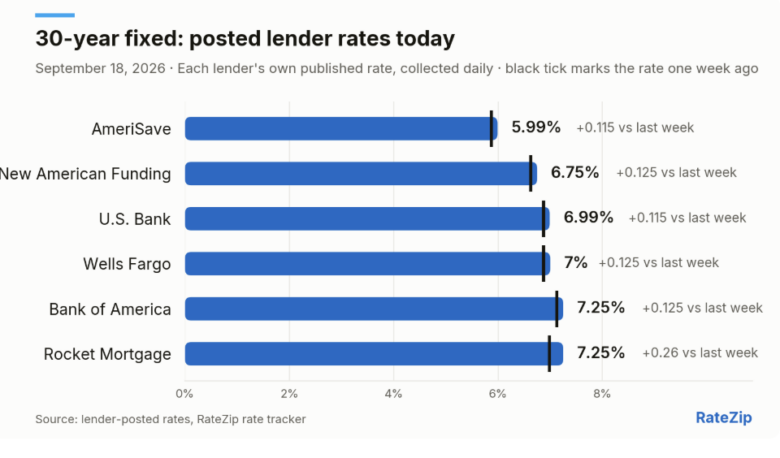
Chart: RateZip · Source: lender-posted rates tracked daily by RateZip.
How rare is a rate this high? Joel Kan, vice president and deputy chief economist at the Mortgage Bankers Association, put it plainly in the group’s weekly application survey: “The 30-year fixed rate at 6.97% was at its highest level since May 2025”.
The refinance is disappearing
Borrowers are reacting. In that same MBA survey, covering the week ending September 11, refinance applications fell 9% from the prior week, purchase applications slipped 1%, and total applications were down 4.1% after adjusting for Labor Day. Refinancing’s share of all applications slid to 39.4%.
RateZip’s own Mortgage Demand Index, built from the inquiries consumers submit across our network, shows a starker version of the same shift. Over the three months through August 2026, refinance accounted for just 2% of inquiries, down from 39% in the same months a year earlier. Home-equity products, meaning HELOCs plus reverse mortgages, took 76% of the mix, up from 43%. Homeowners, in other words, are not walking away from their houses as a source of cash. They are simply going around the first mortgage to get to it.
And they are doing it in growing numbers: August inquiry volume ran 11% above July’s and 157% above August 2025’s.
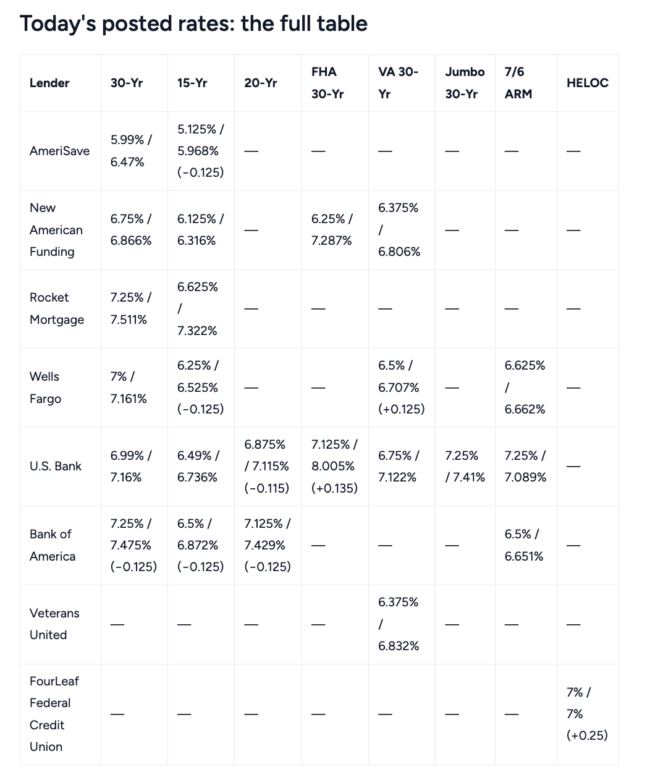
That demand is meeting rising prices of its own. Among the lenders RateZip tracks, FourLeaf Federal Credit Union lifted its variable HELOC rate a quarter point Friday to 7%.
What buyers see this morning
On the purchase side, Friday’s posted rates cut both ways. Bank of America trimmed its 30-year fixed by 0.125 points to 7.25%, while U.S. Bank raised its FHA 30-year by 0.135 points to 7.125%. AmeriSave’s 15-year fixed dropped to 5.125%. The week’s biggest mover was Rocket Mortgage’s posted 15-year fixed, up 0.375 points.
The gap between lenders still dwarfs any single day’s move. The cheapest posted 30-year in the set, AmeriSave at 5.99%, sits 1.26 points below the most expensive, Rocket Mortgage at 7.25%. On a $400,000 loan, that spread works out to roughly $333 a month.
Builders are feeling the chill too. The NAHB/Wells Fargo Housing Market Index fell three points to 32 in September, its lowest reading since September 2025, with builders citing weaker buyer traffic, higher material costs and labor shortages, according to the National Association of Home Builders.
Where it goes from here
The bond market is not offering much relief yet. The 10-year Treasury yield, the benchmark mortgage pricing tracks most closely, closed at 5.01% on Wednesday, per FRED, up 18 basis points over the past week.
Source: Freddie Mac Primary Mortgage Market Survey via FRED®, Federal Reserve Bank of St. Louis. RateZip
Freddie Mac chief economist Sam Khater offered a measured read in the survey release: “The 30-year fixed-rate mortgage continues to fluctuate as markets assess economic data”. For homeowners eyeing their equity and buyers eyeing their budgets, that fluctuation is now the thing to watch.
Rates are each lender’s own published rate as of 9:50 a.m. ET, collected from their public rate pages and feeds. The APR is the better cross-lender comparison; a figure in parentheses is today’s change; a ‘—’ means the lender doesn’t post that product. How we collect and publish this: our rate methodology.
Read more
RateZip is operated by Peklava LLC, DBA RateZip, a licensed mortgage broker (NMLS ID 1592292). We are compensated by some of the partners shown on this page, which may affect which offers appear and where. It does not affect our reporting or our recommendations. Rates shown were last updated September 18, 2026 at 9:50 a.m. ET. See our editorial standards and how we use AI.
How we track rates: methodology. Found an error? Tell us.
Ask us! What questions do you have about content, strategy, pop culture, lifestyle, wellness, history or more? We may use your question in an upcoming article!
Like MediaFeed’s content?Be sure to follow us.
This article originally appeared on RateZip and was syndicated byMediaFeed.co.