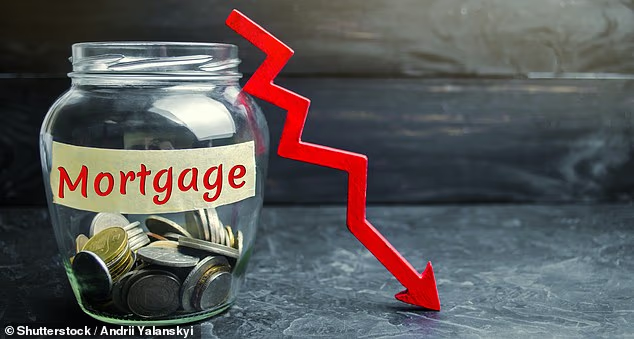
Mortgage rates have seen the biggest monthly fall in almost two years, but brokers have expressed fears this could be short lived as tensions rise in the Middle East.
The average two and five-year fixed rate mortgage fell by 0.16 and 0.11 percentage points respectively in the last four weeks and both are now at 5.52 per cent, according to rates scrutineer Moneyfacts.
This was their lowest point since the start of March 2026, when the Iran conflict had just kicked off.
On a £200,000 mortgage being repaid over 25 years, someone on a 5.52 per cent rate would be paying £1,230 a month.

Falling: Fixed mortgage rates dropped for a consecutive month, citing the biggest monthly reductions since October 2024
What rates can people expect?
Many people will be able to do better than the average rates, especially if they have built up substantial equity in their home and have a good credit record.
The cheapest two-year fix for a home buyer is now 4.19 per cent and the lowest five-year fix is 4.31 per cent.
However, this is not as cheap as in March when the lowest two-year fix was 3.51 per cent while the lowest five-year deal was 3.75 per cent.
On a £200,000 mortgage being repaid over 25 years, 4.19 per cent and 3.51 per cent would be the difference between paying £1,077 and £1,003 a month.
The lowest two-year deal for someone remortgaging with at least 40 per cent equity in their home is 4.44 per cent with Bank of Ireland, albeit with a £1,495 fee.
Premier banking customers with Lloyds, Barclays, HSBC or NatWest may find they can do even better, with some banks offering preferential rates to these customers.
Lloyds Premier Account customers now have access to a 4.13 per cent two-year fix with a £1,099 fee.
On a £200,000 mortgage being repaid over 25 years that would mean paying £1,077 a month.
And someone buying with a 20 per cent deposit could get either a 4.29 per cent two-year fix or 4.35 per cent five-year fix with Halifax – both with a £1,099 fee.
Those buying with smaller deposits of just 5 per cent will also find rates have dropped lower month-on-month.
The average five-year fixed rate for a mortgage covering 95 per cent of the property value has dipped below 6 per cent for the first time since March 2026.
Again, much lower rates are possible for those that shop around.
Skipton Building Society is currently offering a 4.92 per cent two-year fix or a 4.98 per cent five-year fix, neither comes with any product fees.
Rachel Springall, finance expert at Moneyfacts, said: ‘Borrowers will breathe a sigh of relief to see fixed mortgages falling at their fastest pace for almost two years, combined with a calmer period of product churn and an uplift in choice.
‘It has been three months since fixed rates inverted, where the two-year fixed has been higher than its five-year counterpart.
‘However, this has started to unwind, so the rates should hopefully start to fall back into a more traditional pricing structure. However, this positive trajectory could be thrown off course, as renewed escalation in geopolitical tensions could slow the tempo of mortgage rate cuts.’
Will Middle East tensions affect mortgage rates?
Tensions in the Middle East are rising, with the US targeting military sites in Iran over the weekend and Iran claiming to have struck bases with US links in the region.
Shaun Sturgess, director at Swansea-based Sturgess Mortgage Solutions said: ‘Markets and lenders alike will be watching events in the Middle East closely and there is every prospect rates could rise again this week if we see further escalation.
‘As ever, the message to borrowers is do not assume rates will continue to fall, as conditions remain volatile.
‘Too many borrowers attempt to time the market and, at present, that is a high-risk strategy.’
Omer Mehmet, managing director at Welling-based Trinity Finance, added: ‘The latest Moneyfacts data contains many positives but the concern is the backdrop of events in the Middle East, which has the potential to end the current run of falling rates and once again see lenders enter defensive mode.
‘The cuts we’ve seen of late may not continue if tensions escalate.’