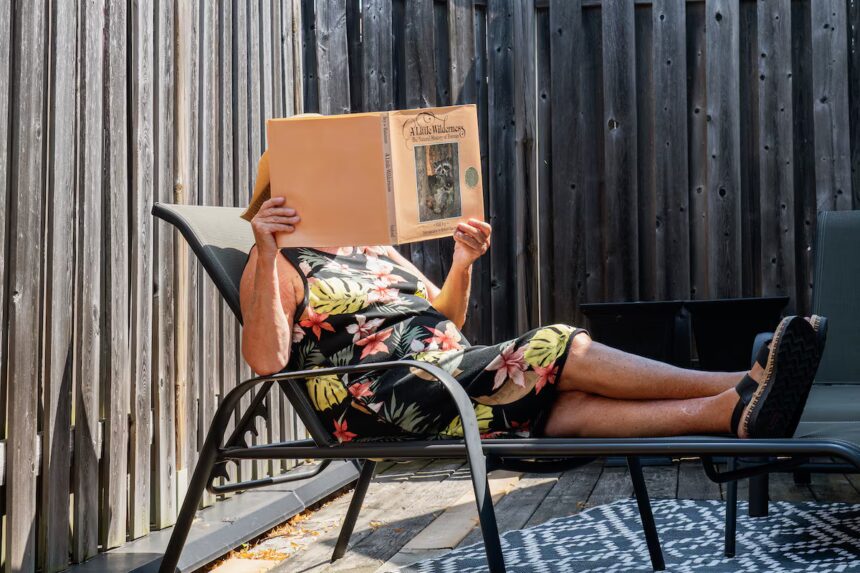
Renata, who bought her condo at the height of the COVID-19 pandemic, is thinking of downsizing to a less expensive condo and discharging the reverse mortgage when it comes up for renewal this fall.DUANE COLE/The Globe and Mail
Five years ago, Renata sold her small Beaches-area condo in Toronto and bought a larger, more expensive one on a better street. She used what is called a reverse mortgage to purchase the new condo for roughly $1.4-million, because her income wasn’t high enough to qualify for a conventional mortgage.
Unlike conventional mortgages, reverse mortgages increase as time goes by. The borrower gives up home equity in return for not having to make payments.
Renata is 75 and divorced, with two sons in their 50s. Her municipal government pension, Canada Pension Plan and Old Age Security benefits add up to more than $50,000 a year.
“I bought my condo at the height of the COVID-19 pandemic and wanted to escape my smaller condo, with its tiny balcony,” Renata writes in an e-mail. “I feared that lockdown might be long, and my location by Woodbine Beach was invaded by crowds of partiers and was extremely noisy.”
The bigger condo, which she has been living in since 2021, has three bedrooms (one serves as a studio) and a large deck. “I stretched my means to purchase and could only be approved for a reverse mortgage of $400,000 because my income and age limited my qualifications,” Renata says.
Her outstanding balance is now $465,000.
“I’d like to explore ways to change my reverse mortgage to a standard mortgage so that I can still leave money in my estate for my two adult sons,” she writes. Renata is thinking of downsizing to a less expensive condo and discharging the reverse mortgage when it comes up for renewal this fall.
“At my age I fear the insecurity of renting and I don’t want to start anew in another community and feel isolated.”
We asked Warren MacKenzie, an independent Nova Scotia-based financial planner, to look at Renata’s situation. Mr. MacKenzie holds the chartered professional accountant designation.
What the expert says
Renata has enough income to meet her lifestyle needs even if she lives to be 100, Mr. MacKenzie says. But she’d use up nearly all of her assets and would not be able to leave as much as she would like to her two sons.
“She wants to leave them her condo and her investment portfolio,” the planner says.
Based on a 5-per-cent average investment return and inflation of 2 per cent, if she continues with her current lifestyle spending, she will leave an inheritance in the range of $500,000 with today’s purchasing power, he says. This inheritance will come from her tax-free savings account and liquid investments. The value of the condo will be totally absorbed by the reverse mortgage.
Renata has three choices, Mr. MacKenzie says.
Her first option is to abandon her goal of leaving a large estate. “She could decide to stay in the home she enjoys, with its large deck and extra space for her hobbies.” She could continue to enjoy her existing retirement lifestyle, let the reverse mortgage accumulate and let her two sons “make it on their own,” he says.
“She can never be forced to sell the condo even if, over time, the mortgage grows and eventually exceeds the value of the home.”
Now single, can Randy, 61, afford to help his niece and nephew financially?
By the time of her death at 100, in the planner’s forecast, the reverse mortgage will have grown to a liability greater than the value of the home. But she will still have investments valued at about $500,000 with today’s purchasing power.
However, Mr. MacKenzie has a note of caution: If she needed to move to a long-term care home at some point, she may not have enough equity left in her condo to help pay for private assisted living.
In 2027, Renata’s income will be $54,610 a year from CPP, OAS and her work pension, plus $7,313 from investments, for a total inflow of $61,923. Her cash outflow will be income tax of $5,768 (she gets a disability tax credit) and spending of $56,155 a year. After interest charges, the balance owing on the reverse mortgage will have increased to about $515,000.
The second option she is considering is to sell the three-bedroom condo, which she values at $1.3-million, pay off the reverse mortgage and then purchase a smaller condo for $700,000.
With the mortgage paid off and the lower operating costs of the smaller condo, she would be on track to leave her sons more than $2-million with today’s purchasing power, Mr. MacKenzie says. In the meantime, she would have plenty of money to pay for assisted living if she needed it.
A third option would be to keep the larger condo and see if she can get a home equity line of credit for about $75,000. The HELOC combined with her investments would be enough to pay off the existing reverse mortgage. The HELOC interest rate is normally lower than the reverse mortgage interest rate.
“By reducing her spending on gifts and travel, Renata could find the funds to repay the HELOC,” the planner says.
If she could cut her spending to $46,000 a year, she could achieve her two goals: being able to stay in the home she enjoys and also leaving her sons a mortgage-free home. In the future, that home might be valued at more than $1-million with today’s purchasing power, Mr. MacKenzie says.
Or instead of a HELOC, she could try to get a $70,000 conventional mortgage to help pay off the reverse mortgage, but she would have to make monthly payments of principal and interest.
“A problem with this scenario is that she will have no cash reserve for emergency expenses that might arise,” the planner says. If Renata faced a major expense, she would have to borrow more on the HELOC, sell her home or apply for a new reverse mortgage.
How should Faye, 68, and Ava, 60, draw down their RRSPs given their $108,000 spending target?
Next, the planner looks at Renata’s investments, which are about 60 per cent in GICs and bond funds.
Because most of her income comes from guaranteed government pensions, she could consider a more diversified investment portfolio, the planner says.
Renata works with a financial adviser, but she does not know the rate of return she has earned or how that return compares to the proper benchmark. “The asset mix does not appear to be goals based.”
Having recently updated her will, Renata should have a family meeting to ensure there will be no surprises when the will is read. “One of her sons is the executor, but she is wisely considering appointing a corporate executor,” Mr. MacKenzie says. By doing so, she will reduce the possibility that her sons will quarrel over the estate.
Client situation
(Income, expenses, assets and liabilities provided by the applicant.)
The person: Renata, 75.
The problem: Should she downsize and pay off her reverse mortgage?
The plan: Weigh the alternatives. She could continue to live comfortably in her large apartment but she wouldn’t leave a big estate. Also, she may not be left with enough home equity to pay for assisted living if she needs it.
The payoff: A path to putting herself on a more secure footing.
Monthly after-tax income including investment income: $5,500.
Assets: Cash $4,740; GICs $114,920; non-registered income fund $103,190; TFSA $174,215; condo $1,300,000. Total: $1.7-million.
Estimated present value of her municipal pension: $700,000. That’s what someone with no pension would have to save to generate the same retirement income.
Monthly outlays: Condo fees $1,310; property tax $565; home insurance $190; heating $150; maintenance, garden $70; transportation $160; groceries $400; clothing $100; gifts, charity $320; vacation, travel $300; dining, drinks, entertainment $480; personal care $50; sports, hobbies, subscriptions $30; health care $360; communications $90. Total: $4,575.
Liabilities: Reverse mortgage $463,000 at 6.59 per cent.
Want a free financial facelift? E-mail finfacelift@pm.me.
Some details may be changed to protect the privacy of the people profiled.