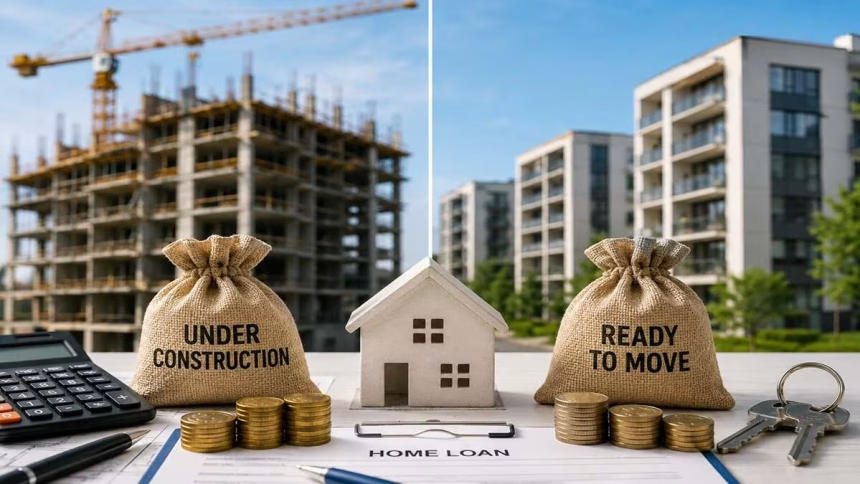
Buying a home is often the biggest financial commitment most families make. While buyers usually compare location, builder reputation, amenities and property prices, one crucial factor often goes unnoticed — how the home loan behaves depending on whether the property is ready to move into or still under construction.
At first glance, a Rs 50 lakh home loan at 8% interest for 20 years appears identical irrespective of the property type. The EMI remains the same and the tenure does not change. However, a closer look at the loan structure reveals that the total interest burden can differ substantially.
According to calculations shared by BankBazaar.com, a buyer opting for an under-construction property could end up paying about Rs 8 lakh more in interest compared to someone purchasing a ready-to-move flat, even when both take the same loan amount at the same interest rate.
Why the difference arises
The answer lies in the way banks disburse home loans.
For a ready-to-move property, the lender usually releases the entire loan amount immediately. The borrower starts paying regular EMIs from the very first month. Every EMI consists of both interest and principal repayment, meaning the outstanding loan gradually reduces.
In the case of an under-construction property, however, the bank releases the loan in stages depending on the progress of construction. Until possession is handed over, the borrower generally pays only the interest on the amount disbursed. This is known as pre-EMI interest.
Since no principal is repaid during this period, the loan amount remains unchanged despite the monthly payments being made.
How pre-EMI interest adds up
Consider a Rs 50 lakh home loan where the lender disburses Rs 10 lakh at booking and releases another ₹10 lakh every year as construction progresses over four years.
Under this illustration:
| Stage | Loan outstanding | Pre-EMI interest paid |
| Booking | ₹10 lakh | ₹80,000 |
| After Year 1 | ₹20 lakh | ₹1.6 lakh |
| After Year 2 | ₹30 lakh | ₹2.4 lakh |
| After Year 3 | ₹40 lakh | ₹3.2 lakh |
(Source: BankBazaar)
By the time possession arrives and the final tranche is disbursed, the borrower would have already paid ₹8 lakh as pre-EMI interest.
Importantly, this Rs 8 lakh does not reduce the principal loan amount. It is purely an interest cost incurred before the regular EMI cycle begins.
The 20-year comparison
BankBazaar’s illustration assumes a loan amount of ₹50 lakh, an interest rate of 8% and a 20-year tenure. The monthly EMI after possession works out to around Rs 41,822 for both buyers.
However, the total interest outgo tells a different story.
| Particulars | Under-construction | Ready-to-move |
| Loan amount | ₹50 lakh | ₹50 lakh |
| Pre-EMI interest | ₹8 lakh | Nil |
| Interest during EMI phase | ₹50.37 lakh | ₹50.37 lakh |
| Total interest outgo | ₹58.37 lakh | ₹50.37 lakh |
| Total repayment | ₹1.08 crore | ₹1.00 crore |
(Source: BankBazaar)
The under-construction buyer pays roughly Rs 58.37 lakh in total interest compared with ₹50.37 lakh for the ready-to-move buyer — a difference of nearly Rs 8 lakh.
Viewed purely from an interest-cost perspective, the ready-to-move property clearly has an advantage.
Then why do buyers still prefer under-construction homes?
The answer lies in property prices.
Many homebuyers enter under-construction projects because they are often priced lower than completed homes. The buyer effectively locks in the property’s purchase price years before possession.
Ankit Bagadia, Director – Business, BankBazaar.com, explains: “Most homebuyers compare loan amounts, rates, and tenures — and assume these work the same way whether the flat is ready to move into or still under construction. That assumption comes with a hidden cost.
“When a flat is still being built, the bank disburses the loan in stages. Interest starts accruing the moment the first tranche is released — but since the flat is not ready, there is no EMI yet. The buyer pays only the interest portion every month, without reducing the principal by even a rupee. On a Rs 50 lakh loan disbursed over four years, this pre-EMI adds up to Rs.8 lakh, paid before possession and before a single full EMI begins. The ready-to-move buyer pays none of this. Their EMI starts on day one, and every payment reduces the debt.
“But the Rs.8 lakh pre-EMI cost must be read alongside price lock. The under-construction buyer signs at today’s price, say Rs.50 lakh. If the same flat is selling for Rs.65–70 lakh by possession, a buyer entering the market then must borrow more, pay a higher EMI, and carry that larger debt across the full tenure. The buyer who entered early is still paying off Rs 50 lakh. The pre-EMI interest is simply the cost of locking in before the market moved.”
So which option should buyers choose?
There is no one-size-fits-all answer.
A ready-to-move property may suit buyers who want certainty, immediate possession and lower overall interest costs. There is no construction risk, no waiting period and no pre-EMI burden.
An under-construction property, meanwhile, may work better for buyers willing to wait a few years and who believe property prices in the area are likely to appreciate significantly before completion. The lower entry price can potentially offset the additional pre-EMI interest cost.
In simple terms, the choice is not just about home loan interest. It is a trade-off between saving money on financing and benefiting from future price appreciation.
For buyers evaluating the two options, the key question is not merely “How much interest will I pay?” but also “How much more will this property cost if I buy it later?”
That answer could ultimately determine which purchase turns out to be the smarter financial move.
Disclaimer: The calculations and illustrations used in this article are based on assumptions provided by BankBazaar.com, including a Rs 50 lakh home loan, 8% interest rate, and 20-year tenure. Actual loan costs, property prices, disbursement schedules, interest rates, and returns may vary depending on individual circumstances, lender policies, and market conditions. Readers should consult financial and real estate professionals before making any property purchase decision.