The far-right Alternative for Germany scored its best-ever result in a state election on Sunday amid growing public discontent with the political establishment, delivering a powerful blow to Chancellor Friedrich Merz.
The AfD secured 44.5% of the vote in the eastern state of Saxony-Anhalt, well ahead of the long-governing Christian Democratic Union with 18.5%, according to early projections broadcast by ARD. That would put the AfD just short of an outright majority. The anti-capitalist Left party had 9.4%, while the Social Democrats and Greens won 8.2% and 8.9% respectively.
Merz, who kept well away from voters on the campaign trail, will have to grapple with the fallout after his CDU performed worse than polling predicted amid sluggish economic growth and rising energy prices. The AfD has capitalized on the frustration, tapping into public grievances with its call to halt migration, end efforts to tackle climate change and restore relations with Russia.
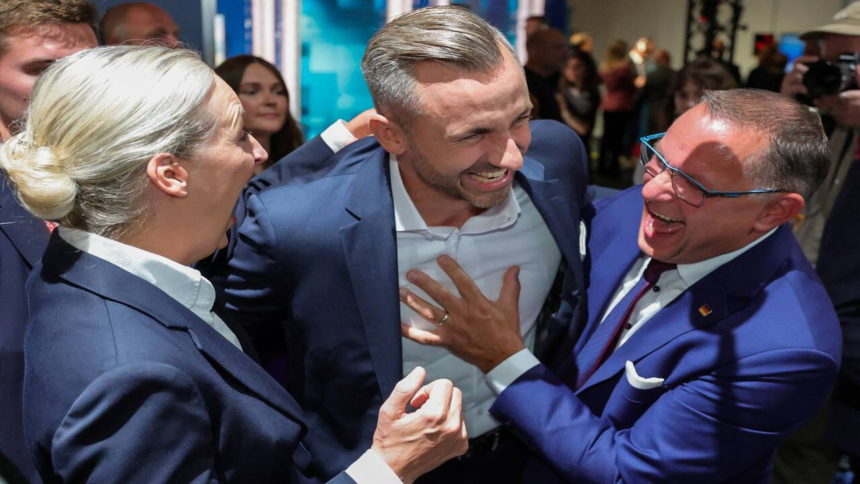
“We achieved exactly what we set out to achieve” the AfD’s lead candidate, Ulrich Siegmund, who has said his goal was to secure enough seats to form a government without relying on coalition partners. A failure to win an outright majority would mean the remaining parties — which have all ruled out working with the AfD — would be left to cobble together a fragmented alliance.
AfD co-leader Alice Weidel said the results give the party a “clear mandate to govern” — and that it would reach out to potential partners, including from lawmakers in the CDU, to assemble a majority. CDU state premier Sven Schulze said that state voters “sent a signal,” though the party has repeatedly said it won’t work with the AfD.
“Some say this is a dark day for Saxony-Anhalt,” Schulze told party members in the state capital, Magdeburg. “I say that this is democracy.”
Coalition building could become even more complicated if BSW, a breakaway party founded by former Left party leader Sahra Wagenknecht, enters parliament. The exit poll had it with 5% backing.
Saxony-Anhalt, which has the lowest GDP per capita of Germany’s 16 states, has a population of around 2 million. Since Germany reunified, the region has seen its population decline more sharply than any other state, with the number of inhabitants having fallen by more than a quarter between 1990 and 2024.
During a rush of campaigning ahead of the vote, Siegmund drew thousands to festival-like events, where supporters clamored for autographs and selfies. It was a clear demonstration of the party’s growing support — and a contrast with Merz, who was kept away from voters.
Siegmund has said that if he fails to gain the necessary majority to lead the state as premier, he would wait out the political chaos that he said would ensue if the CDU formed a government, which he predicted would last “a few months.” The AfD will simply gain more in the next election, he told Bloomberg: “We can only win.”
Merz has warned that the AfD would send Germany “into the abyss.” Business leaders have warned of deterring investment. Domestic counterintelligence has categorized elements of the party as a threat to the constitutional order.
But the party has continued to gain public support. In Saxony-Anhalt, its leaders have discussed plans set up a state-funded “deportation task force,” to purge the ranks of civil servants — and to overhaul the education system to expunge it of “left-wing indoctrination.”
Even as its popularity has gained, the party has coalesced around an ethno-nationalist ideology and shed many of its more moderate language, according to Germany’s federal counterintelligence agency, the Federal Office for the Protection of the Constitution. In its annual report issued in June, it said an increased number of party officials have openly adopted the concept of “remigration,” or large-scale expulsions.
That has isolated it in Europe, even among far-right peers. France’s Marine Le Pen ended cooperation with the party in 2024 after an AfD lawmaker said in an interview that not every Nazi SS member should be considered a criminal. Italian Prime Minister Giorgia Meloni, whose Brothers of Italy has embraced transatlantic ties, has kept her distance given the AfD’s embrace of Russia.