Introduction
This is the 17th installment in a series explaining IT Passport terms one by one.
This time, continuing from the previous article, we will cover industrial property rights and other rights.
Regarding other rights, we will look at trade secrets and limited provision data protected by the Unfair Competition Prevention Act, as well as portrait rights and publicity rights.
Let’s look at this using the same ramen company example as before.
The three requirements for trade secrets and the three conditions for limited provision data have similar names and are easy to confuse.
Therefore, we will use diagrams to organize the differences.
Last time (Part 16), we explained intellectual property rights and copyrights.
If you haven’t read it yet, please check it out here.
▶ Part 16 Article: [IT Passport Terms Part 16] Intellectual Property Rights and Copyrights: Explaining What Is and Isn’t Protected with Diagrams
▶ Part 1 Article: [IT Passport Terms Part 1] Explaining the Differences Between Management Philosophy, Mission, Vision, and Values Using Examples from Famous Companies
What you will learn in this article
-
Differences between industrial property rights (patent rights, utility model rights, design rights, trademark rights)
-
What is the Unfair Competition Prevention Act?
-
Three requirements for trade secrets (secrecy management, utility, non-publicity)
-
Three conditions for limited provision data (limited provision, substantial accumulation, electromagnetic management)
-
Portrait rights and publicity rights
-
Key points for the exam and practice questions
1. What are industrial property rights?
Industrial property rights are a collective term for rights that protect inventions, designs, product names, etc., by filing an application with the Japan Patent Office and registering them.
They are intended for industrial development, and allow only the registered person to use them exclusively for a certain period.
Copyrights are automatically generated at the moment of creation, but industrial property rights are not generated unless they are filed and registered.
This difference is often asked about on the exam.
-
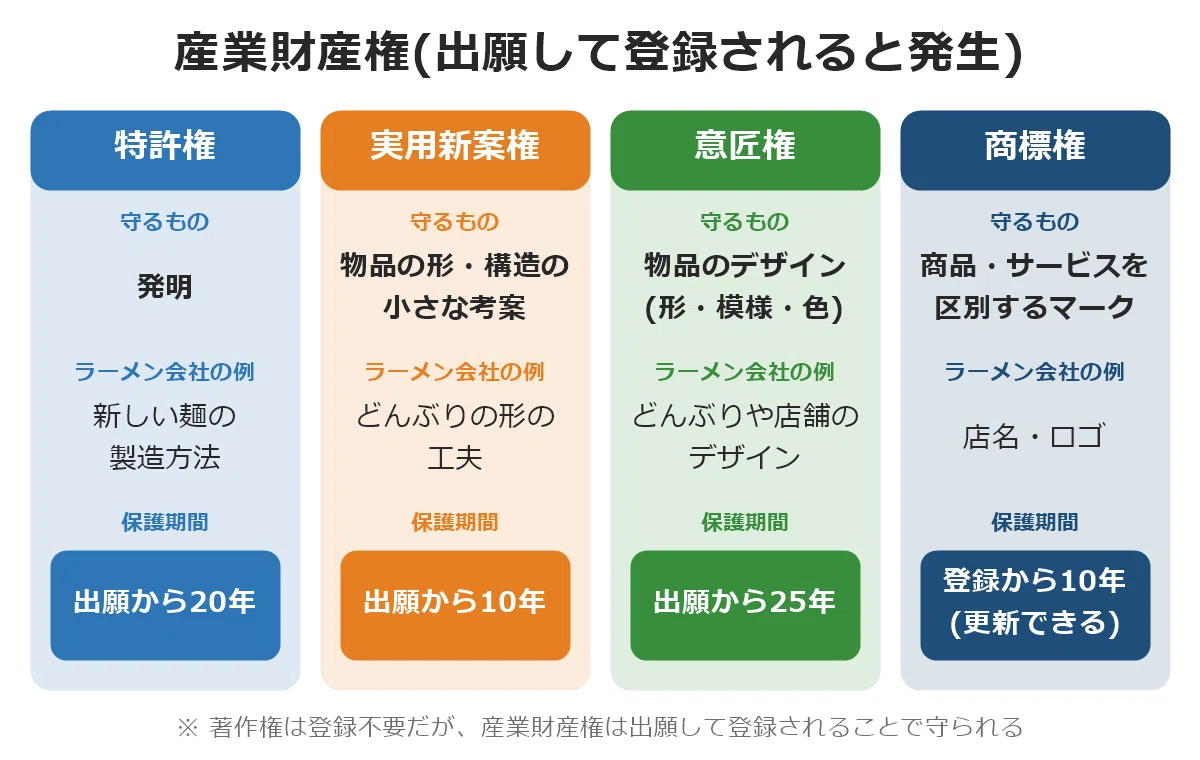
Patent rights: Protect new inventions. Protection period is 20 years from filing
-
Utility model rights: Protect small inventions related to the shape or structure of an article. Protection period is 10 years from filing
-
Design rights: Protect the design (combination of shape, pattern, and color) of an article, etc. Protection period is 25 years from filing
-
Trademark Right: Protects marks (trademarks) such as characters and figures used to distinguish products or services. The protection period is 10 years from registration and can be extended by renewal.
For a ramen company, a new noodle manufacturing method can be protected by a patent right, improvements to the shape of a bowl by a utility model right, the design of the bowl or store by a design right, and the store name or logo by a trademark right.
Related terms
-
Business model patent: A patent targeting a new business mechanism using IT.
-
Trademark: A mark attached to a product (a type of trademark used for products).
-
Service mark: A mark attached to a service (a type of trademark used for services).
Note that the number of years for the protection period may change due to amendments to the law.
This article explains the current general content.
2. What are other rights?
Among intellectual property rights, those that do not fall under copyright or industrial property rights are summarized in this article as other rights.
Specifically, we will cover the following three.
-
Trade secret: Confidential company information protected by the Unfair Competition Prevention Act.
-
Limited provision data: Data provided only to specific parties, protected by the Unfair Competition Prevention Act.
-
Portrait rights and publicity rights: Rights related to a person’s face, appearance, or a celebrity’s name.
Note that in the syllabus, the Unfair Competition Prevention Act and portrait/publicity rights are listed as separate items.
In this article, they are treated in one chapter so that rights other than industrial property rights can be checked together.
3. What is the Unfair Competition Prevention Act?
The Unfair Competition Prevention Act is a law to protect fair competition among business operators.
It prohibits acts such as free-riding on the results of others’ efforts or deceiving consumers as unfair competition.
Acts prohibited by this law include, for example, the following:
-
Stealing, using without permission, or leaking another person’s secrets (trade secrets).
-
Illegally acquiring or using another person’s limited provision data.
-
Imitating and using famous product names or designs.
-
Making false representations regarding the place of origin or quality.
If violated, you may be subject to requests to stop the activity (injunctions) or claims for damages, and in malicious cases, you may also be subject to criminal penalties.
Industrial property rights cannot be protected unless registered, but a feature of the Unfair Competition Prevention Act is that it provides protection if requirements are met, even without registration.
From the next chapter, we will look at trade secrets and data for limited provision, which are important for the exam.
4. Trade Secrets and the 3 Requirements
Trade secrets are information that a company keeps secret and that is useful for business.
This includes manufacturing know-how, customer lists, and sales strategies.
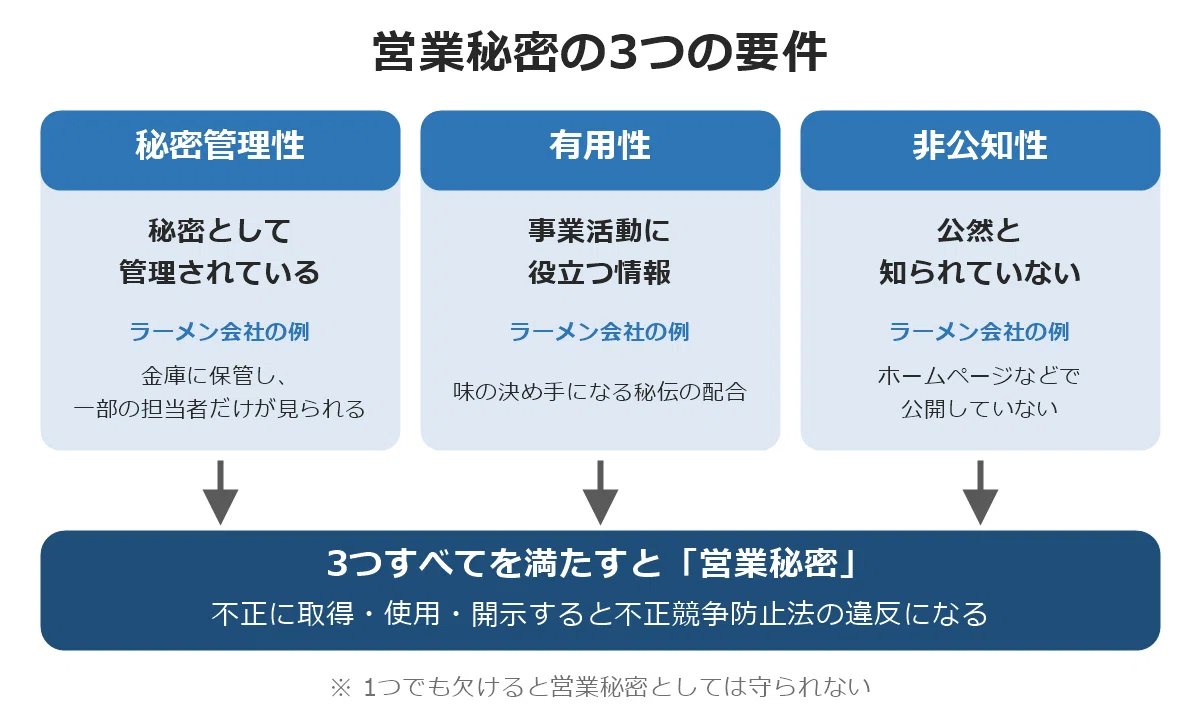
To be protected as a trade secret, all of the following three requirements must be met.
-
Confidentiality: Managed as a secret (limiting access to specific people, labeling as “Confidential,” etc.)
-
Utility: Information useful for business activities (manufacturing methods, customer lists, sales know-how, etc.)
-
Non-publicity: Not publicly known (not disclosed and not something anyone can look up)
For a ramen company, the secret recipe for the soup and the manufacturing procedures are kept in a locked safe so that only certain staff members can see them (confidentiality), they are useful for business because they are the key to the flavor (utility), and they are not disclosed (non-publicity), so they qualify as trade secrets.
If even one of the three is missing, it will not be protected as a trade secret.
For example, a recipe placed in a shared folder that anyone can see does not meet the confidentiality requirement and therefore does not become a trade secret.
Illegally acquiring, using, or leaking trade secrets is a violation of the Unfair Competition Prevention Act.
5. Data for Limited Provision and the 3 Conditions
Data for limited provision is data that has been accumulated and managed in large quantities to be provided only to specific parties.
As the use of big data progresses, it was added to the Unfair Competition Prevention Act to protect data that cannot be fully covered by trade secrets.
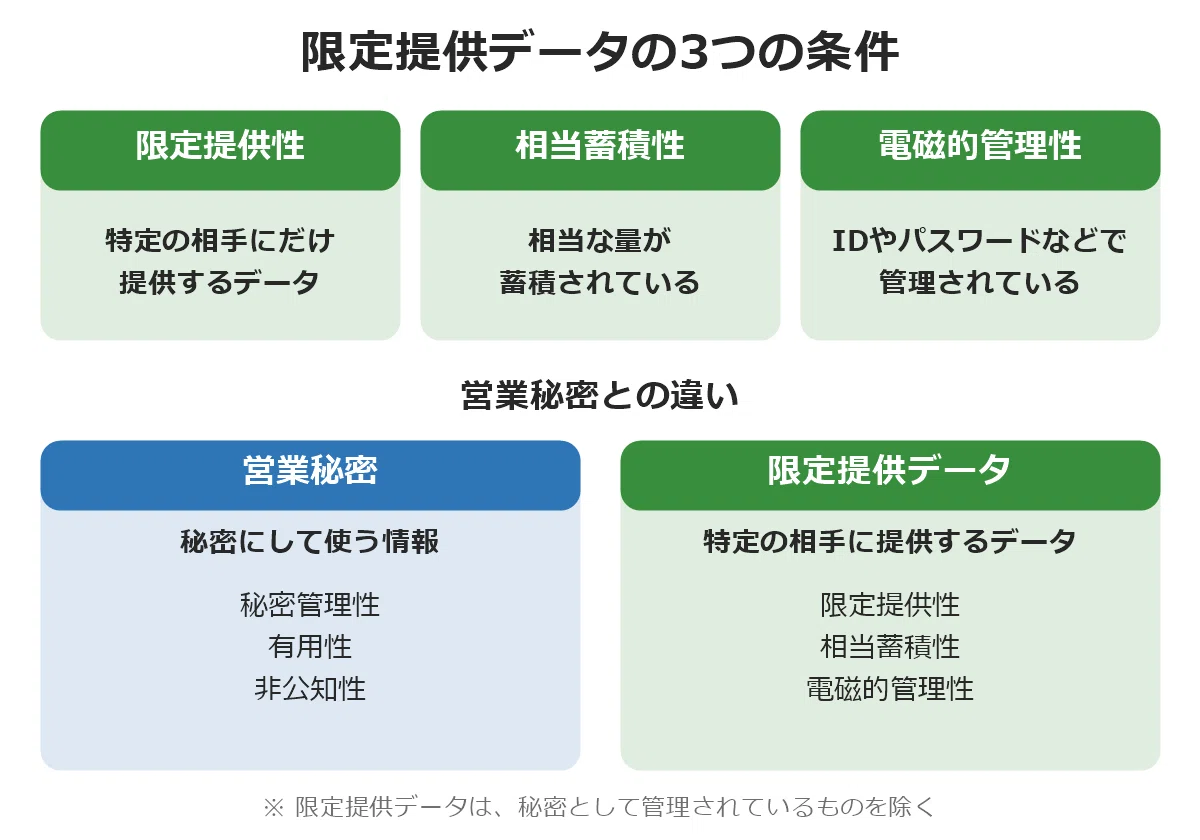
To be protected as data for limited provision, the following three conditions must be met.
-
Limited Provision: Data provided only to specific parties (provided to a limited number of people, such as members or business partners)
-
Substantial Accumulation: A substantial amount of data has been accumulated (a large volume of data is gathered together)
-
Electromagnetic Management: Managed by electromagnetic methods, such as IDs and passwords (made available only to a limited number of people on a network)
For a ramen company, this applies to cases where purchase data collected via a member app is provided only to partner food manufacturers.
The data is managed with IDs and passwords so that only the partners can use it.
Differences from trade secrets
Trade secrets are information that is “kept secret,” while limited provision data is information that is “provided to specific parties.”
Since limited provision data is provided to specific parties, information managed as a secret is excluded from this category.
Therefore, the condition is not secret management, but rather electromagnetic management.
-
Trade secrets: Three requirements are secret management, utility, and non-public nature. Applies to information used while kept secret.
-
Limited provision data: Three conditions are limited provision, substantial accumulation, and electromagnetic management. Applies to data provided to specific parties.
6. Portrait Rights and Publicity Rights
Portrait rights and publicity rights are rights related to individuals.
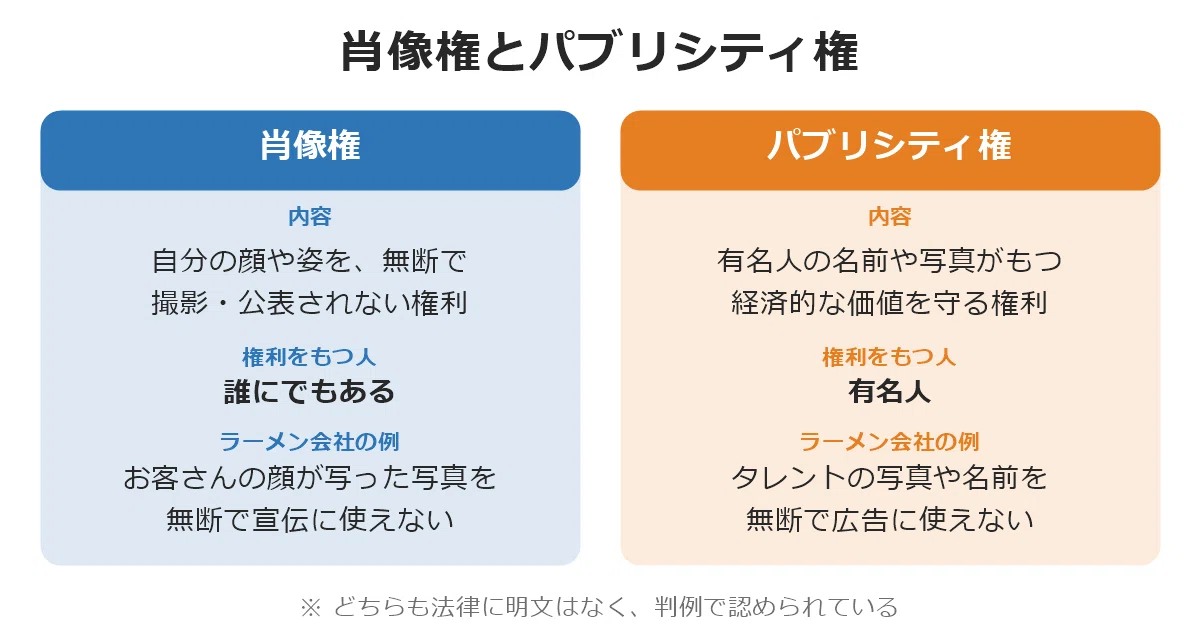
Neither has explicit provisions in the law, and both are recognized through court judgments (precedents).
-
Portrait rights: The right not to have one’s face or figure photographed or published without permission (recognized for everyone).
-
Publicity rights: The right for a celebrity to be the only one to utilize the attractive power (economic value) inherent in their name or photograph.
If a ramen company uses a famous celebrity’s photo or name in an advertisement without permission, it constitutes an infringement of publicity rights.
Also, using a photo of a customer at a shop for advertising without permission may constitute an infringement of portrait rights.
7. Key Points for the Exam
-
Industrial property rights consist of patent rights, utility model rights, design rights, and trademark rights, which are acquired by filing and registering with the Japan Patent Office (unlike copyright).
-
Patent rights protect inventions, utility model rights protect the shape or structure of articles, design rights protect designs, and trademark rights protect marks.
-
The Unfair Competition Prevention Act is a law that protects fair competition among business operators.
-
The three requirements for trade secrets are secret management, utility, and non-public nature.
-
The three conditions for limited provision data are limited provision, substantial accumulation, and electromagnetic management.
-
Portrait rights belong to everyone, while publicity rights are rights that protect the economic value inherent in a celebrity’s name or photograph.
The terms “trade secrets” and “limited provision data” are very similar, so it is best to organize them as a set.
It is helpful to remember: “Information kept secret is a trade secret, and data provided to specific parties is limited provision data.”
Practice Questions (Original questions for this article)
Q1. Which of the following is not included in industrial property rights?
A. Patent rights, B. Copyright, C. Design rights, D. Trademark rights
Q2. Which of the following is not a requirement for protection as a trade secret?
A. Secret management, B. Utility, C. Substantial accumulation, D. Non-public nature
Q3. Which of the following is not included in the conditions for limited provision data?
A. Limited provision nature, B. Non-public nature, C. Substantial accumulation nature, D. Electromagnetic management nature
Q4. Which right protects marks such as letters or figures used to distinguish products or services?
A. Patent right, B. Utility model right, C. Design right, D. Trademark right
Q5. Which right protects designs such as the shape, pattern, or color combination of an article?
A. Design right, B. Patent right, C. Utility model right, D. Trademark right
Q6. Which of the following constitutes a trade secret?
A. A product price list published on the company’s website, B. Company sales figures published in a newspaper, C. A manufacturing formula kept in a locked safe and accessible only to specific personnel, D. A work procedure manual placed in a shared folder accessible to everyone
Answers: Q1 B / Q2 C / Q3 B / Q4 D / Q5 A / Q6 C
8. Summary
-
Industrial property rights consist of four types: patent rights, utility model rights, design rights, and trademark rights, which are protected by filing and registration.
-
The Unfair Competition Prevention Act is a law that protects fair competition between business operators and protects trade secrets and limited provision data.
-
The three requirements for trade secrets are confidentiality management, utility, and non-public nature.
-
The three conditions for limited provision data are limited provision nature, substantial accumulation nature, and electromagnetic management nature.
-
Portrait rights are rights to protect one’s face and appearance, while publicity rights are rights to protect the economic value of a celebrity’s name or photograph.
Reference
All diagrams and data are fictional and created for this article.
The organization of terms is based on the term examples in the IPA syllabus, exam preparation materials, and explanations on learning websites.
Since the details of laws may be amended, please check the accurate exam scope and the latest information yourself via the IPA syllabus or official sources.
The IPA has announced that the current IT Passport exam is scheduled to end in fiscal year 2026 and transition to a new system around the spring of fiscal year 2027 (the classification of fields is also expected to change).
This article is based on the current system.
Next Preview
Next time (Part 18), I will explain software licenses.
Stay tuned.
▶ Part 16 Article: [IT Passport Terms Part 16] Intellectual Property Rights and Copyright: Explaining What Is and Is Not Protected with Diagrams
▶ Part 1 Article: [IT Passport Terms Part 1] Explaining the Differences Between Management Philosophy, Mission, Vision, and Values with Examples from Famous Companies