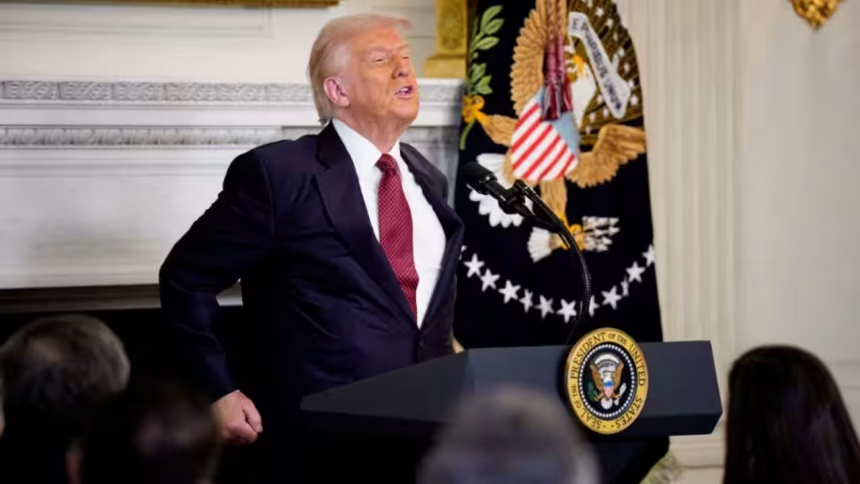
US President Donald Trump on Wednesday ruled out offering sanctions relief to Iran in exchange for Tehran giving up its highly enriched uranium stockpile, signalling that major differences remain unresolved despite ongoing diplomatic contacts between the two countries.
Speaking to PBS News shortly before the start of his cabinet meeting, Trump firmly rejected the idea that Washington would ease sanctions as part of any nuclear-related understanding with Tehran.
“No, no, not at all. Not sanctions relief, no,” Trump said when asked whether the US would consider lifting sanctions if Iran surrendered its highly enriched uranium.
“They’re gonna give up their highly enriched uranium not for sanctions relief. No, no, not at all,” he added.
The remarks come amid continued negotiations between Washington and Tehran following months of military confrontation that erupted on February 28 and destabilised much of West Asia.
Although a fragile ceasefire has technically remained in place since April 8, tensions between the two sides remain high, particularly over Iran’s nuclear programme, maritime security and American military deployments in the Gulf region.
Trump’s comments also came just hours after the White House dismissed Iranian media reports claiming that Tehran and Washington were close to a draft agreement involving the reopening of commercial shipping through the Strait of Hormuz.
Iranian state television, cited by Reuters earlier in the day, had claimed that Tehran received a preliminary Memorandum of Understanding from the United States that included commitments to lift the American naval blockade on Iran and reduce US military pressure in the Gulf.
According to the Iranian report, the proposed framework would have allowed commercial maritime traffic through the Strait of Hormuz to return to pre-war levels within one month.
“The United States has committed itself to lifting Iran’s naval blockade and to cease harassing ships passing to or from the Islamic Republic of Iran,” Iranian state television reported.
The report also claimed that the draft understanding included discussions over a possible withdrawal of American forces from areas near Iran and a 60-day negotiation process that could eventually culminate in a binding United Nations Security Council resolution.
However, the White House categorically rejected the report, calling it a “complete fabrication”.
Officials insisted that no such finalised agreement currently exists between Washington and Tehran.
Despite rejecting the Iranian claims, White House spokeswoman Olivia Wales later said negotiations with Iran were still “proceeding nicely” and reiterated that Trump’s “red lines” remained unchanged.
While Trump has not publicly laid out a detailed list of those red lines, he has repeatedly insisted that Iran must never acquire a nuclear weapon.
The issue of Iran’s highly enriched uranium stockpile remains one of the most sensitive parts of the ongoing discussions.
Earlier reports suggested that Washington wanted Tehran to either surrender or severely reduce its stockpile of highly enriched uranium as part of a broader de-escalation arrangement.
However, Iranian officials have consistently resisted external pressure regarding the country’s nuclear programme and have insisted that any agreement must include “tangible verification” of American commitments before Tehran takes reciprocal steps.
Iran has also maintained that discussions regarding its nuclear infrastructure and enriched uranium reserves require separate negotiations and cannot simply be folded into maritime or ceasefire arrangements.
The Strait of Hormuz remains central to the broader crisis.
The narrow waterway is one of the world’s most strategically important shipping corridors, handling a significant share of global crude oil and liquefied natural gas trade. Disruptions in maritime traffic through the Strait have repeatedly triggered volatility in global energy prices during the conflict.
Since April 13, the United States has maintained a naval blockade around Iranian ports, according to Iranian media reports, while Tehran tightened control over shipping routes through Hormuz.
The proposed framework described by Iranian state television suggested that Iran would continue managing shipping lanes, inspecting vessels and collecting service fees on commercial ships passing through the Strait. However, Tehran reportedly did not agree to fully reopen the corridor for military vessels.
Despite the public denials and conflicting narratives, indirect negotiations between Washington and Tehran are believed to be continuing through regional intermediaries, including Oman and Pakistan.
For now, Trump’s latest remarks suggest that while diplomatic engagement remains active, the core disputes over sanctions, uranium enrichment and regional military presence remain far from resolved.