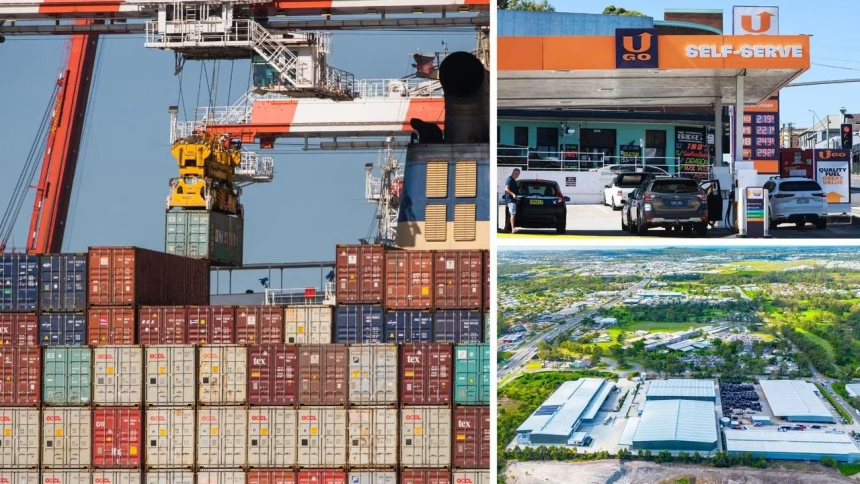
Disruptions to global supply chains will increase investor returns for industrial property as businesses brace for the impacts of rising fuel prices.
REA senior economist Anne Flaherty said conditions for the industrial sector, which has long been the darling of the commercial property market, could improve amid further strain to global supply chains resulting from the United States’ war with Iran.
The trend of businesses stockpiling goods important to their output is set to drive further demand for industrial property across the nation.
RELATED: Costco Australia expansion opens more Aussies to membership mistakes
Fashion capital to fight for survival: What happened to Chapel Street?
Melbourne’s luxe Shangri-La hotel a ‘ghost tower’ years from opening

“(What is) happening with global supply chains and price increases now could even increase demand for industrial property further,” Ms Flaherty said.
“What we saw during the pandemic was this transition from just-in-time to just-in-case logistics where, because it was taking so long for goods to be transported around the world, or the cost of transporting goods around the world has increased, businesses are more likely to need to have more storage space.”
The continued long-term rise in the share of online retail spending would also create more need for industrial space, Ms Flaherty said.
Gross yields: Industrial
| Region | Gross yield | 3 month change (bp) | 12 month change (bp) |
| Sydney | 4.2% | 0 | -3 |
| Melbourne | 4.2% | -4 | -6 |
| Brisbane | 5.3% | -7 | -14 |
| Adelaide | 4.8% | -14 | -37 |
| Perth | 5% | -8 | -37 |
| Rest of NSW | 5.3% | +1 | 0 |
| Rest of Vic | 5.3% | +9 | +37 |
| Rest of Qld | 5.1% | -2 | -8 |
| Rest of WA | 8.7% | -15 | -69 |
Source: realcommercial Commercial Yield Report
Gross yields for industrial property sit between 4.2 per cent in Melbourne and Sydney, and 5.3 per cent in Brisbane, according to the realcommercial.com.au Commercial Yield Report, released today.
But the increased risk in the retail sector as a whole was reflected in the retail yields, which were higher than in both the office and industrial sectors.
“A lot of households are really tightening their budgets. Interest rates are rising again, fuel costs are going up, inflation is high – that can decrease people’s discretionary spend.”
Gross yields: Retail
| Region | Gross yield | 3 month change (bp) | 12 month change (bp) |
| Sydney | 6.6% | 0 | +27 |
| Melbourne | 5.7% | +7 | +10 |
| Brisbane | 8.2% | -8 | -14 |
| Adelaide | 6.4% | -9 | -33 |
| Perth | 7.7% | -5 | +2 |
| Rest of NSW | 8.3% | -16 | +13 |
| Rest of Vic | 7% | 37 | 0 |
| Rest of Qld | 7.5% | -5 | -119 |
| Rest of WA | 7.9% | +43 | +30 |
Source: realcommercial Commercial Yield Report
Gross yields ranged between 5.7 per cent in Melbourne and 8.2 per cent in Brisbane.
Changes to office yields show investors were still downgrading where office values sat, especially in Melbourne where the vacancy rate had grown six-fold in the five years since the pandemic.
Ms Flaherty said Property Council of Australia figures showed Melbourne’s office vacancy rate was sitting at 3 per cent in January 2020. It’s 19 per cent now.
“A tonne of new office buildings have been built in Melbourne and if we look at net tenant demand, that’s been increasing,” Ms Flaherty said.
“There is increased demand to lease office space, it’s just that increased demand has not been keeping up with how much new supply comes online.”
Ms Flaherty said new office builds typically don’t happen without pre-leasing commitments, and businesses were leaving older buildings for new ones.
“We call that the flight to quality, and in the current market where rent growth has been very subdued and office incentives are very high, there’s a lot of opportunities for businesses to move into nicer office space, and sometimes even on a lower rent,” she said.
Gross yield: Office
| Region | Gross yield | 3 month change (bp) | 12 month change (bp) |
| Sydney | 5.3% | -2 | -12 |
| Melbourne | 5.6% | +6 | +37 |
| Brisbane | 7.1% | -21 | +12 |
| Adelaide | 5.6% | +1 | -37 |
| Perth | 5.8% | +11 | +21 |
| Rest of NSW | 7.5% | 5 | -66 |
| Rest of Vic | 6.7% | +24 | -6 |
| Rest of Qld | 7.3% | +3 | -52 |
| Rest of WA | 9.4% | +18 | +18 |
Source: realcommercial Commercial Yield Report
Ms Flaherty said there could be a counter-cyclic argument to buy an office building in Melbourne now.
“For an investor that can tolerate long periods of vacancy, or maybe they’re looking to refurbish an office building, there’s a lot of buildings out there selling well below the cost of replacement.”
Ms Flaherty said Brisbane offered a lot of opportunities to investors across all sectors.
“Brisbane is seeing very strong population growth, and over time, that’s also going to contribute to a bit more diversity in its economy.”
Originally published as Industrial property demand poised for boost amid supply chain chaos